Breitung Ben, Aguiló-Aguayo Noemí, Bechtold Thomas, Hahn Horst, Janek Jürgen, Brezesinski Torsten
Battery and Electrochemistry Laboratory, Institute of Nanotechnology, Karlsruhe Institute of Technology, Hermann-von-Helmholtz-Platz 1, 76344, Eggenstein-Leopoldshafen, Germany.
Research Institute of Textile Chemistry and Textile Physics, Leopold-Franzens-University Innsbruck, Höchsterstraße 73, 6850, Dornbirn, Austria.
Sci Rep. 2017 Oct 12;7(1):13010. doi: 10.1038/s41598-017-13261-y.
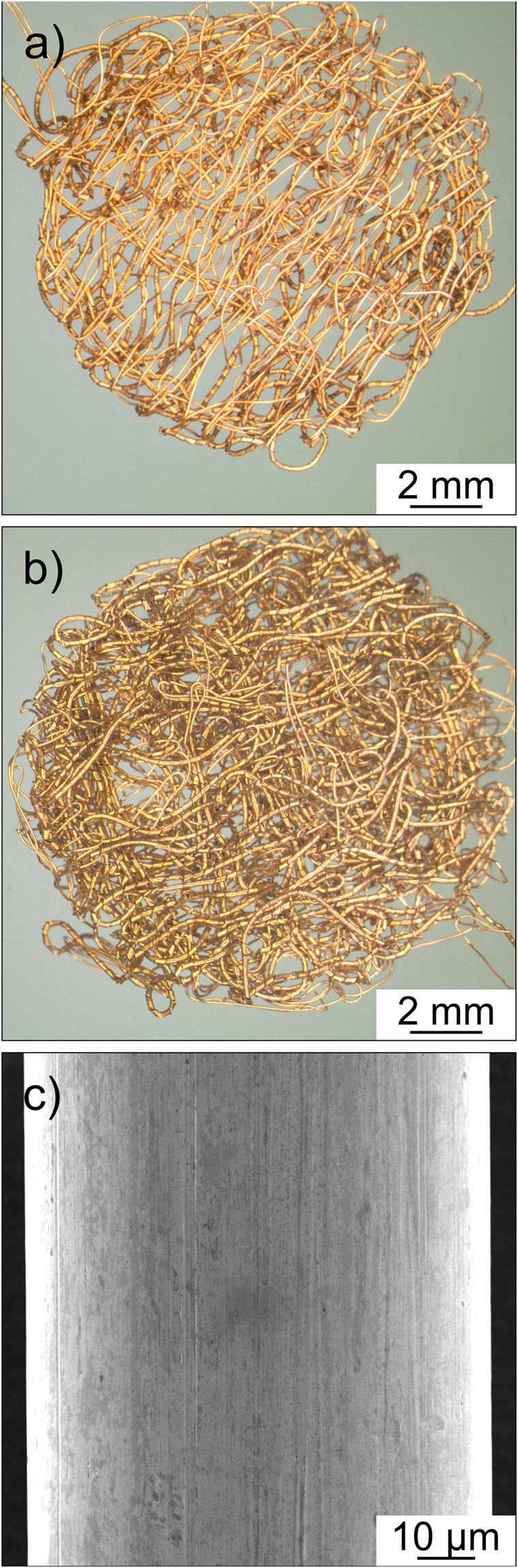
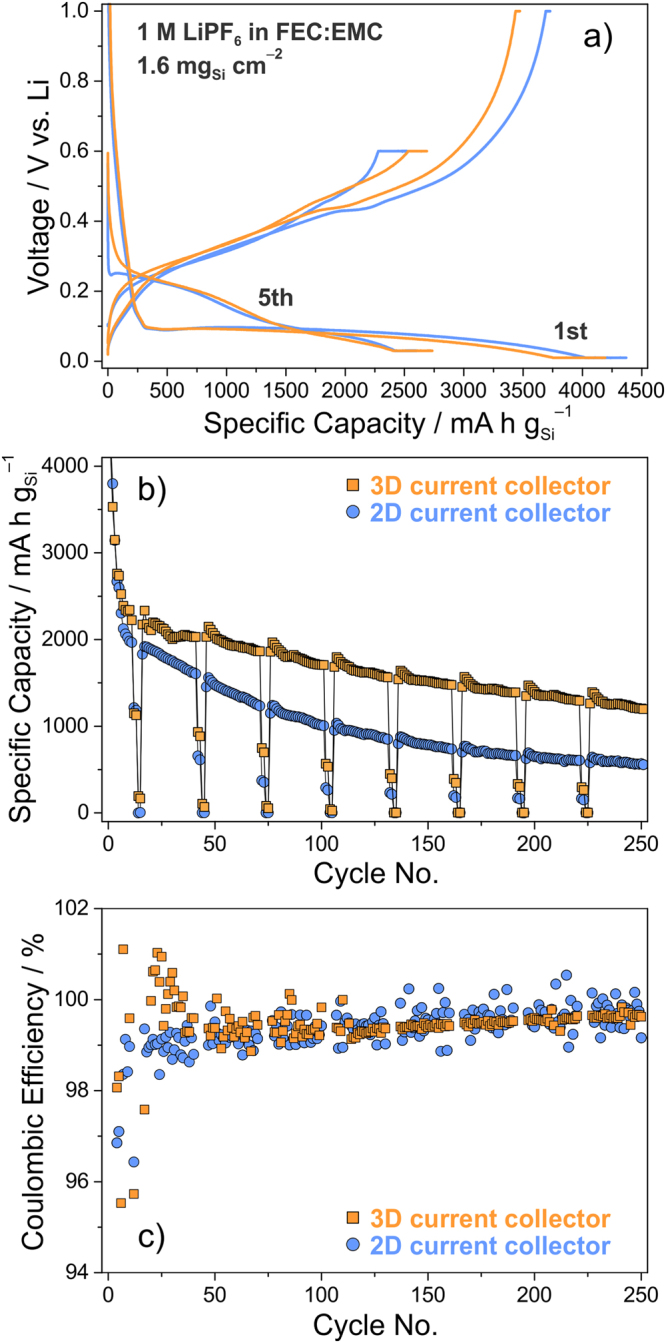
Si holds great promise as an alloying anode material for Li-ion batteries with improved energy density because of its high theoretical specific capacity and favorable operation voltage range. However, the large volume expansion of Si during electrochemical reaction with Li and the associated adverse effects strongly limit its prospect for application. Here, we report on the use of three-dimensional instead of flat current collectors for high-capacity Si anodes in an attempt to mitigate the loss of electrical contact of active electrode regions as a result of structural disintegration with cycling. The current collectors were produced by technical embroidery and consist of interconnected Cu wires of diameter <150 µm. In comparison to Si/Li cells using a conventional Cu foil current collector, the embroidered microwire network-based cells show much enhanced capacity and reversibility due to a higher degree of tolerance to cycling.
由于硅具有高理论比容量和良好的工作电压范围,作为一种用于锂离子电池的合金负极材料,有望提高能量密度。然而,硅在与锂发生电化学反应时会发生大量体积膨胀以及相关的不利影响,这严重限制了其应用前景。在此,我们报告了在高容量硅负极中使用三维而非平面集流体,以试图减轻由于循环导致的结构解体而造成的活性电极区域电接触损失。这些集流体是通过工业刺绣制作的,由直径小于150微米的相互连接的铜线组成。与使用传统铜箔集流体的硅/锂电池相比,基于刺绣微线网络的电池由于对循环具有更高的耐受度,因而显示出大大增强的容量和可逆性。