Jannati Ali, Block Gabrielle, Oberman Lindsay M, Rotenberg Alexander, Pascual-Leone Alvaro
Berenson-Allen Center for Noninvasive Brain Stimulation and Division of Cognitive Neurology, Department of Neurology, Beth Israel Deaconess Medical Center, Harvard Medical School, Boston, MA, USA.
Berenson-Allen Center for Noninvasive Brain Stimulation and Division of Cognitive Neurology, Department of Neurology, Beth Israel Deaconess Medical Center, Harvard Medical School, Boston, MA, USA.
Clin Neurophysiol. 2017 Nov;128(11):2268-2278. doi: 10.1016/j.clinph.2017.08.023. Epub 2017 Sep 21.
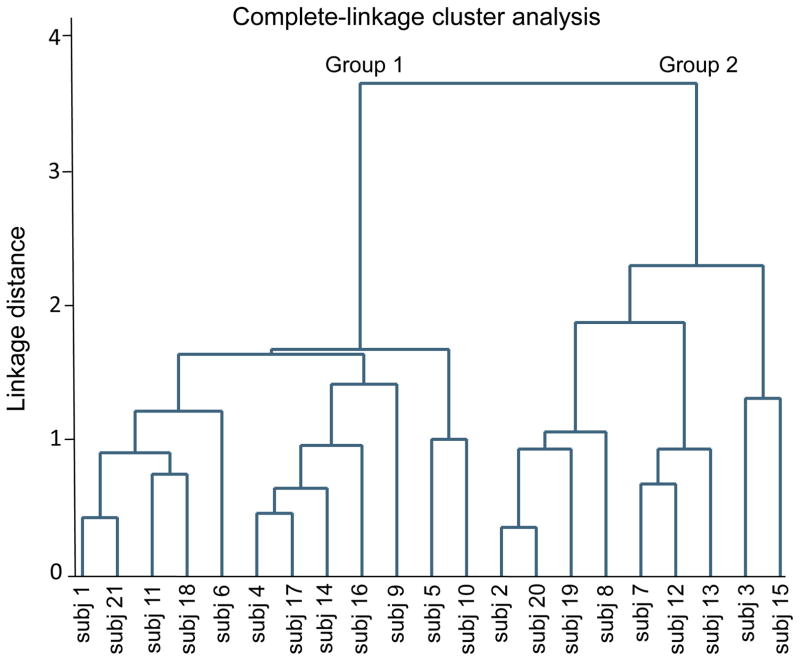
We used complete-linkage cluster analysis to identify healthy subpopulations with distinct responses to continuous theta-burst stimulation (cTBS).
21 healthy adults (age±SD, 36.9±15.2years) underwent cTBS of left motor cortex. Natural log-transformed motor evoked potentials (LnMEPs) at 5-50min post-cTBS (T5-T50) were calculated.
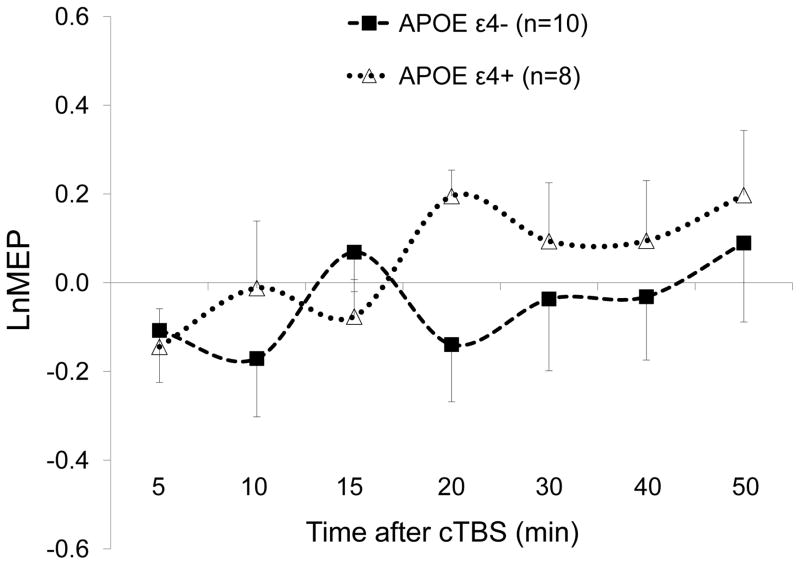
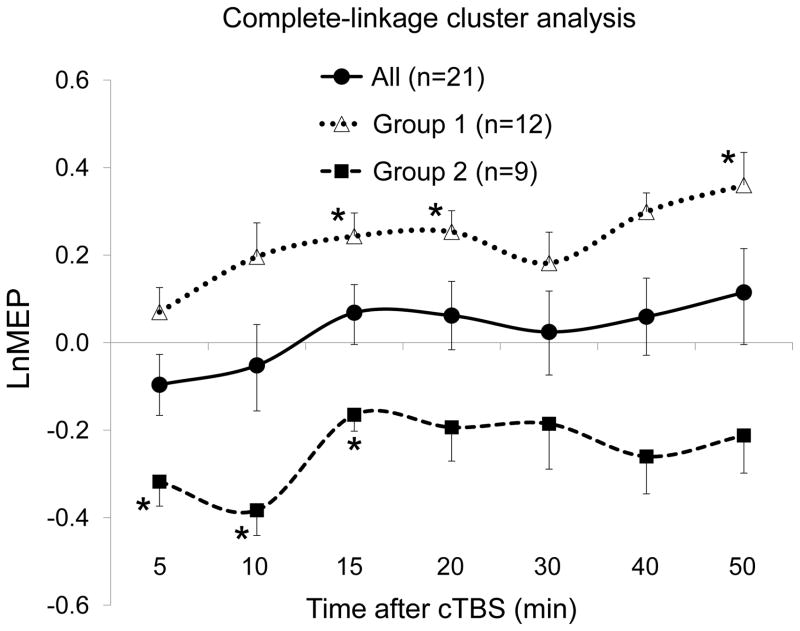
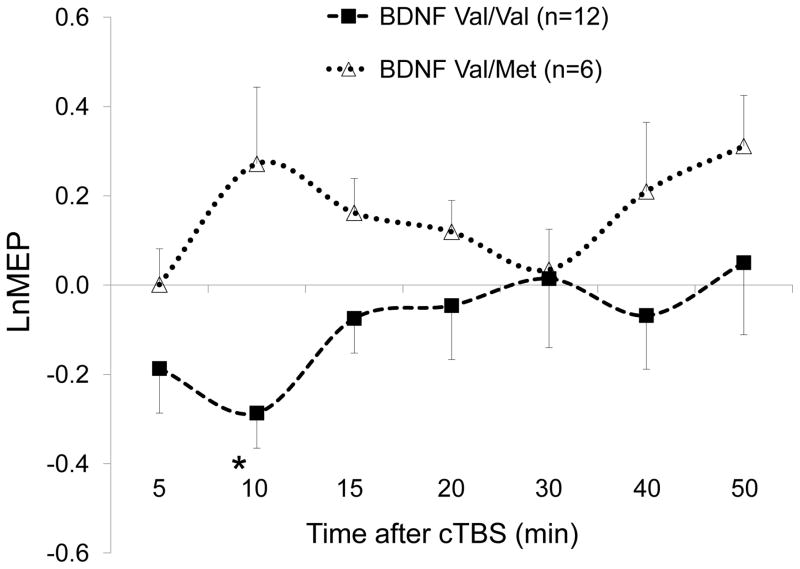
Two clusters were found; Group 1 (n=12) that showed significant MEP facilitation at T15, T20, and T50 (p's<0.006), and Group 2 (n=9) that showed significant suppression at T5-T15 (p's<0.022). LnMEPs at T10 and T40 were best predictors of, and together accounted for 80% of, cluster assignment. In an exploratory analysis, we examined the roles of brain-derived neurotrophic factor (BDNF) and apolipoprotein E (APOE) polymorphisms in the cTBS response. Val66Met participants showed greater facilitation at T10 than Val66Val participants (p=0.025). BDNF and cTBS intensity predicted 59% of interindividual variability in LnMEP at T10. APOE did not significantly affect LnMEPs at any time point (p's>0.32).
Data-driven cluster analysis can identify healthy subpopulations with distinct cTBS responses. T10 and T40 LnMEPs were best predictors of cluster assignment. T10 LnMEP was influenced by BDNF polymorphism and cTBS intensity.
Healthy adults can be sorted into subpopulations with distinct cTBS responses that are influenced by genetics.
我们采用完全连锁聚类分析来识别对连续θ波爆发刺激(cTBS)有不同反应的健康亚群。
21名健康成年人(年龄±标准差,36.9±15.2岁)接受了左侧运动皮层的cTBS。计算cTBS后5 - 50分钟(T5 - T50)时自然对数转换后的运动诱发电位(LnMEPs)。
发现两个聚类;第1组(n = 12)在T15、T20和T50时显示出显著的运动诱发电位易化(p值<0.006),第2组(n = 9)在T5 - T15时显示出显著抑制(p值<0.022)。T10和T40时的LnMEPs是聚类分配的最佳预测指标,二者共同解释了80%的聚类分配情况。在一项探索性分析中,我们研究了脑源性神经营养因子(BDNF)和载脂蛋白E(APOE)基因多态性在cTBS反应中的作用。Val66Met参与者在T10时比Val66Val参与者表现出更大的易化(p = 0.025)。BDNF和cTBS强度预测了T10时LnMEP个体间变异性的59%。APOE在任何时间点均未对LnMEPs产生显著影响(p值>0.32)。
数据驱动的聚类分析可识别出对cTBS有不同反应的健康亚群。T10和T40时的LnMEPs是聚类分配的最佳预测指标。T10时的LnMEP受BDNF基因多态性和cTBS强度的影响。
健康成年人可被分为对cTBS有不同反应且受基因影响的亚群。