Aly Mahmoud, Elrobh Mohamed, Alzayer Maha, Aljuhani Sameera, Balkhy Hanan
King Abdullah International Medical Research Center, Riyadh, Saudi Arabia.
King Saud bin Abdulaziz University for Health Sciences, Riyadh, Saudi Arabia.
PLoS One. 2017 Oct 13;12(10):e0183850. doi: 10.1371/journal.pone.0183850. eCollection 2017.
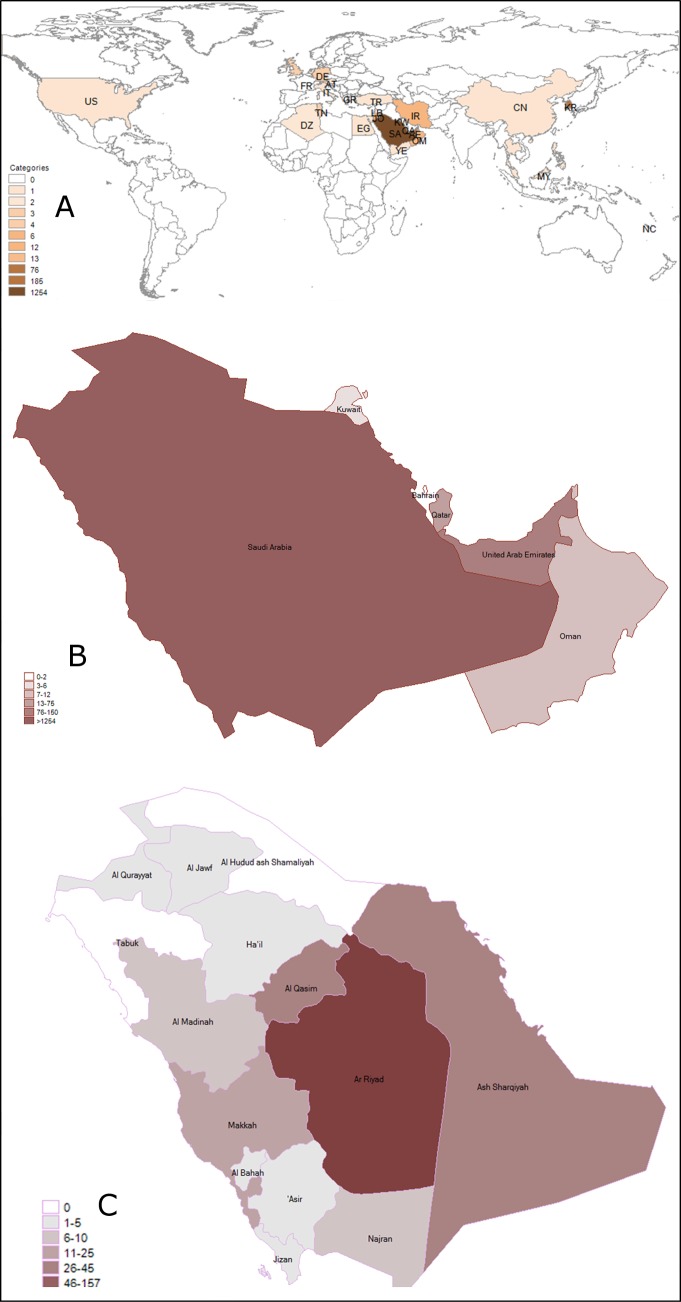
The emergence of the Middle East Respiratory Syndrome Coronavirus (MERS-CoV) infections has become a global issue of dire concerns. MERS-CoV infections have been identified in many countries all over the world whereas high level occurrences have been documented in the Middle East and Korea. MERS-CoV is mainly spreading across the geographical region of the Middle East, especially in the Arabian Peninsula, while some imported sporadic cases were reported from the Europe, North America, Africa, and lately Asia. The prevalence of MERS-CoV infections across the Gulf Corporation Council (GCC) countries still remains unclear. Therefore, the objective of the current study was to report the prevalence of MERS-CoV in the GCC countries and to also elucidate on its demographics in the Arabian Peninsula. To date, the World Health Organization (WHO) has reported 1,797 laboratory-confirmed cases of MERS-CoV infection since June 2012, involving 687 deaths in 27 different countries worldwide. Within a time span of 4 years from June 2012 to July 2016, we collect samples form MERS-CoV infected individuals from National Guard Hospital, Riyadh, and Ministry of health Saudi Arabia and other GCC countries. Our data comprise a total of 1550 cases (67.1% male and 32.9% female). The age-specific prevalence and distribution of MERS-CoV was as follow: <20 yrs (36 cases: 3.28%), 20-39 yrs (331 cases: 30.15%), 40-59 yrs (314 cases: 28.60%), and the highest-risk elderly group aged ≥60 yrs (417 cases: 37.98%). The case distribution among GCC countries was as follows: Saudi Arabia (1441 cases: 93%), Kuwait (4 cases: 0.3%), Bahrain (1 case: 0.1%), Oman (8 cases: 0.5%), Qatar (16 cases: 1.0%), and United Arab Emirates (80 cases: 5.2%). Thus, MERS-CoV was found to be more prevalent in Saudi Arabia especially in Riyadh, where 756 cases (52.4%) were the worst hit area of the country identified, followed by the western region Makkah where 298 cases (20.6%) were recorded. This prevalence update indicates that the Arabian Peninsula, particularly Saudi Arabia, is the hardest hit region regarding the emerging MERS-CoV infections worldwide. GCC countries including Saudi Arabia now have the infrastructure in place that allows physicians and scientific community to identify and immediately respond to the potential risks posed by new outbreaks of MERS-CoV infections in the region. Given the continuum of emergence and the large magnitude of the disease in our region, more studies will be required to bolster capabilities for timely detection and effective control and prevention of MERS-CoV in our region.
中东呼吸综合征冠状病毒(MERS-CoV)感染的出现已成为一个令人极为担忧的全球性问题。全球许多国家都已发现MERS-CoV感染病例,其中中东地区和韩国的感染发生率较高。MERS-CoV主要在中东地理区域传播,尤其是阿拉伯半岛,同时欧洲、北美、非洲以及最近在亚洲都报告了一些输入性散发病例。海湾阿拉伯国家合作委员会(GCC)成员国中MERS-CoV感染的流行情况仍不清楚。因此,本研究的目的是报告GCC国家中MERS-CoV的流行情况,并阐明其在阿拉伯半岛的人口统计学特征。迄今为止,世界卫生组织(WHO)报告称,自2012年6月以来,全球27个不同国家共有1797例实验室确诊的MERS-CoV感染病例,其中687例死亡。在2012年6月至2016年7月的4年时间跨度内,我们从利雅得国民警卫队医院、沙特阿拉伯卫生部以及其他GCC国家的MERS-CoV感染个体中采集样本。我们的数据总共包括1550例病例(男性占67.1%,女性占32.9%)。MERS-CoV的年龄特异性患病率和分布情况如下:<20岁(36例:3.28%),20 - 39岁(331例:30.15%),40 - 59岁(314例:28.60%),以及风险最高的≥60岁老年组(417例:37.98%)。GCC国家之间的病例分布如下:沙特阿拉伯(1441例:93%),科威特(4例:0.3%),巴林(1例:0.1%),阿曼(8例:0.5%),卡塔尔(16例:1.0%),阿拉伯联合酋长国(80例:5.2%)。因此,发现MERS-CoV在沙特阿拉伯更为流行,尤其是在利雅得,那里有756例(52.4%)是该国受灾最严重的地区,其次是西部地区麦加,记录了298例(20.6%)。这一流行情况更新表明,阿拉伯半岛,特别是沙特阿拉伯,是全球新出现的MERS-CoV感染受灾最严重的地区。包括沙特阿拉伯在内的GCC国家目前已具备相应基础设施,使医生和科学界能够识别并立即应对该地区新爆发的MERS-CoV感染所带来的潜在风险。鉴于该疾病在我们地区持续出现且规模巨大,需要开展更多研究以增强我们地区及时检测和有效控制及预防MERS-CoV的能力。