Ammerlaan Judy, van Os-Medendorp Harmieke, de Boer-Nijhof Nienke, Scholtus Lieske, Kruize Aike A, van Pelt Philomine, Prakken Berent, Bijlsma Hans
Department Rheumatology & Clinical Immunology HPN D02.244, University Medical Center Utrecht, PO Box 85090, 3508 GA, Utrecht, the Netherlands.
Department Rheumatology & Clinical Immunology, HPN D02.244, University Medical Center Utrecht, PO Box 85500, 3500 GA, Utrecht, the Netherlands.
Pediatr Rheumatol Online J. 2017 Oct 13;15(1):75. doi: 10.1186/s12969-017-0201-1.
A web-based self-management intervention guided by peer-trainers was developed to support young adults' self-management in coping with Juvenile Idiopathic Arthritis (JIA). To investigate its effectiveness, a randomized controlled trial (RCT) was conducted. In addition, the content of the chat and participants' goals were studied to identify underlying processes.
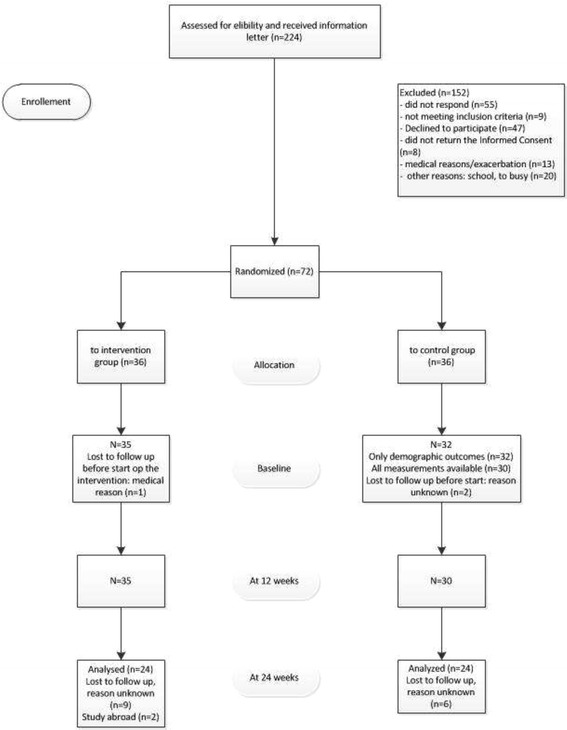
An RCT with a six-month follow up period was conducted among 72 young adults with JIA, aged between 16 and 25 years old, randomly assigned to the intervention or to the usual care control group. After 24 weeks, in both groups 24 participants completed all measurements. Intentions to treat analyses were carried out by means of linear mixed models for longitudinal measurements. With self-efficacy as primary outcome, self-management, disease activity, quality of life, absenteeism of school/work, health care medication use and adherence to the intervention were studied. The participants' goals, personal achievements, interactions on the chat, and their appreciation of the intervention were analyzed using thematic analyses.
No significant differences were found on self-efficacy, quality of life, and self-management between the participants of the control group and the intervention group. In the intervention group, modeling and sharing experiences were the most recognized themes. Fifty-five goals were formulated and divided into the following categories: improvement and maintaining balance, setting and recognizing boundaries, communicating and coping with incomprehension. Adherence, appreciation of the own learning experience, and personal achievements were rated positively.
The web-based intervention did not lead to an improvement of self-efficacy. However, additional qualitative analyses showed that the intervention was appreciated and valuable for the participants. More research is needed on how to measure the added value of this intervention compared to the usual care.
Trial registration number NTR4679 .
开发了一种由同伴培训师指导的基于网络的自我管理干预措施,以支持青少年特发性关节炎(JIA)青年患者的自我管理。为了调查其有效性,进行了一项随机对照试验(RCT)。此外,还研究了聊天内容和参与者的目标,以确定潜在过程。
对72名年龄在16至25岁之间的JIA青年患者进行了一项为期6个月随访期的RCT,随机分为干预组或常规护理对照组。24周后,两组各有24名参与者完成了所有测量。通过线性混合模型对纵向测量进行意向性分析。以自我效能感为主要结果,研究自我管理、疾病活动度、生活质量、学校/工作缺勤率、医疗保健药物使用情况以及对干预措施的依从性。使用主题分析法分析参与者的目标、个人成就、聊天互动以及他们对干预措施的评价。
对照组和干预组参与者在自我效能感、生活质量和自我管理方面未发现显著差异。在干预组中,模仿和分享经验是最受认可的主题。制定了55个目标,并分为以下几类:改善和保持平衡、设定和认识界限、沟通和应对误解。对依从性、对自身学习经历的评价以及个人成就给予了积极评价。
基于网络的干预措施并未导致自我效能感的提高。然而,额外的定性分析表明,该干预措施受到参与者的赞赏且具有价值。与常规护理相比,如何衡量该干预措施的附加价值还需要更多研究。
试验注册号NTR4679 。