Division of Experimental Therapeutics, Department of Psychiatry, New York State Psychiatric Institute at Columbia University, New York, NY, USA; Schizophrenia Research Division, Nathan Kline Institute for Psychiatric Research, Orangeburg, NY, USA; Icahn School of Medicine at Mount Sinai, New York, NY, USA.
Schizophrenia Research Division, Nathan Kline Institute for Psychiatric Research, Orangeburg, NY, USA.
Schizophr Res. 2018 Jan;191:101-108. doi: 10.1016/j.schres.2017.09.047. Epub 2017 Oct 13.
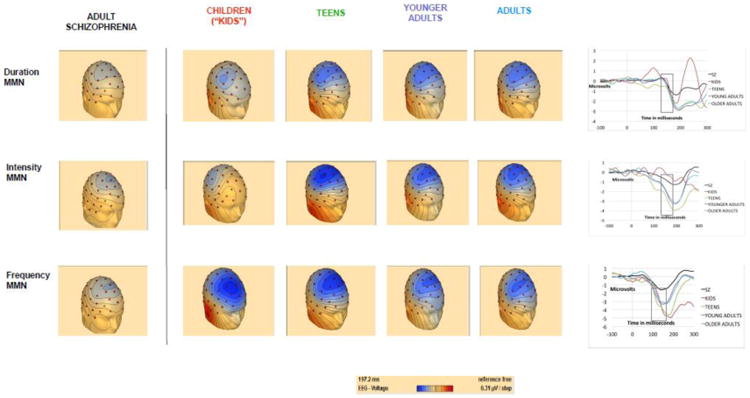
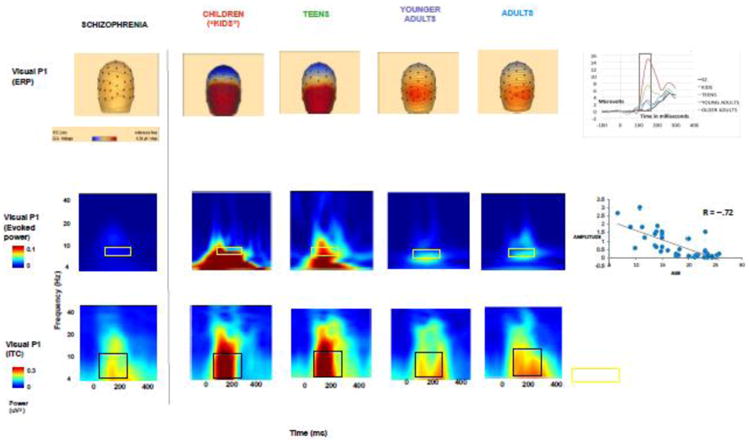
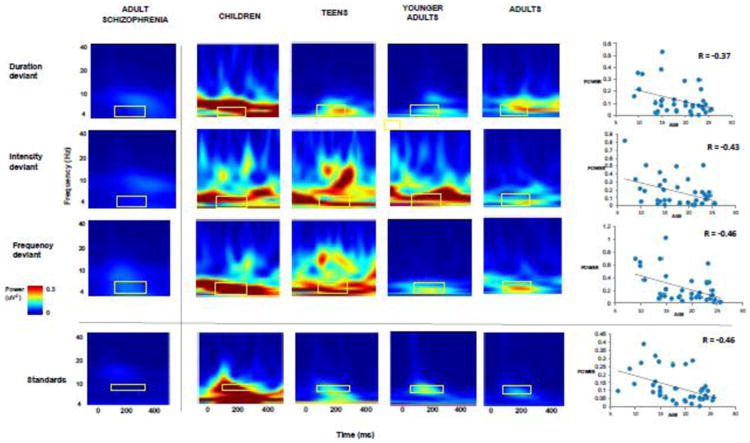
Sensory processing deficits are core features of schizophrenia, reflected in impaired generation of event-related potential (ERP) measures such as auditory mismatch negativity (MMN) and visual P1. To understand the potential time course of development of deficits in schizophrenia, we obtained MMN to unattended duration, intensity and frequency deviants, and visual P1 to attended LSF stimuli, in 43 healthy individuals ages 6 to 25years (mean 17), and compared results to data from 30 adult schizophrenia patients (mean age 38). We analyzed "time-domain" measures of amplitude and latency, and event-related spectral perturbation (ERSP, "time-frequency") to evaluate underlying neurophysiological mechanisms. Duration and intensity MMN amplitudes increased from childhood to late adolescence, while frequency MMN reached maximum amplitude during early development. As reported previously, in ERSP analyses, MMN activity corresponded primarily to theta-band (4-7Hz) activity, while responses to standards occurred primarily in alpha (8-12Hz) across age groups. Both deviant-induced theta and standard-induced alpha activity declined significantly with age for all deviant types. Likewise, visual P1 also showed an amplitude decline over development, reflecting a reduction in both evoked power and ITC. While MMN "difference" waveform ERP data suggest failure of maturation in schizophrenia, MMN ERSP analyses instead support a neurodegenerative process, as these isolate responses to deviants and standards, showing large low-frequency evoked power for both in children. Neurodegenerative processes are also supported by large visual P1 amplitudes and large low-frequency evoked power in children, in contrast with adult schizophrenia. Sensory processing deficits in schizophrenia may be related to accelerated synaptic pruning.
感觉处理缺陷是精神分裂症的核心特征,反映在事件相关电位 (ERP) 测量中,如听觉失匹配负波 (MMN) 和视觉 P1 的产生受损。为了了解精神分裂症缺陷潜在的发展时间进程,我们在 43 名年龄在 6 至 25 岁之间的健康个体(平均年龄 17 岁)中获得了对未注意到的持续时间、强度和频率偏差的 MMN,以及对注意到的低空间频率刺激的视觉 P1,并将结果与 30 名成年精神分裂症患者(平均年龄 38 岁)的数据进行了比较。我们分析了振幅和潜伏期的“时域”测量,以及事件相关光谱扰动 (ERSP,“时频”),以评估潜在的神经生理机制。持续时间和强度 MMN 振幅从儿童期到青春期后期增加,而频率 MMN 在早期发育期间达到最大振幅。如前所述,在 ERSP 分析中,MMN 活动主要对应于 theta 波段(4-7Hz)活动,而对标准的反应主要发生在 alpha 波段(8-12Hz)在不同年龄组中。所有偏差类型的 theta 和标准诱导的 alpha 活动都随年龄显著下降。同样,视觉 P1 也随着发育而表现出振幅下降,反映出诱发功率和 ITC 的减少。虽然 MMN“差异”波形 ERP 数据表明精神分裂症的成熟失败,但 MMN ERSP 分析反而支持神经退行性过程,因为这些分析分离了对偏差和标准的反应,在儿童中对两者都显示出较大的低频诱发功率。神经退行性过程也得到了儿童中较大的视觉 P1 振幅和较大的低频诱发功率的支持,与成年精神分裂症形成对比。精神分裂症的感觉处理缺陷可能与加速的突触修剪有关。