Inoue Kosuke, Saito Jun, Kondo Tetsuo, Miki Kaoru, Sugisawa Chiho, Tsurutani Yuya, Hasegawa Naoki, Kowase Shinya, Kakuta Yukio, Omura Masao, Nishikawa Tetsuo
Endocrinology and Diabetes Center, Yokohama Rosai Hospital, Japan.
Department of Human Pathology, University of Yamanashi Interdisciplinary Graduate School of Medicine and Engineering, Japan.
Intern Med. 2018 Jan 1;57(1):59-63. doi: 10.2169/internalmedicine.9177-17. Epub 2017 Oct 16.
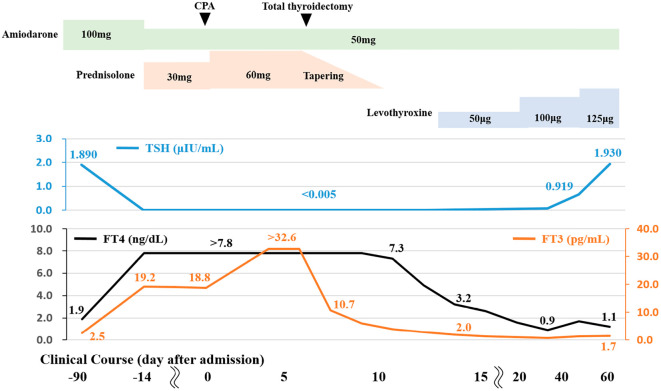
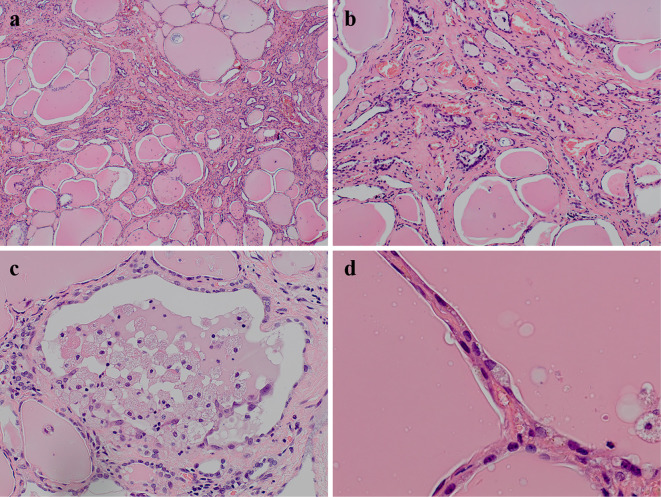
We describe a case of amiodarone-induced thyrotoxicosis (AIT) with cardiopulmonary arrest (CPA) in a 49-year-old woman. The patient had been treated with amiodarone for non-sustained ventricular tachycardia. Two weeks prior to her admission, she developed thyrotoxicosis and prednisolone (PSL, 30 mg daily) was administered with the continuation of amiodarone. However, she was admitted to our hospital for CPA. We performed total thyroidectomy to control her thyrotoxicosis and the pathological findings were consistent with type 2 AIT. She gradually improved and was discharged on day 84. This case demonstrates the importance of considering immediate total thyroidectomy for patients with uncontrollable AIT.
我们描述了一例49岁女性因胺碘酮诱发甲状腺毒症(AIT)并发生心肺骤停(CPA)的病例。该患者因非持续性室性心动过速接受胺碘酮治疗。入院前两周,她出现甲状腺毒症,在继续使用胺碘酮的同时给予泼尼松龙(PSL,每日30 mg)治疗。然而,她因心肺骤停入住我院。我们进行了甲状腺全切除术以控制她的甲状腺毒症,病理结果与2型AIT一致。她逐渐康复,并于第84天出院。该病例表明,对于无法控制的AIT患者,考虑立即进行甲状腺全切除术具有重要意义。