Ayaki Masahiko, Kawashima Motoko, Uchino Miki, Tsubota Kazuo, Negishi Kazuno
Department of Ophthalmology, Keio University, Shinjuku, Tokyo, Japan.
Clin Ophthalmol. 2017 Sep 30;11:1769-1775. doi: 10.2147/OPTH.S148650. eCollection 2017.
The purpose of this study was to evaluate the influence of seasons on the signs and symptoms of dry eye disease (DED).
This is a cross-sectional, case-control study, and participants were non-DED subjects (n=1,916, mean age 54.4±14.4 years) and DED patients (n=684, 54.2±12.1 years) visiting six eye clinics at various practices and locations in Japan. We evaluated the signs and symptoms of DED and the seasons with the most severe results were compared to those with the least severe results in both groups. Main outcome measures were differences in the severity of the signs and symptoms of DED between the most and least severe seasons.
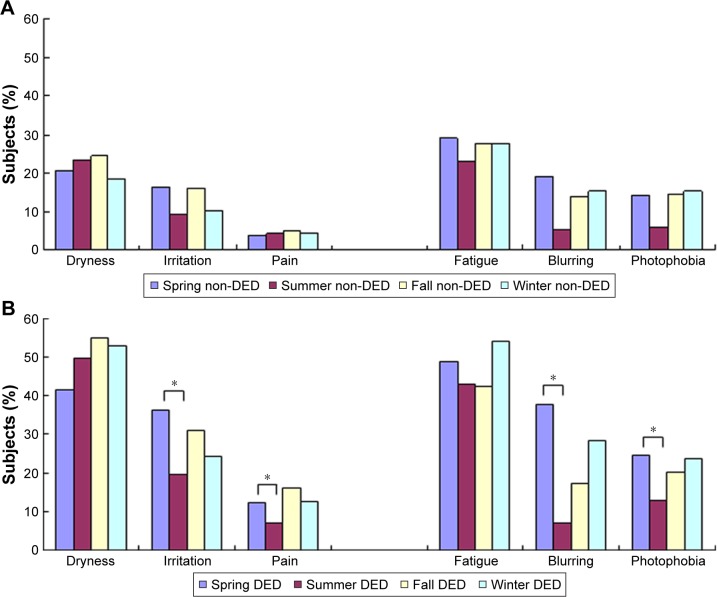
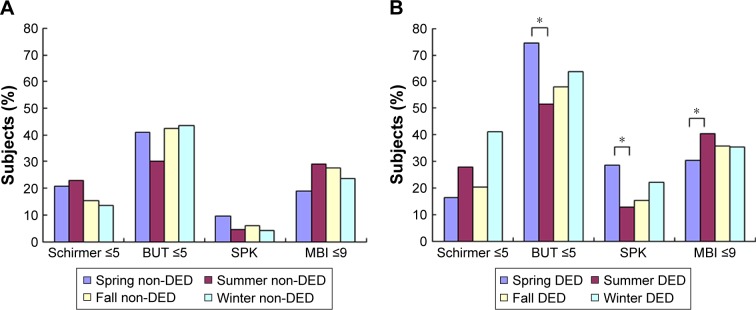
The majority of DED symptoms were most severe during spring and least severe in summer. Significant differences between these two seasons were found for irritation (=0.001), pain (=0.007), blurring (=0.000), and photophobia (=0.007) in the DED group. Superficial punctate keratopathy (=0.001) and tear break-up time (BUT; =0.000) results also indicated that DED was most severe in spring. In contrast, fewer patients had low Schirmer test results in spring, although this was not statistically significant (=0.061).
Our results demonstrated that the severity of DED is seasonal, which may explain the increase of short BUT-type DED cases observed in spring when air pollen counts are highest.
本研究旨在评估季节对干眼症(DED)体征和症状的影响。
这是一项横断面病例对照研究,参与者为日本不同医疗机构和地点的6家眼科诊所的非干眼症受试者(n = 1916,平均年龄54.4±14.4岁)和干眼症患者(n = 684,54.2±12.1岁)。我们评估了干眼症的体征和症状,并将两组中结果最严重的季节与结果最不严重的季节进行了比较。主要观察指标是最严重季节和最不严重季节之间干眼症体征和症状严重程度的差异。
大多数干眼症症状在春季最为严重,在夏季最为轻微。干眼症组在这两个季节之间,在眼刺激感(=0.001)、疼痛(=0.007)、视物模糊(=0.000)和畏光(=0.007)方面存在显著差异。浅层点状角膜炎(=0.001)和泪膜破裂时间(BUT;=0.000)结果也表明,干眼症在春季最为严重。相比之下,春季泪液分泌试验结果较低的患者较少,尽管这在统计学上不显著(=0.061)。
我们的结果表明,干眼症的严重程度具有季节性,这可能解释了在春季空气中花粉计数最高时观察到的短BUT型干眼症病例增加的现象。