Division of Ophthalmology, Matsusaka Central General Hospital, Matsusaka, Japan.
Department of Ophthalmology, Mie University School of Medicine, Tsu, Japan.
Sci Rep. 2020 Aug 18;10(1):13949. doi: 10.1038/s41598-020-70606-w.
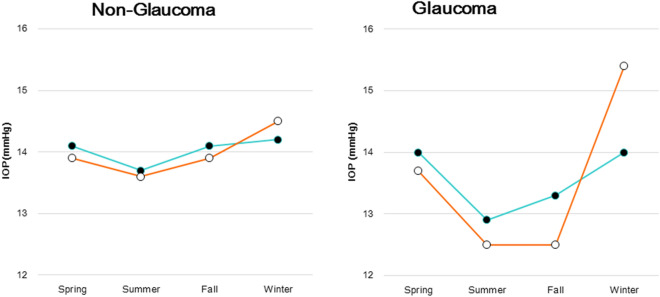
The management of intra-ocular pressure (IOP) is important for glaucoma treatment. IOP is recognized for showing seasonal fluctuation. Glaucoma patients can be at high risk of dry eye disease (DED). We thus evaluated seasonal variation of IOP with and without DED in glaucoma patients. This study enrolled 4,708 patients, with mean age of 55.2 years, who visited our clinics in Japan from Mar 2015 to Feb 2017. We compared the seasonal variation in IOP (mean ± SD) across spring (March-May), summer (June-August), fall (September-November), and winter (December-February). IOP was highest in winter and lowest in summer, at 14.2/13.7 for non-glaucoma without DED group (n = 2,853, P = 0.001), 14.5/13.6 for non-glaucoma with DED group (n = 1,500, P = 0.000), 14.0/13.0 for glaucoma without DED group (n = 240, P = 0.051), and 15.4/12.4 for glaucoma with DED group (n = 115, P = 0.015). Seasonal variation was largest across the seasons in the glaucoma with DED group. IOP was also inversely correlated with corneal staining score (P = 0.000). In conclusion, the seasonal variation was significant in most of study groups and IOP could tend to be low in summer.
眼压(IOP)的管理对于青光眼治疗很重要。人们已经认识到IOP 存在季节性波动。青光眼患者可能患有干眼症(DED)的风险较高。因此,我们评估了青光眼患者中有无 DED 的 IOP 的季节性变化。本研究纳入了 4708 名患者,平均年龄为 55.2 岁,他们于 2015 年 3 月至 2017 年 2 月期间在日本的诊所就诊。我们比较了春季(3 月至 5 月)、夏季(6 月至 8 月)、秋季(9 月至 11 月)和冬季(12 月至 2 月)IOP 的季节性变化(平均值±标准差)。非青光眼无 DED 组(n=2853)的 IOP 冬季最高,夏季最低,为 14.2/13.7(P=0.001),非青光眼有 DED 组(n=1500)的 IOP 冬季最高,夏季最低,为 14.5/13.6(P=0.000),无 DED 青光眼组(n=240)的 IOP 冬季最高,夏季最低,为 14.0/13.0(P=0.051),有 DED 青光眼组(n=115)的 IOP 冬季最高,夏季最低,为 15.4/12.4(P=0.015)。DED 青光眼组的季节间变化最大。IOP 还与角膜染色评分呈负相关(P=0.000)。总之,大多数研究组的季节性变化都很显著,IOP 在夏季可能会较低。