Department of Dermatology, Tokyo Medical University, Tokyo, Japan.
Osaka City University Hospital, Osaka City University Graduate School of Medicine, Osaka, Japan.
J Eur Acad Dermatol Venereol. 2018 Apr;32(4):606-614. doi: 10.1111/jdv.14630. Epub 2017 Nov 6.
Appropriate goal-oriented treatment strategies are important for optimal treatment outcomes and may prevent under-treatment. As treatment goals vary by patient, a study to examine treatment goals is more meaningful when patients and their physicians are paired. There has not been any study that examines alignment between paired psoriasis patients and physicians in real-world clinical practice using skin clearance as a treatment goal indicator.
To evaluate treatment goal alignment between psoriasis patients and their paired physicians, and to quantitatively identify factors associated with goal misalignment.
The study was a nationwide multicenter cross-sectional observational study. Subjects were physician-reported moderate-to-severe psoriasis patients with a history of systemic treatments, directly paired with their treating physicians. Subjects completed surveys independently. Treatment goals included seven categories, and patient-physician pairs were grouped as 'aligned' or 'misaligned' when the answers were the same or different, respectively.
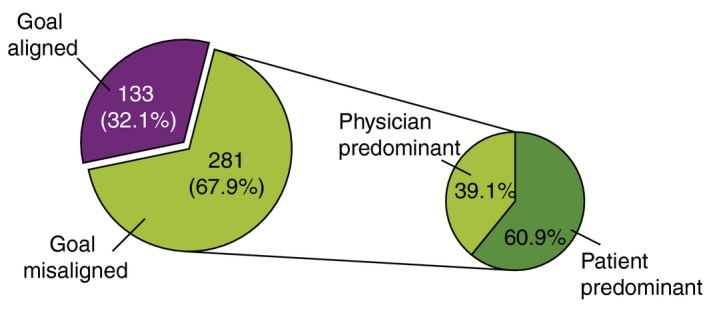
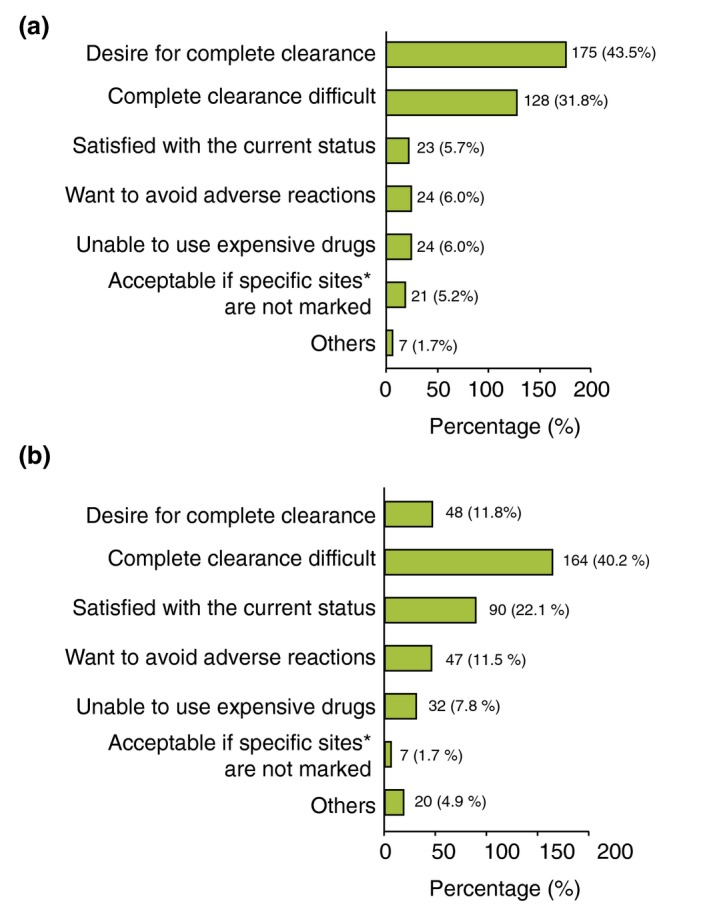
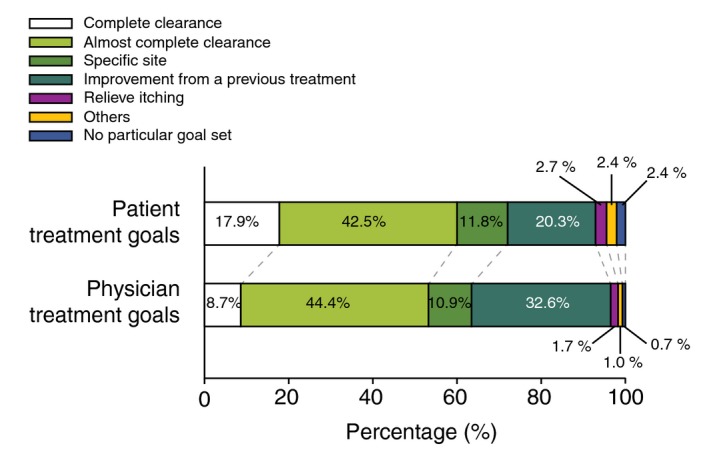
A total of 425 pairs (mean response rate, 94.7%) of responses were collected from 54 sites (64.8% general practitioners or clinics; 35.2% university or large hospitals). Treatment goal misalignment was found in 67.9% of the patient-physician pairs. The misalignment was mainly 'patient predominant' (60.9%) indicating that patients had higher goals ('complete clearance') than physicians. In the multivariate logistic regression analyses, patients' treatment expectation for 'complete clearance' [odds ratio (OR): 1.927; 95% confidential interval (CI): 1.232-3.016] and physician rating of 'level of understanding on treatment options' being low (OR: 1.552, 95% CI; 1.082-2.227) were significant factors for treatment goal misalignment.
The majority of treatment goal misalignment was found between paired psoriasis patients and their treating physicians in Japan. The most important contributing factors to misalignment were patients' treatment expectation for 'complete clearance' and physicians' rating of their patients' 'level of understanding on treatment options' being low.
对于获得最佳治疗效果和避免治疗不足而言,采用恰当的以目标为导向的治疗策略十分重要。由于每位患者的治疗目标各不相同,因此在将患者与其医生进行配对的情况下,研究治疗目标更具意义。目前尚无研究使用皮损清除率作为治疗目标指标,评估真实世界临床实践中配对银屑病患者及其医生之间的治疗目标一致性。
评估银屑病患者与其配对医生之间的治疗目标一致性,并定量确定与目标不一致相关的因素。
该研究是一项全国性多中心横断面观察性研究。研究对象为有系统治疗史的、经医生报告的中重度银屑病患者,他们与治疗医生直接配对。患者独立完成调查。治疗目标分为 7 个类别,当医生和患者的答案相同时为“一致”,否则为“不一致”。
共从 54 个研究中心(64.8%为全科医生或诊所;35.2%为大学或大医院)收集了 425 对(平均应答率为 94.7%)患者-医生配对的回复。67.9%的患者-医生对存在治疗目标不一致。这种不一致主要表现为“患者主导”(60.9%),即患者的治疗目标(“完全清除”)高于医生。在多变量逻辑回归分析中,患者对“完全清除”的治疗期望(比值比 [OR]:1.927;95%置信区间 [CI]:1.232-3.016)和医生对“治疗方案理解程度”的低评分(OR:1.552,95%CI:1.082-2.227)是治疗目标不一致的显著因素。
在日本,配对的银屑病患者与其治疗医生之间存在大量的治疗目标不一致。导致不一致的最重要因素是患者对“完全清除”的治疗期望以及医生对患者“治疗方案理解程度”的低评分。