Kim Hye Jin, Lee Won Jun
Department of Kinesiology and Sports Studies, College of Science and Industry Convergence, Ewha Womans University, Seoul, Republic of Korea.
J Exerc Nutrition Biochem. 2017 Sep 30;21(3):19-25. doi: 10.20463/jenb.2017.0022.
Postmenopausal women are highly susceptible to diseases, such as obesity, type 2 diabetes, osteoporosis, or skeletal muscle atrophy and many people recognize the need for regular physical activity. Aerobic exercise training is known to improve the oxidative capacity and insulin sensitivity of skeletal muscles. This study aimed to investigate the role of low-intensity aerobic exercise training on skeletal muscle protein degradation or synthesis in the plantaris muscles of high-fat-fed ovariectomized rats.
Ovariectomized female rats were divided into two groups: a high-fat diet-sedentary group (HFD), and a high-fat diet-aerobic exercise group (HFD+EX). The exercise group exercised aerobically on a treadmill 5 days/week for 8 weeks. The rats progressively ran 30 min/day at 15 m/min, up to 40 min/day at 18 m/min, 0% slope, in the last 4 weeks.
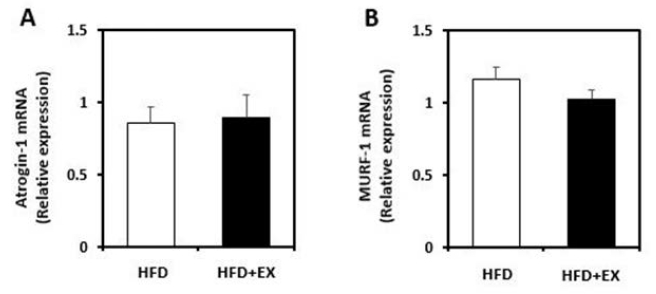
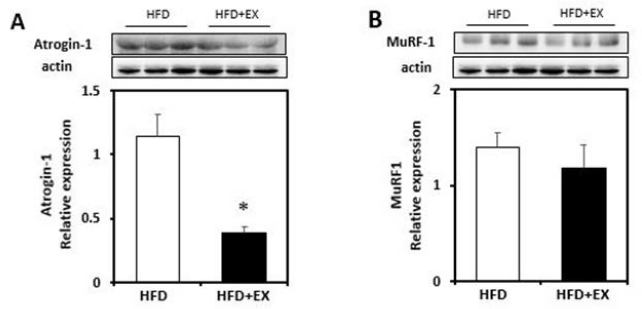
Although aerobic exercise led to significantly increased AMP-activated protein kinase (AMPK) phosphorylation at Thr172, phosphorylation of the mammalian target of rapamycin (mTOR) substrate Thr389 S6K1 level did not decrease. Additionally, even though Akt activity did not increase at Ser473, the atrogin-1 level significantly decreased in the exercise group compared to the non-exercise group. Immunohistochemical staining revealed that high-fat-induced TSC2 protein expression was eliminated in response to aerobic exercise.
These results suggest that aerobic exercise can inhibit skeletal muscle protein degradation, but it cannot increase protein synthesis in the plantaris muscle of high-fat-fed ovariectomized rats. Our findings have implications in understanding skeletal muscle mass maintenance with low intensity aerobic exercise in post-menopausal women.
绝经后女性极易患肥胖、2型糖尿病、骨质疏松症或骨骼肌萎缩等疾病,许多人认识到有必要进行定期体育锻炼。已知有氧运动训练可提高骨骼肌的氧化能力和胰岛素敏感性。本研究旨在探讨低强度有氧运动训练对高脂喂养的去卵巢大鼠比目鱼肌骨骼肌蛋白质降解或合成的作用。
将去卵巢雌性大鼠分为两组:高脂饮食久坐组(HFD)和高脂饮食有氧运动组(HFD+EX)。运动组每周5天在跑步机上进行有氧运动,持续8周。在最后4周,大鼠以15米/分钟的速度每天逐渐跑30分钟,直至以18米/分钟的速度每天跑40分钟,坡度为0%。
尽管有氧运动导致Thr172处的AMP激活蛋白激酶(AMPK)磷酸化显著增加,但雷帕霉素哺乳动物靶点(mTOR)底物Thr389 S6K1水平的磷酸化并未降低。此外,尽管Ser473处的Akt活性没有增加,但与非运动组相比,运动组的atrogin-1水平显著降低。免疫组织化学染色显示,有氧运动可消除高脂诱导的TSC2蛋白表达。
这些结果表明,有氧运动可抑制高脂喂养的去卵巢大鼠比目鱼肌的骨骼肌蛋白质降解,但不能增加其蛋白质合成。我们的研究结果对于理解绝经后女性通过低强度有氧运动维持骨骼肌质量具有重要意义。