Medical Center of The Graduate School, Nanchang University, Nanchang, China.
Department of Endocrinology, Second Affliated Hospital, Nanchang University, Nanchang, China.
Lipids Health Dis. 2017 Oct 16;16(1):203. doi: 10.1186/s12944-017-0572-9.
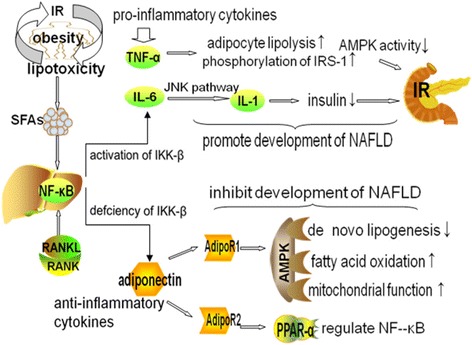
Nonalcoholic fatty liver disease (NAFLD) comprises a spectrum of diseases, including simple steatosis, nonalcoholic steatohepatitis (NASH), liver cirrhosis and hepatocellular carcinoma. Lipotoxicity, insulin resistance (IR) and inflammation are involved in the disease process. Lipotoxicity promotes inflammation and IR, which in turn, increase adipocyte lipolysis and exacerbates lipotoxicity. Furthermore, IR and inflammation form a vicious circle, with each condition promoting the other and accelerating the development of NAFLD in the presence of lipotoxicity. As an integrator of inflammatory pathway networks, nuclear factor-kappa B (NF-κB) regulates expression of pro-inflammatory cytokines, such as tumor necrosis factor-alpha (TNF-α), interleukin 6 (IL-6), and anti-inflammatory cytokines, such as adiponectin in NAFLD. In this review, the relationships between lipotoxicity, IR and inflammation in NAFLD are discussed, with particular emphasis on the inflammatory pathways.
非酒精性脂肪性肝病(NAFLD)包括一系列疾病,包括单纯性脂肪变性、非酒精性脂肪性肝炎(NASH)、肝硬化和肝细胞癌。脂毒性、胰岛素抵抗(IR)和炎症参与了疾病过程。脂毒性促进炎症和 IR,反过来,又增加脂肪细胞脂肪分解并加剧脂毒性。此外,IR 和炎症形成恶性循环,每种情况都会促进另一种情况,并在存在脂毒性的情况下加速 NAFLD 的发展。核因子-κB(NF-κB)作为炎症途径网络的整合因子,调节促炎细胞因子,如肿瘤坏死因子-α(TNF-α)、白细胞介素 6(IL-6)和抗炎细胞因子,如 NAFLD 中的脂联素的表达。在这篇综述中,讨论了 NAFLD 中脂毒性、IR 和炎症之间的关系,特别强调了炎症途径。