Chappell Grace A, Israel Jennifer W, Simon Jeremy M, Pott Sebastian, Safi Alexias, Eklund Karl, Sexton Kenneth G, Bodnar Wanda, Lieb Jason D, Crawford Gregory E, Rusyn Ivan, Furey Terrence S
Department of Veterinary Integrative Biosciences, College of Veterinary Medicine and Biomedical Sciences, Texas A&M University, College Station , Texas, USA.
Department of Environmental Sciences and Engineering, University of North Carolina , Chapel Hill, North Carolina, USA.
Environ Health Perspect. 2017 Oct 16;125(10):107006. doi: 10.1289/EHP1937.
The damaging effects of exposure to environmental toxicants differentially affect genetically distinct individuals, but the mechanisms contributing to these differences are poorly understood. Genetic variation affects the establishment of the gene regulatory landscape and thus gene expression, and we hypothesized that this contributes to the observed heterogeneity in individual responses to exogenous cellular insults.
We performed an study of how genetic variation and chromatin organization may dictate susceptibility to DNA damage, and influence the cellular response to such damage, caused by an environmental toxicant.
We measured DNA damage, messenger RNA (mRNA) and microRNA (miRNA) expression, and genome-wide chromatin accessibility in lung tissue from two genetically divergent inbred mouse strains, C57BL/6J and CAST/EiJ, both in unexposed mice and in mice exposed to a model DNA-damaging chemical, 1,3-butadiene.
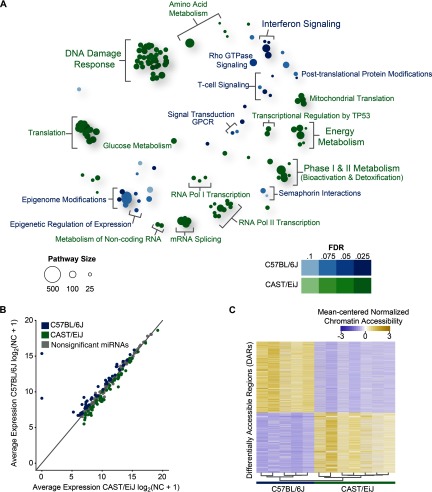
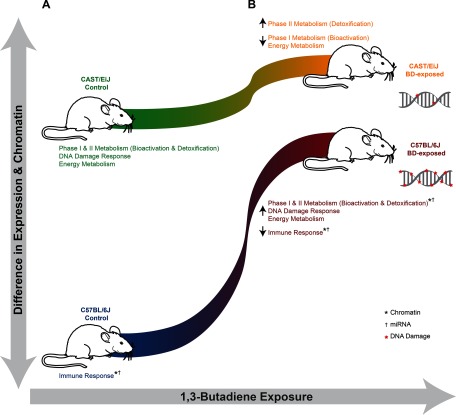
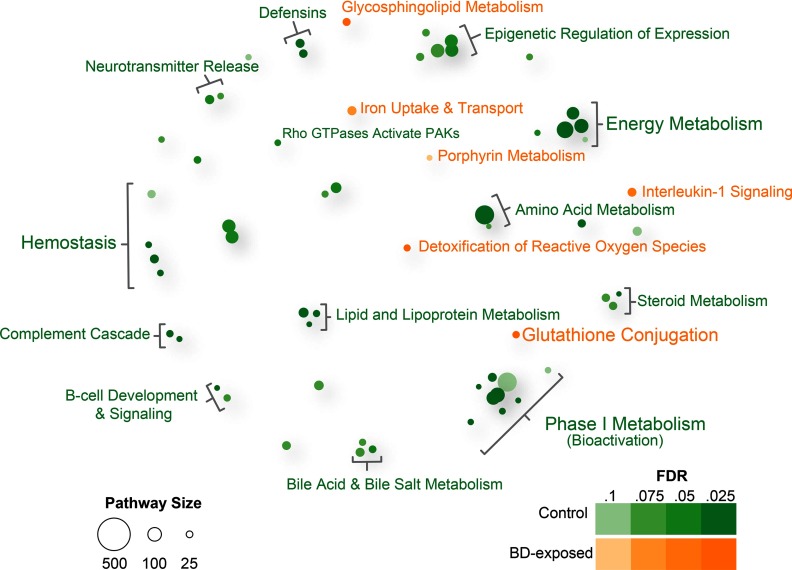
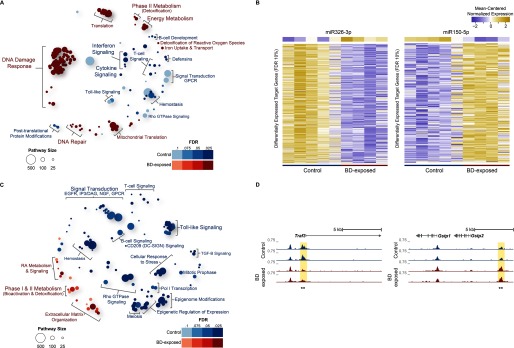
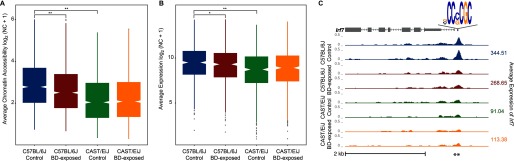
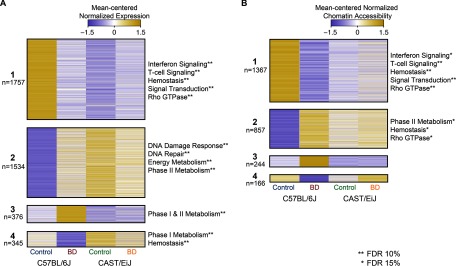
Our results showed that unexposed CAST/EiJ and C57BL/6J mice have very different chromatin organization and transcription profiles in the lung. Importantly, in unexposed CAST/EiJ mice, which acquired relatively less 1,3-butadiene-induced DNA damage, we observed increased transcription and a more accessible chromatin landscape around genes involved in detoxification pathways. Upon chemical exposure, chromatin was significantly remodeled in the lung of C57BL/6J mice, a strain that acquired higher levels of 1,3-butadiene-induced DNA damage, around the same genes, ultimately resembling the molecular profile of CAST/EiJ.
These results suggest that strain-specific changes in chromatin and transcription in response to chemical exposure lead to a "compensation" for underlying genetic-driven interindividual differences in the baseline chromatin and transcriptional state. This work represents an example of how chemical and environmental exposures can be evaluated to better understand gene-by-environment interactions, and it demonstrates the important role of chromatin response in transcriptomic changes and, potentially, in deleterious effects of exposure. https://doi.org/10.1289/EHP1937.
接触环境毒物的有害影响对基因不同的个体有不同影响,但导致这些差异的机制尚不清楚。基因变异影响基因调控格局的建立,进而影响基因表达,我们推测这是个体对外源细胞损伤反应中观察到的异质性的原因。
我们进行了一项研究,探究基因变异和染色质组织如何决定对DNA损伤的易感性,并影响由环境毒物引起的此类损伤的细胞反应。
我们测量了两种基因不同的近交系小鼠品系C57BL/6J和CAST/EiJ的肺组织中的DNA损伤、信使核糖核酸(mRNA)和微小核糖核酸(miRNA)表达,以及全基因组染色质可及性,这些小鼠既有未接触毒物的,也有接触了一种DNA损伤模型化学物质1,3 - 丁二烯的。
我们的结果表明,未接触毒物的CAST/EiJ和C57BL/6J小鼠在肺中的染色质组织和转录谱有很大差异。重要的是,在未接触毒物的CAST/EiJ小鼠中,其1,3 - 丁二烯诱导的DNA损伤相对较少,我们观察到参与解毒途径的基因周围转录增加,染色质格局更易接近。在化学物质暴露后,C57BL/6J小鼠(该品系1,3 - 丁二烯诱导的DNA损伤水平较高)肺中的染色质在相同基因周围发生了显著重塑,最终类似于CAST/EiJ的分子谱。
这些结果表明,化学物质暴露后染色质和转录的品系特异性变化导致对基线染色质和转录状态中潜在基因驱动的个体间差异的“补偿”。这项工作代表了一个如何评估化学和环境暴露以更好地理解基因 - 环境相互作用的例子,它证明了染色质反应在转录组变化以及潜在的暴露有害影响中的重要作用。https://doi.org/10.1289/EHP1937