Department of Preventive Dentistry, The Affiliated Stomatological Hospital, Fujian Medical University, Fuzhou, Fujian 350002, P.R. China.
Department of Pathology, The Affiliated Stomatological Hospital, Fujian Medical University, Fuzhou, Fujian 350002, P.R. China.
Mol Med Rep. 2017 Dec;16(6):8907-8915. doi: 10.3892/mmr.2017.7744. Epub 2017 Oct 9.
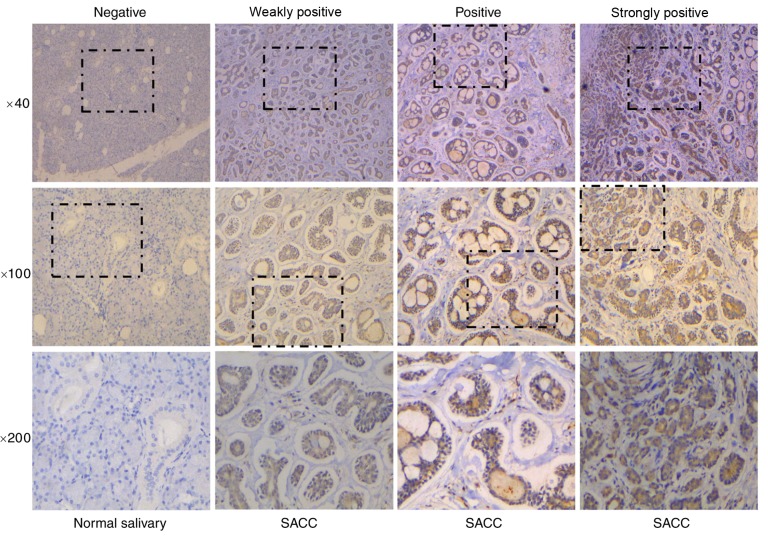
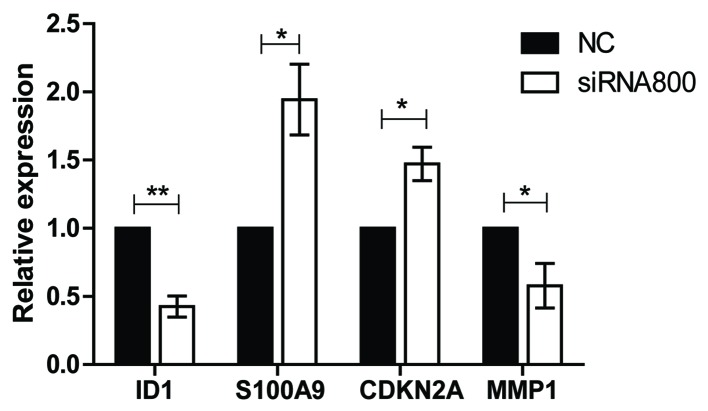
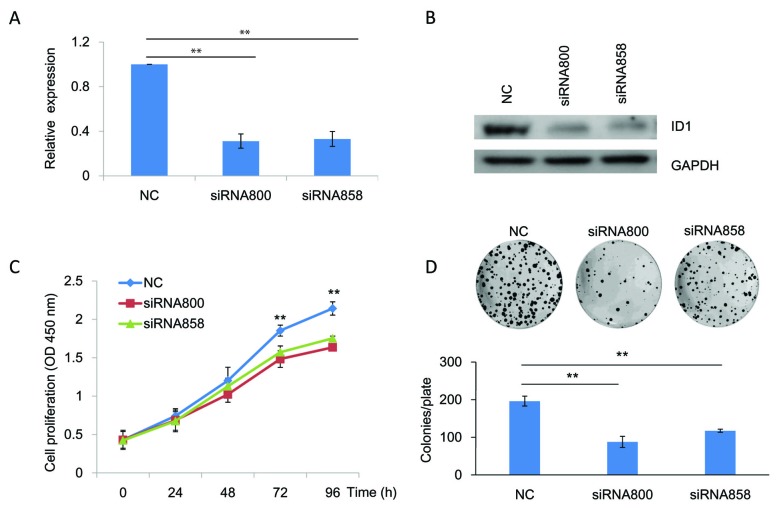
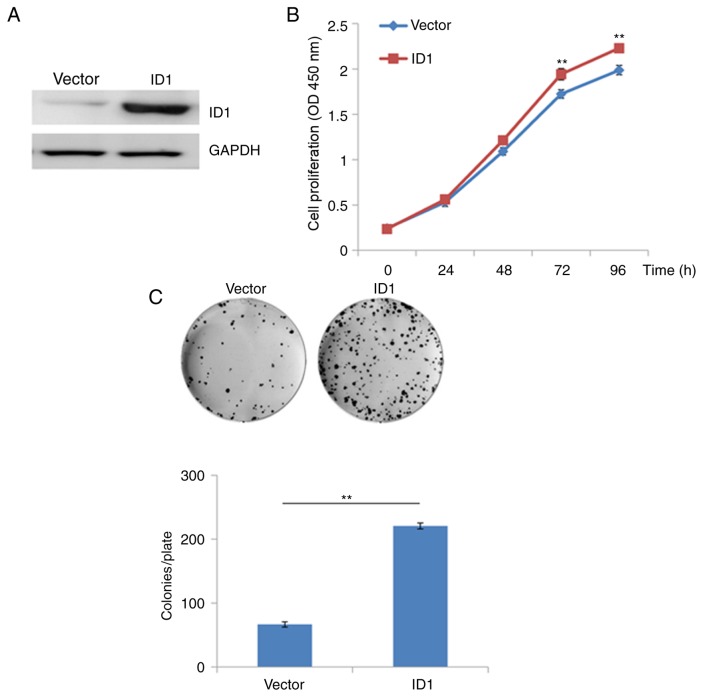
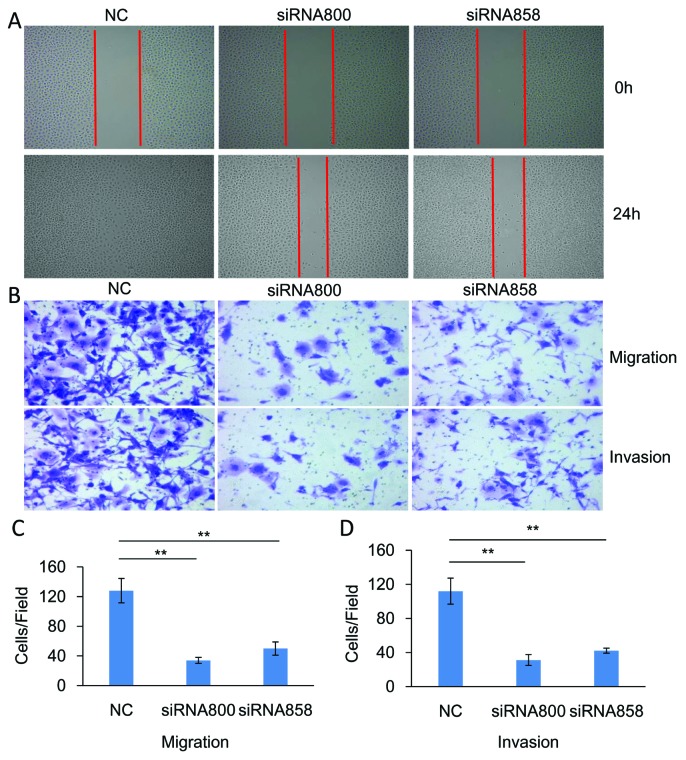
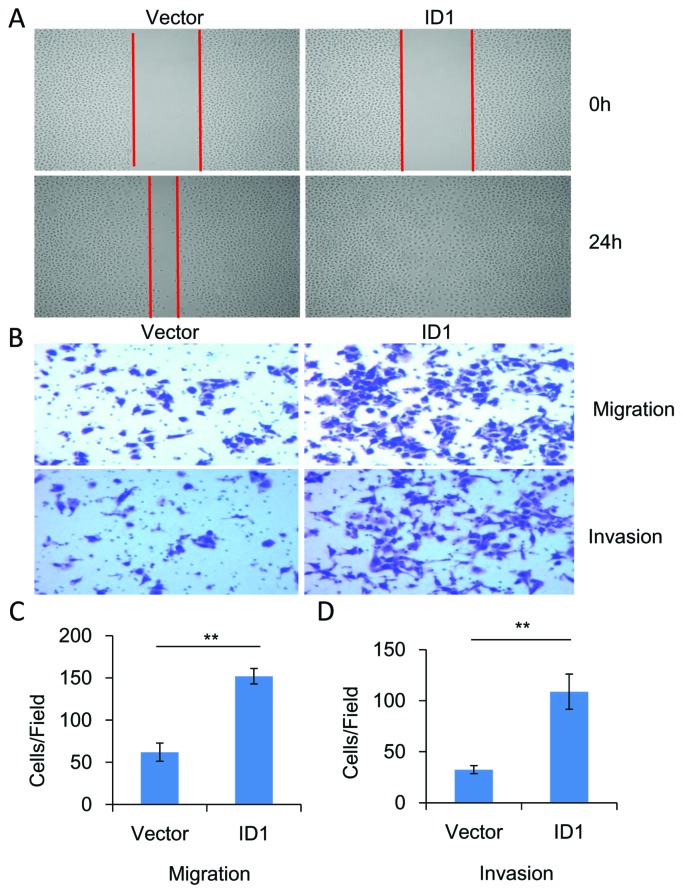
Previous studies have reported that inhibitor of DNA binding 1 (ID1) exerts an oncogenic role in a number of tumors. In the present study, the role of ID1 in the growth, invasion and migration of salivary adenoid cystic carcinoma (SACC) cells was investigated. ID1 expression in clinical SACC samples was compared with that in normal salivary tissues using immunohistochemical staining, and the correlation between ID1 expression and clinical pathological characteristics was then determined. Subsequently, ID1 was overexpressed or silenced to investigate the effects of ID1 expression on SACC cell proliferation, invasion and migration. In addition, the gene expression levels of known ID1 target genes, including S100A9, CDKN2A and matrix metalloproteinase 1 (MMP1) was measured using reverse transcription‑quantitative polymerase chain reaction to elucidate the potential mechanisms of ID1 in SACC. The results of the present study indicated that the protein expression levels of ID1 were significantly increased in the SACC tissues compared with that in the normal salivary tissues (P<0.001), and a positive correlation between ID1 expression and tumor stage (P=0.001), tumor invasion (P=0.002) and metastasis (P=0.019) in SACC was observed. Knockdown of ID1 in SACC cells significantly inhibited cell growth, invasion and migration (all P<0.01), whereas overexpression of ID1 promoted cell proliferation, invasion and migration (all P<0.01). The gene expression level of MMP1 was significantly reduced following ID1 knockdown in SACC‑83 cells when compared with negative controls (P<0.05), whereas S100A9 and CDKN2A expression levels were significantly upregulated (both P<0.05). The results suggest that ID1 may regulate the growth, invasion and migration of SACC cells, and that MMP1, S100A9 and CDKN2A may serve as target genes of ID1 and mediate the effects of ID1 in SACC cells. Therefore, ID1 may present a potential target gene for the treatment of patients with SACC to inhibit cancer cell growth and metastasis.
先前的研究报告称,DNA 结合抑制因子 1(ID1)在许多肿瘤中发挥致癌作用。本研究旨在探讨 ID1 在唾液腺腺样囊性癌(SACC)细胞生长、侵袭和迁移中的作用。采用免疫组织化学染色法比较临床 SACC 样本和正常唾液组织中的 ID1 表达情况,然后确定 ID1 表达与临床病理特征的相关性。随后,过表达或沉默 ID1 以研究 ID1 表达对 SACC 细胞增殖、侵袭和迁移的影响。此外,还使用逆转录-定量聚合酶链反应测量了已知 ID1 靶基因(包括 S100A9、CDKN2A 和基质金属蛋白酶 1(MMP1))的基因表达水平,以阐明 ID1 在 SACC 中的潜在作用机制。本研究结果表明,与正常唾液组织相比,SACC 组织中 ID1 的蛋白表达水平显著升高(P<0.001),并且 ID1 表达与 SACC 肿瘤分期(P=0.001)、肿瘤侵袭(P=0.002)和转移(P=0.019)呈正相关。在 SACC 细胞中敲低 ID1 可显著抑制细胞生长、侵袭和迁移(均 P<0.01),而过表达 ID1 则可促进细胞增殖、侵袭和迁移(均 P<0.01)。与阴性对照相比,SACC-83 细胞中 ID1 敲低后 MMP1 的基因表达水平显著降低(P<0.05),而 S100A9 和 CDKN2A 的表达水平显著上调(均 P<0.05)。结果表明,ID1 可能调节 SACC 细胞的生长、侵袭和迁移,而 MMP1、S100A9 和 CDKN2A 可能作为 ID1 的靶基因并介导 ID1 在 SACC 细胞中的作用。因此,ID1 可能成为治疗 SACC 患者的潜在靶基因,以抑制癌细胞生长和转移。