CAS Key Laboratory of Regenerative Biology, Joint School of Life Sciences, Guangzhou Institutes of Biomedicine and Health, Chinese Academy of Sciences, Guangzhou 510530, China;Guangzhou Medical University, Guangzhou, 511436, China.
Guangdong Provincial Key Laboratory of Biocomputing, Guangzhou Institutes of Biomedicine and Health, Chinese Academy of Sciences, Guangzhou, 510530, China.
Sci Rep. 2017 Oct 18;7(1):13496. doi: 10.1038/s41598-017-13680-x.
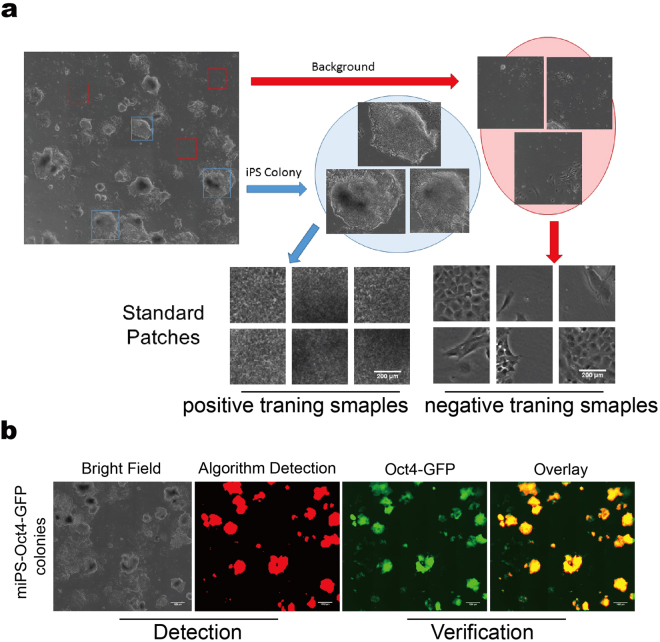
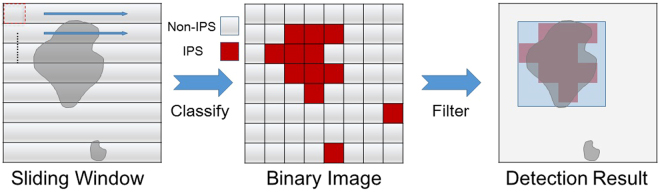
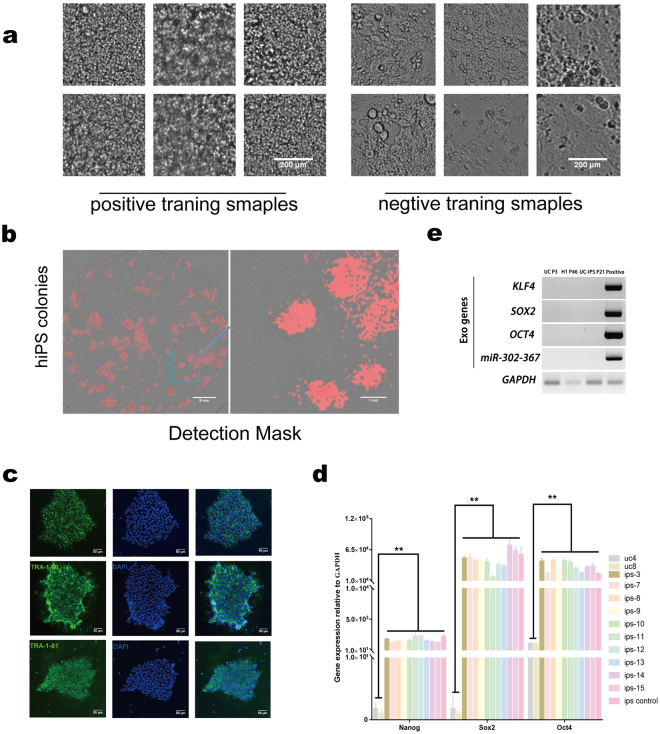
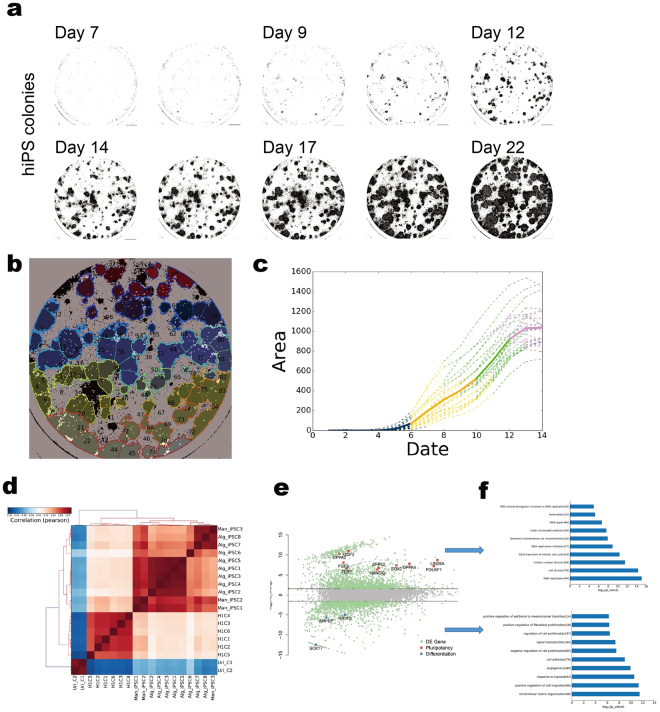
During cellular reprogramming, the mesenchymal-to-epithelial transition is accompanied by changes in morphology, which occur prior to iPSC colony formation. The current approach for detecting morphological changes associated with reprogramming purely relies on human experiences, which involve intensive amounts of upfront training, human error with limited quality control and batch-to-batch variations. Here, we report a time-lapse-based bright-field imaging analysis system that allows us to implement a label-free, non-invasive approach to measure morphological dynamics. To automatically analyse and determine iPSC colony formation, a machine learning-based classification, segmentation, and statistical modelling system was developed to guide colony selection. The system can detect and monitor the earliest cellular texture changes after the induction of reprogramming in human somatic cells on day 7 from the 20-24 day process. Moreover, after determining the reprogramming process and iPSC colony formation quantitatively, a mathematical model was developed to statistically predict the best iPSC selection phase independent of any other resources. All the computational detection and prediction experiments were evaluated using a validation dataset, and biological verification was performed. These algorithm-detected colonies show no significant differences (Pearson Coefficient) in terms of their biological features compared to the manually processed colonies using standard molecular approaches.
在细胞重编程过程中,间充质向上皮转化伴随着形态的变化,这种变化发生在 iPSC 集落形成之前。目前用于检测与重编程相关的形态变化的方法纯粹依赖于人类的经验,这涉及大量的前期培训、有限质量控制和批次间变化的人为错误。在这里,我们报告了一种基于延时的明场成像分析系统,该系统允许我们实施一种无标记、非侵入性的方法来测量形态动力学。为了自动分析和确定 iPSC 集落形成,开发了一种基于机器学习的分类、分割和统计建模系统,以指导集落选择。该系统可以在人类体细胞重编程诱导后第 7 天检测和监测 20-24 天过程中最早的细胞纹理变化。此外,在定量确定重编程过程和 iPSC 集落形成后,开发了一个数学模型,以便在不依赖任何其他资源的情况下统计预测最佳 iPSC 选择阶段。所有的计算检测和预测实验都使用验证数据集进行了评估,并进行了生物学验证。与使用标准分子方法手动处理的集落相比,这些算法检测到的集落在其生物学特征方面没有显著差异(皮尔逊系数)。