Maramraju Sudhiksha, Kowalczewski Andrew, Kaza Anirudh, Liu Xiyuan, Singaraju Jathin Pranav, Albert Mark V, Ma Zhen, Yang Huaxiao
Department of Biomedical Engineering University of North Texas Denton Texas USA.
Texas Academy of Mathematics and Science University of North Texas Denton Texas USA.
Bioeng Transl Med. 2024 Jan 20;9(2):e10641. doi: 10.1002/btm2.10641. eCollection 2024 Mar.
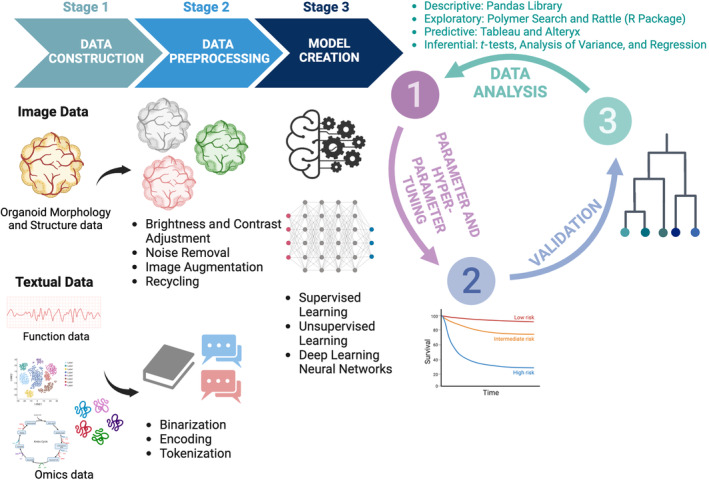
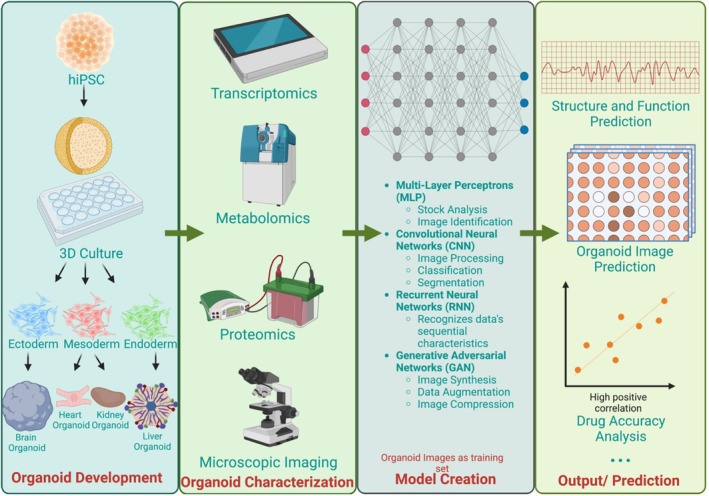
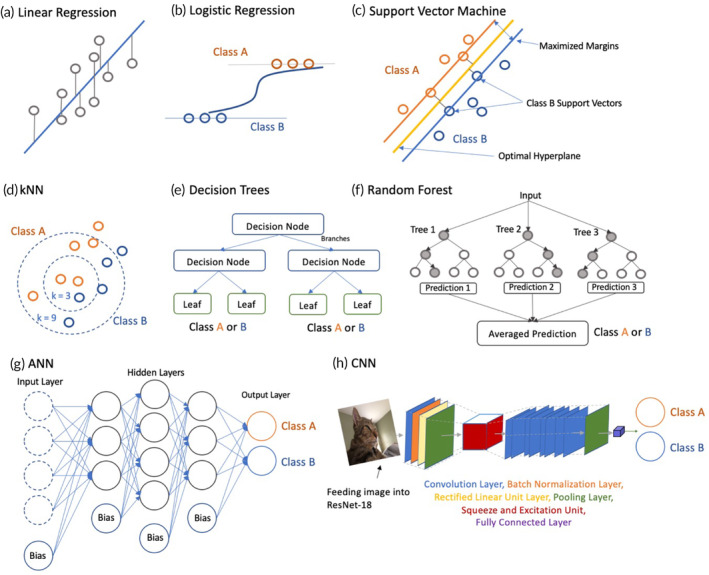
In this review, we explore the growing role of artificial intelligence (AI) in advancing the biomedical applications of human pluripotent stem cell (hPSC)-derived organoids. Stem cell-derived organoids, these miniature organ replicas, have become essential tools for disease modeling, drug discovery, and regenerative medicine. However, analyzing the vast and intricate datasets generated from these organoids can be inefficient and error-prone. AI techniques offer a promising solution to efficiently extract insights and make predictions from diverse data types generated from microscopy images, transcriptomics, metabolomics, and proteomics. This review offers a brief overview of organoid characterization and fundamental concepts in AI while focusing on a comprehensive exploration of AI applications in organoid-based disease modeling and drug evaluation. It provides insights into the future possibilities of AI in enhancing the quality control of organoid fabrication, label-free organoid recognition, and three-dimensional image reconstruction of complex organoid structures. This review presents the challenges and potential solutions in AI-organoid integration, focusing on the establishment of reliable AI model decision-making processes and the standardization of organoid research.
在本综述中,我们探讨了人工智能(AI)在推进人类多能干细胞(hPSC)来源的类器官生物医学应用方面日益重要的作用。干细胞来源的类器官,即这些微型器官复制品,已成为疾病建模、药物发现和再生医学的重要工具。然而,分析从这些类器官产生的大量复杂数据集可能效率低下且容易出错。人工智能技术为从显微镜图像、转录组学、代谢组学和蛋白质组学产生的各种数据类型中有效提取见解并进行预测提供了一个有前景的解决方案。本综述简要概述了类器官表征和人工智能的基本概念,同时重点全面探讨人工智能在基于类器官的疾病建模和药物评估中的应用。它深入探讨了人工智能在提高类器官制造质量控制、无标记类器官识别以及复杂类器官结构的三维图像重建方面的未来可能性。本综述介绍了人工智能与类器官整合中的挑战和潜在解决方案,重点在于建立可靠的人工智能模型决策过程和类器官研究的标准化。