Centre for Integrative Neuroscience and Neurodynamics, School of Psychology and Clinical Language Sciences University of Reading, Whiteknights Campus, Reading, United Kingdom.
Psychology Department, Sapienza University of Rome, Rome, Italy.
PLoS One. 2017 Oct 18;12(10):e0185146. doi: 10.1371/journal.pone.0185146. eCollection 2017.
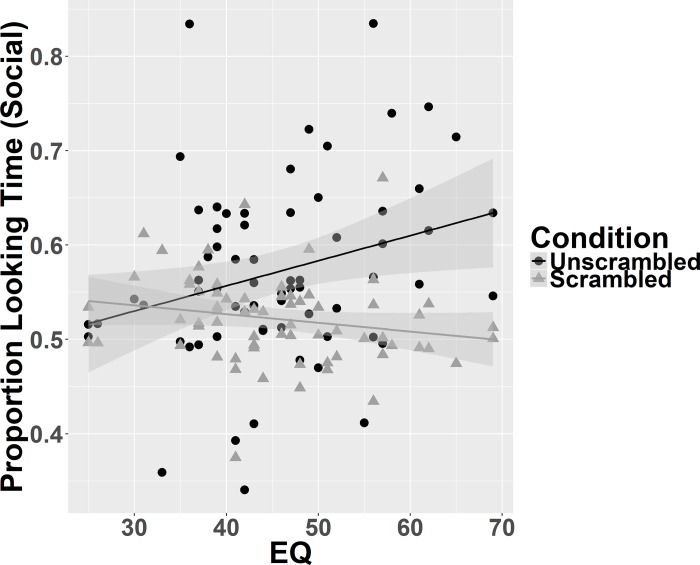
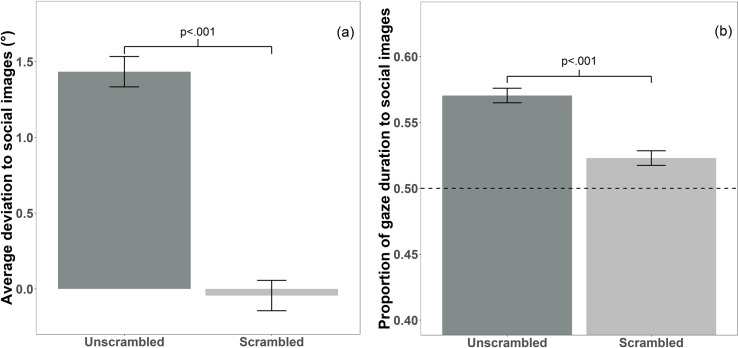
Humans generally prefer social over nonsocial stimuli from an early age. Reduced preference for social rewards has been observed in individuals with autism spectrum conditions (ASC). This preference has typically been noted in separate tasks that measure orienting toward and engaging with social stimuli. In this experiment, we used two eye-tracking tasks to index both of these aspects of social preference in in 77 typical adults. We used two measures, global effect and preferential looking time. The global effect task measures saccadic deviation toward a social stimulus (related to 'orienting'), while the preferential looking task records gaze duration bias toward social stimuli (relating to 'engaging'). Social rewards were found to elicit greater saccadic deviation and greater gaze duration bias, suggesting that they have both greater salience and higher value compared to nonsocial rewards. Trait empathy was positively correlated with the measure of relative value of social rewards, but not with their salience. This study thus elucidates the relationship of empathy with social reward processing.
人类通常从小就更喜欢社交刺激而非非社交刺激。在自闭症谱系障碍(ASC)患者中,观察到他们对社会奖励的偏好降低。这种偏好通常在分别测量对社交刺激的定向和参与的任务中注意到。在这项实验中,我们使用了两种眼动追踪任务来衡量 77 名典型成年人的这两个方面的社交偏好。我们使用了两个衡量标准,即全局效应和偏好注视时间。全局效应任务衡量向社交刺激的扫视偏差(与“定向”有关),而偏好注视任务记录对社交刺激的注视时间偏向(与“参与”有关)。社会奖励引起了更大的扫视偏差和更长的注视时间偏向,这表明它们与非社会奖励相比,具有更高的显著性和更高的价值。特质同理心与社会奖励相对价值的衡量呈正相关,但与显著性无关。因此,这项研究阐明了同理心与社会奖励处理的关系。