Porcherie Marion, Vaillant Zoé, Faure Emmanuelle, Rican Stéphane, Simos Jean, Cantoreggi Nicola Luca, Heritage Zoé, Le Gall Anne Roue, Cambon Linda, Diallo Thierno Amadou, Vidales Eva, Pommier Jeanine
EHESP -School of Public Health, Department of Social Sciences and Health, 15 avenue du Professeur Léon-Bernard - CS74312 -, 35043, Rennes cedex, France.
ARENES, (UMR/CNRS 6051), University of Rennes 1 Institut d'Etudes Politiques, 104 Boulevard de la Duchesse Anne, 35700, Rennes, France.
BMC Public Health. 2017 Oct 18;17(1):820. doi: 10.1186/s12889-017-4812-8.
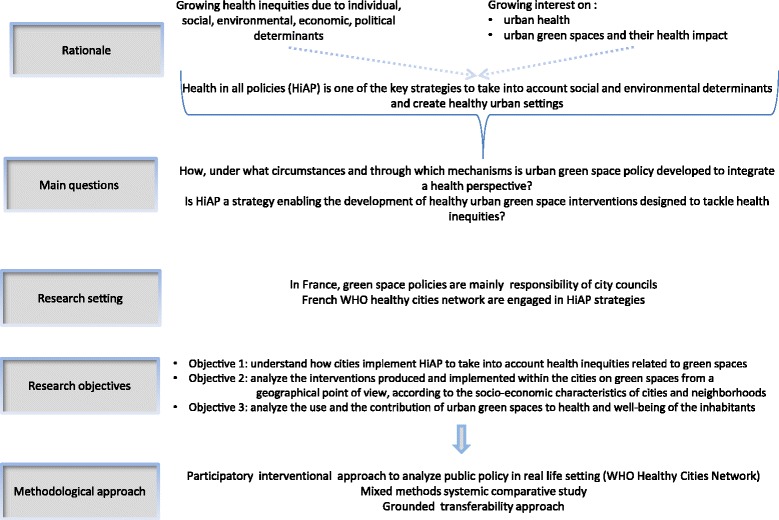
This paper presents the research protocol of the GoveRnance for Equity, EnviroNment and Health in the City (GREENH-City) project funded by the National Institute for Cancer (Subvention N°2017-003-INCA). In France, health inequities have tended to increase since the late 1980s. Numerous studies show the influence of social, economic, geographic and political determinants on health inequities across the life course. Exposure to environmental factors is uneven across the population and may impact on health and health inequities. In cities, green spaces contribute to creating healthy settings which may help tackle health inequities. Health in All Policies (HiAP) represents one of the key strategies for addressing social and environmental determinants of health inequities. The objective of this research is to identify the most promising interventions to operationalize the HiAP approaches at the city level to tackle health inequities through urban green spaces. It is a participatory interventional research to analyze public policy in real life setting (WHO Healthy Cities).
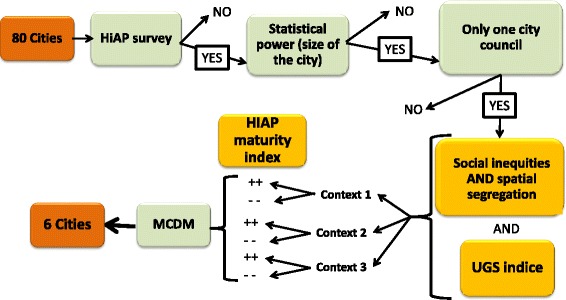
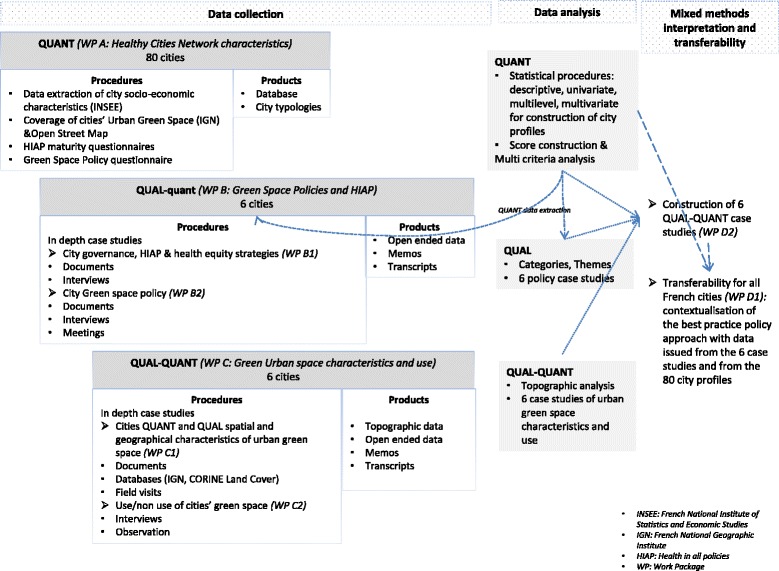
METHOD/DESIGN: It is a mixed method systemic study with a quantitative approach for the 80 cities and a comparative qualitative multiple case-studies of 6 cities. The research combines 3 different lens: 1/a political analysis of how municipalities apply HiAP to reduce social inequities of health through green space policies and interventions 2/a geographical and topological characterization of green spaces and 3/ on-site observations of the use of green spaces by the inhabitants.
City profiles will be identified regarding their HiAP approaches and the extent to which these cities address social inequities in health as part of their green space policy action. The analysis of the transferability of the results will inform policy recommendations in the rest of the Health City Network and widely for the French municipalities.
DISCUSSION/CONCLUSION: The study will help identify factors enabling the implementation of the HiAP approach at a municipal level, promoting the development of green spaces policies in urban areas in order to tackle the social inequities in health.
本文介绍了由国家癌症研究所资助的“城市公平、环境与健康治理(GREENH-City)”项目的研究方案(资助编号:2017-003-INCA)。在法国,自20世纪80年代末以来,健康不平等现象呈上升趋势。大量研究表明,社会、经济、地理和政治因素在整个生命过程中对健康不平等产生影响。人群接触环境因素的情况不均衡,这可能会影响健康及健康不平等。在城市中,绿地有助于营造健康环境,这可能有助于解决健康不平等问题。“健康融入所有政策”(HiAP)是应对健康不平等的社会和环境决定因素的关键策略之一。本研究的目的是确定最有前景的干预措施,以便在城市层面实施HiAP方法,通过城市绿地解决健康不平等问题。这是一项参与性干预研究,旨在分析现实生活环境中的公共政策(世界卫生组织健康城市)。
方法/设计:这是一项混合方法的系统研究,对80个城市采用定量方法,对6个城市进行比较性定性多案例研究。该研究结合了3个不同视角:1/对市政当局如何通过绿地政策和干预措施应用HiAP以减少健康方面的社会不平等进行政治分析;2/对绿地进行地理和拓扑特征描述;3/对居民使用绿地的情况进行实地观察。
将根据城市的HiAP方法以及这些城市在多大程度上把解决健康方面的社会不平等作为其绿地政策行动的一部分来确定城市概况。对结果可转移性的分析将为健康城市网络其他地区以及法国各市政当局的政策建议提供参考。
讨论/结论:该研究将有助于确定在市政层面实施HiAP方法的推动因素,促进城市地区绿地政策的制定,以解决健康方面的社会不平等问题。