Fafenrot Susanna, Grimmelsmann Nils, Wortmann Martin, Ehrmann Andrea
Faculty of Engineering and Mathematics, Bielefeld University of Applied Sciences, 33619 Bielefeld, Germany.
Materials (Basel). 2017 Oct 19;10(10):1199. doi: 10.3390/ma10101199.
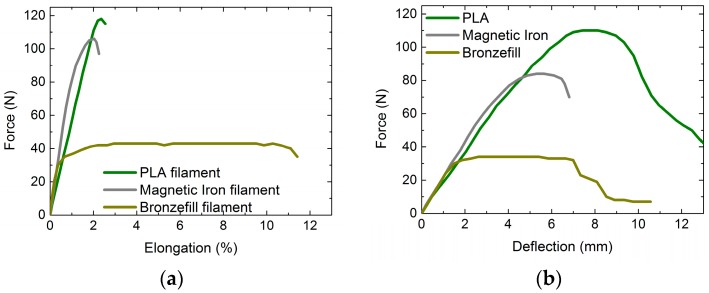
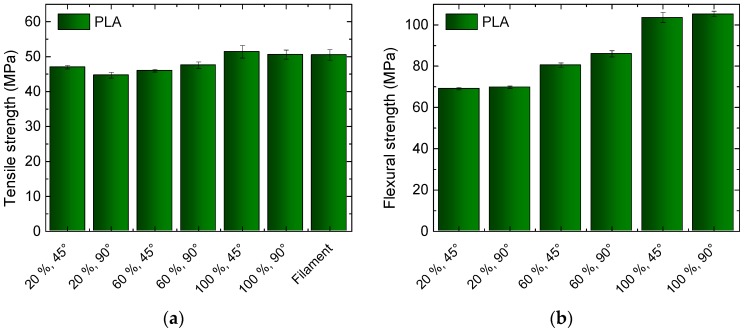
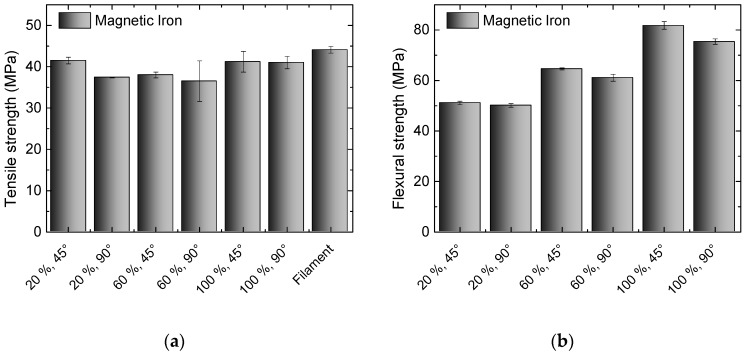
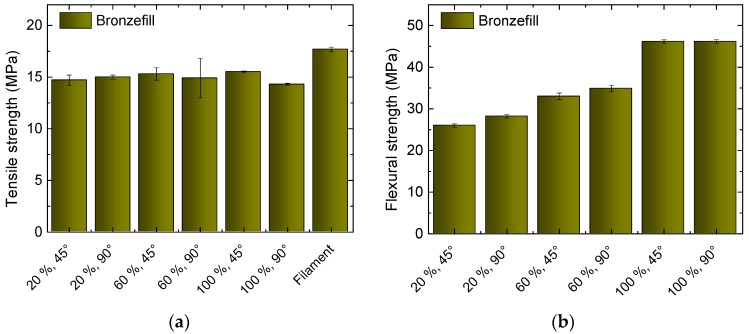
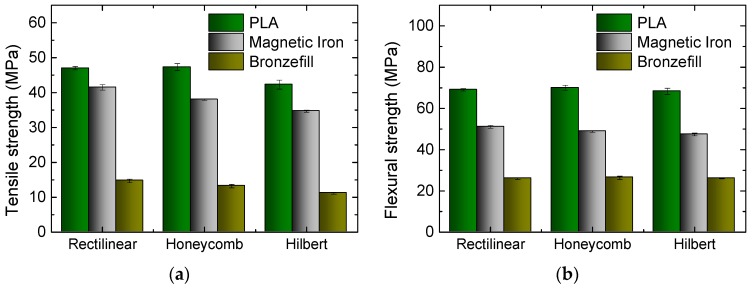
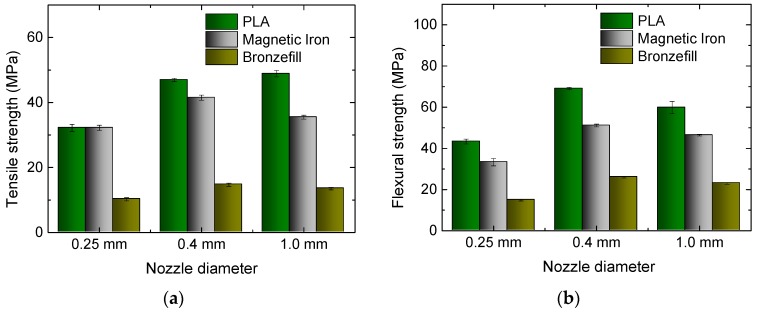
Fused deposition modeling (FDM) is a three-dimensional (3D) printing technology that is usually performed with polymers that are molten in a printer nozzle and placed line by line on the printing bed or the previous layer, respectively. Nowadays, hybrid materials combining polymers with functional materials are also commercially available. Especially combinations of polymers with metal particles result in printed objects with interesting optical and mechanical properties. The mechanical properties of objects printed with two of these metal-polymer blends were compared to common poly (lactide acid) (PLA) printed objects. Tensile tests and bending tests show that hybrid materials mostly containing bronze have significantly reduced mechanical properties. Tensile strengths of the 3D-printed objects were unexpectedly nearly identical with those of the original filaments, indicating sufficient quality of the printing process. Our investigations show that while FDM printing allows for producing objects with mechanical properties similar to the original materials, metal-polymer blends cannot be used for the rapid manufacturing of objects necessitating mechanical strength.
熔融沉积建模(FDM)是一种三维(3D)打印技术,通常使用在打印机喷嘴中熔化的聚合物,分别逐行放置在打印床或前一层上。如今,将聚合物与功能材料结合的混合材料也已商业化。特别是聚合物与金属颗粒的组合会产生具有有趣光学和机械性能的打印物体。将用其中两种金属 - 聚合物共混物打印的物体的机械性能与普通聚乳酸(PLA)打印物体进行了比较。拉伸试验和弯曲试验表明,主要含有青铜的混合材料的机械性能显著降低。3D打印物体的拉伸强度意外地与原始长丝的拉伸强度几乎相同,表明打印过程质量足够。我们的研究表明,虽然FDM打印能够生产出具有与原始材料相似机械性能的物体,但金属 - 聚合物共混物不能用于快速制造需要机械强度的物体。