Martenies Sheena E, Milando Chad W, Williams Guy O, Batterman Stuart A
Environmental Health Sciences, University of Michigan School of Public Health, 1415 Washington Heights, Ann Arbor, MI 48109, USA.
Detroiters Working for Environmental Justice, 4750 Woodward Ave., Suite 415, Detroit, MI 48201, USA.
Int J Environ Res Public Health. 2017 Oct 19;14(10):1243. doi: 10.3390/ijerph14101243.
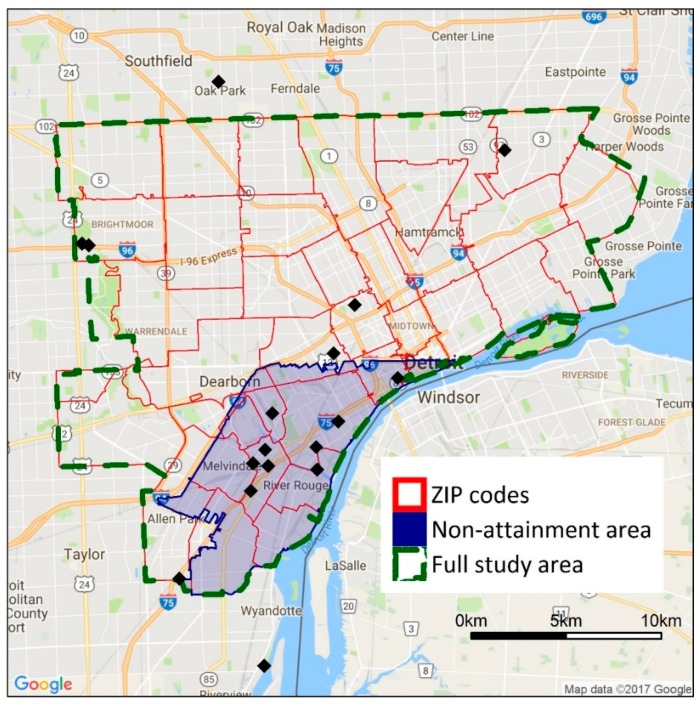
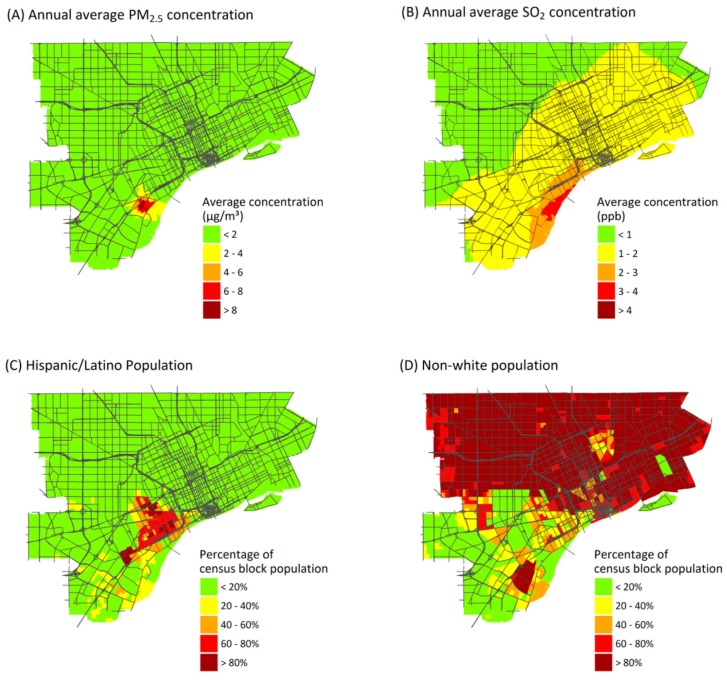
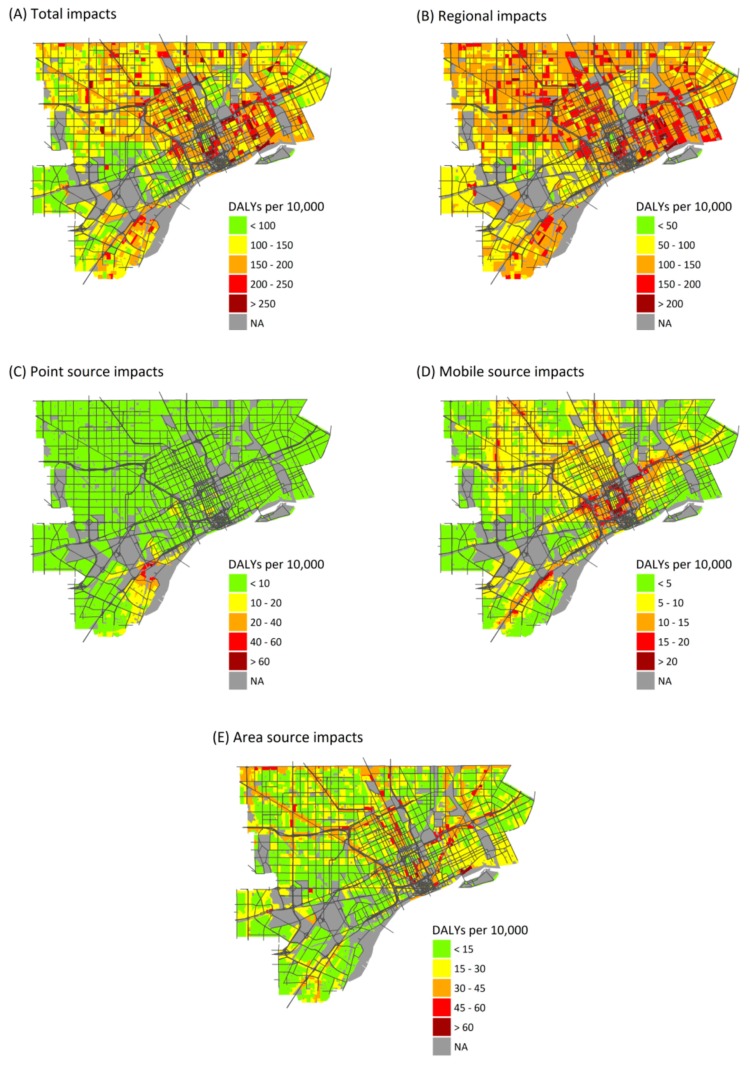
The environmental burden of disease is the mortality and morbidity attributable to exposures of air pollution and other stressors. The inequality metrics used in cumulative impact and environmental justice studies can be incorporated into environmental burden studies to better understand the health disparities of ambient air pollutant exposures. This study examines the diseases and health disparities attributable to air pollutants for the Detroit urban area. We apportion this burden to various groups of emission sources and pollutants, and show how the burden is distributed among demographic and socioeconomic subgroups. The analysis uses spatially-resolved estimates of exposures, baseline health rates, age-stratified populations, and demographic characteristics that serve as proxies for increased vulnerability, e.g., race/ethnicity and income. Based on current levels, exposures to fine particulate matter (PM), ozone (O₃), sulfur dioxide (SO₂), and nitrogen dioxide (NO₂) are responsible for more than 10,000 disability-adjusted life years (DALYs) per year, causing an annual monetized health impact of $6.5 billion. This burden is mainly driven by PM and O₃ exposures, which cause 660 premature deaths each year among the 945,000 individuals in the study area. NO₂ exposures, largely from traffic, are important for respiratory outcomes among older adults and children with asthma, e.g., 46% of air-pollution related asthma hospitalizations are due to NO₂ exposures. Based on quantitative inequality metrics, the greatest inequality of health burdens results from industrial and traffic emissions. These metrics also show disproportionate burdens among Hispanic/Latino populations due to industrial emissions, and among low income populations due to traffic emissions. Attributable health burdens are a function of exposures, susceptibility and vulnerability (e.g., baseline incidence rates), and population density. Because of these dependencies, inequality metrics should be calculated using the attributable health burden when feasible to avoid potentially underestimating inequality. Quantitative health impact and inequality analyses can inform health and environmental justice evaluations, providing important information to decision makers for prioritizing strategies to address exposures at the local level.
疾病的环境负担是指因接触空气污染和其他应激源而导致的死亡率和发病率。累积影响和环境正义研究中使用的不平等指标可纳入环境负担研究,以更好地了解环境空气污染物暴露造成的健康差异。本研究调查了底特律市区因空气污染物导致的疾病和健康差异。我们将这一负担分摊到不同的排放源和污染物类别,并展示该负担在人口和社会经济亚组中的分布情况。该分析使用了空间分辨率的暴露估计值、基线健康率、年龄分层人口以及作为易感性增加代理指标的人口特征,如种族/族裔和收入。根据当前水平,接触细颗粒物(PM)、臭氧(O₃)、二氧化硫(SO₂)和二氧化氮(NO₂)每年导致超过10000个伤残调整生命年(DALYs),造成每年65亿美元的货币化健康影响。这一负担主要由PM和O₃暴露驱动,它们每年在研究区域的94.5万人中导致660例过早死亡。NO₂暴露主要来自交通,对老年人和哮喘儿童的呼吸结局很重要,例如,46%的与空气污染相关的哮喘住院病例是由NO₂暴露导致的。基于定量不平等指标,健康负担的最大不平等源于工业和交通排放。这些指标还显示,由于工业排放,西班牙裔/拉丁裔人群负担过重,由于交通排放,低收入人群负担过重。可归因的健康负担是暴露、易感性和脆弱性(如基线发病率)以及人口密度的函数。由于这些依存关系,应在可行时使用可归因的健康负担来计算不平等指标,以避免潜在地低估不平等。定量健康影响和不平等分析可为健康和环境正义评估提供信息,为决策者在地方层面优先制定应对暴露的策略提供重要信息。