Ndombo Paul Koki, Ndze Valantine N, Fokunang Charles, Ashukem Taku Nadesh, Boula Angeline, Kinkela Mina N, Ndode Corlins E, Seheri Mapaseka L, Bowen Michael D, Waku-Kouomou Diane, Esona Mathew D
Faculty of Medicine and Biomedical Sciences, University of Yaoundé I, Yaounde, Cameroon, South Africa.
Rotavirus National Reference Laboratory, Mother and Child Centre of the Chantal Biya Foundation, Yaoundé, Cameroon, South Africa.
Virology (Lond). 2017 Aug;1(4). doi: 10.15761/VRR.1000120. Epub 2017 Jul 25.
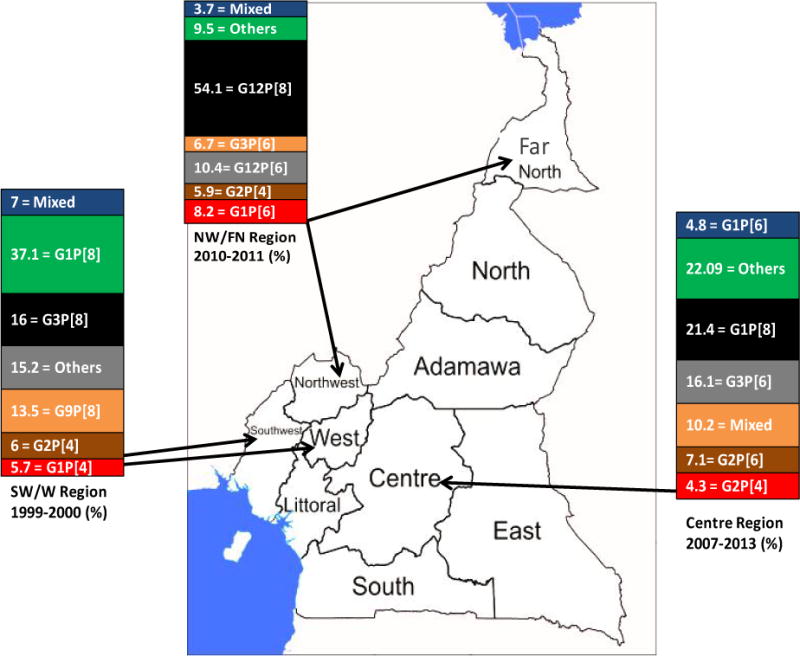
The aim of this review was to assess all the studies on rotavirus G and P characterization during the pre-vaccine period (1999-2013) in Cameroon to have a better basis for post-vaccine introduction evaluations. A retrospective study was done through a comprehensive review of published (PubMed, Google Scholar) and accessible unpublished data on rotavirus G and P genotypes circulating in five regions of Cameroon. Descriptive data were expressed as frequencies tables and proportions. A total of 1844 rotavirus positive cases were analyzed. In all, 1534 strains were characterized for the P (VP4) specificity. Six different VP4 genotypes were observed, including P [4], P [6], P [8], P [9], P [10] and P [14]. The most predominant P genotypes were P [8] at 42.6%, and P [6] at 37.9%. Mixed infections were observed at 5.3%, whereas 4.1% of the strains were P non-typeable. A total of 1518 rotavirus strains were characterized for the G (VP7) specificity. VP7 genotypes G1, G2, G3, G4, G5, G6, G8, G9, G10 and G12 were observed. G1 (35.3%), G3 (19.5%), G2 (14.9%) and G12 (10.1%) were the predominant G genotypes while G5 and G10 were least prevalent at 0.06% each. Approximately 5.1% of all strains were G non-typeable whereas 5.3% were mixed G genotypes. A total of 1472 strains were characterized for both G and P genes, from which 38 different G-P combinations were observed. Overall, G1P [8] (22%) was identified as the predominant rotavirus strain circulating in Cameroon followed by G3P [6] (15%). In conclusion, we observed that the genotypes identified in Cameroon during 1999-2013 were partially covered by the two WHO recommended rotavirus vaccines. This review provides comprehensive up-to-date information on rotavirus strain surveillance in Cameroon during the pre-vaccination era.
本综述的目的是评估喀麦隆疫苗接种前时期(1999 - 2013年)所有关于轮状病毒G和P特征的研究,以便为疫苗接种后引入评估提供更好的依据。通过全面回顾喀麦隆五个地区已发表(PubMed、谷歌学术)和可获取的未发表的关于轮状病毒G和P基因型的数据,进行了一项回顾性研究。描述性数据以频率表和比例表示。共分析了1844例轮状病毒阳性病例。总共对1534株病毒进行了P(VP4)特异性鉴定。观察到六种不同的VP4基因型,包括P[4]、P[6]、P[8]、P[9]、P[10]和P[14]。最主要的P基因型是P[8],占42.6%,P[6]占37.9%。观察到混合感染率为5.3%,而4.1%的菌株无法进行P分型。总共对1518株轮状病毒进行了G(VP7)特异性鉴定。观察到VP7基因型有G1、G2、G3、G4、G5、G6、G8、G9、G10和G12。G1(35.3%)、G3(19.5%)、G2(14.9%)和G12(10.1%)是主要的G基因型,而G5和G10最不常见,各占0.06%。所有菌株中约5.1%无法进行G分型,而5.3%为混合G基因型。总共对1472株病毒进行了G和P基因鉴定,从中观察到38种不同的G - P组合。总体而言,G1P[8](22%)被确定为喀麦隆流行的主要轮状病毒株,其次是G3P[6](15%)。总之,我们观察到1999 - 2013年在喀麦隆鉴定出的基因型被世界卫生组织推荐的两种轮状病毒疫苗部分覆盖。本综述提供了喀麦隆疫苗接种前时代轮状病毒株监测的全面最新信息。