Farr Institute, Scottish Collaboration for Public Health Research and Policy, University of Edinburgh, Edinburgh, UK.
Institute of Health and Wellbeing, University of Glasgow, Glasgow, UK.
J Epidemiol Community Health. 2018 Jan;72(1):27-33. doi: 10.1136/jech-2017-208995. Epub 2017 Oct 22.
This paper examines socioeconomic inequalities in mental health at school entry and explores changes in these inequalities over the first 3 years of school.
The study utilises routinely collected mental health data from education records and demographic data at ages 4 and 7 years, along with administrative school-level data. The study was set in preschool establishments and schools in Glasgow City, Scotland. Data were available on 4011 children (59.4%)at age 4 years, and 3166 of these children were followed at age 7 years (46.9% of the population). The main outcome measure was the teacher-rated Goodman's Strengths and Difficulties Questionnaire (4-16 version) at age 7 years, which measures social, emotional and behavioural difficulties.
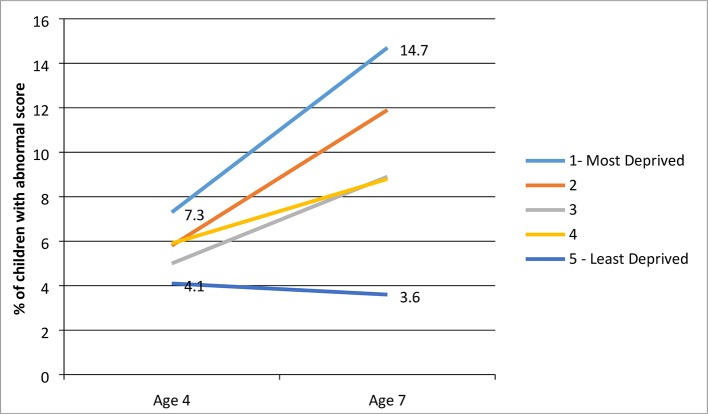
Children living in the most deprived area had higher levels of mental health difficulties at age 4 years, compared with their most affluent counterparts (7.3%vs4.1% with abnormal range scores). There was a more than threefold widening of this disparity over time, so that by the age of 7 years, children from the most deprived area quintile had rates of difficulties 3.5 times higher than their more affluent peers. Children's demographic backgrounds strongly predicted their age 7 scores, although schools appeared to make a significant contribution to mental health trajectories.
Additional support to help children from disadvantaged backgrounds at preschool and in early primary school may help narrow inequalities. Children from disadvantaged backgrounds started school with a higher prevalence of mental health difficulties, compared with their more advantaged peers, and this disparity widened markedly over the first 3 years of school.
本文研究了入学时心理健康方面的社会经济不平等现象,并探讨了这些不平等现象在学校头 3 年期间的变化。
本研究利用了从苏格兰格拉斯哥市的学前教育机构和学校收集到的常规教育记录中的心理健康数据以及人口统计数据,并在年龄为 4 岁和 7 岁时使用了行政学校数据。4 岁时有 4011 名儿童(59.4%)的数据可用,其中 3166 名儿童在 7 岁时进行了随访(占总人口的 46.9%)。主要结局指标是 7 岁时教师评定的 Goodman's Strengths and Difficulties Questionnaire(4-16 版本),该问卷衡量社交、情绪和行为困难。
与最富裕的同龄人相比,生活在最贫困地区的儿童在 4 岁时的心理健康问题更为严重(异常范围评分分别为 7.3%和 4.1%)。随着时间的推移,这种差距扩大了三倍多,以至于到 7 岁时,最贫困地区五分位数的儿童的困难发生率是其富裕同龄人 的 3.5 倍。儿童的人口统计学背景强烈预测了他们在 7 岁时的得分,尽管学校似乎对心理健康轨迹产生了重大影响。
为在学前和小学早期处于不利地位的儿童提供额外的支持,可能有助于缩小不平等差距。与他们更有优势的同龄人相比,处于不利背景的儿童在入学时就已经出现了更高的心理健康问题发生率,而且这种差距在学校的头 3 年中明显扩大。