Kellner M, Porseryd T, Porsch-Hällström I, Borg B, Roufidou C, Olsén K H
School of Natural Sciences, Technology and Environmental Studies, Södertörn University, Alfred Nobels allé 7, SE-141 89, Huddinge, Sweden.
Department of Zoology, Stockholm University, Svante Arrhenius väg 18 B, SE-106 91, Stockholm, Sweden.
Ecotoxicology. 2018 Jan;27(1):12-22. doi: 10.1007/s10646-017-1866-4. Epub 2017 Oct 23.
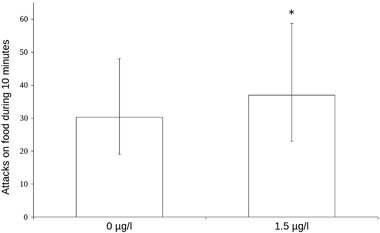
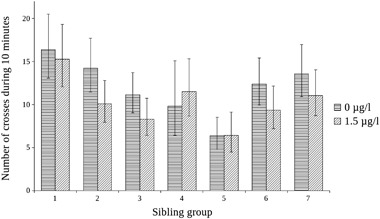
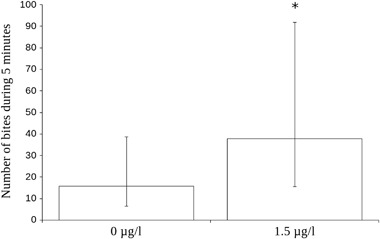
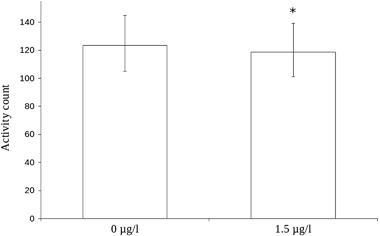
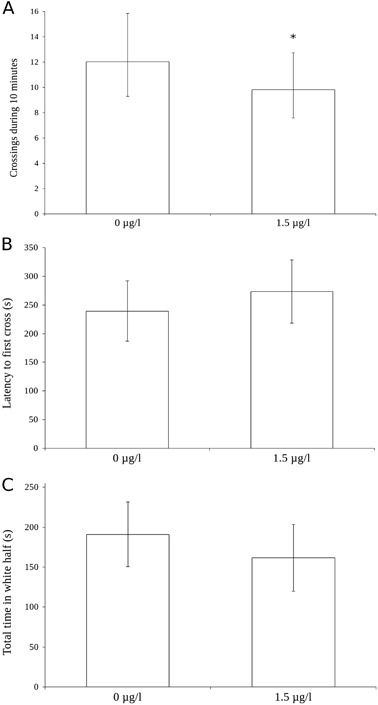
Selective Serotonin re-uptake inhibitors (SSRIs) are a class of psychotropic drugs used to treat depression in both adolescents and pregnant or breast-feeding mothers as well as in the general population. Recent research on rodents points to long-lasting behavioural effects of pre- and perinatal exposure to SSRIs which last into adulthood. In fish however, studies on effects of developmental exposure to SSRIs appears to be non-existent. In order to study effects of developmental SSRI exposure in fish, three-spine sticklebacks were exposed to 1.5 µg/l of the SSRI citalopram in the ambient water for 30 days, starting two days post-fertilisation. After approximately 100 days of remediation in clean water the fish were put through an extensive battery of behavioural tests. Feeding behaviour was tested as the number of bites against a piece of food and found to be increased in the exposed fish. Aggression levels were measured as the number of bites against a mirror image during 10 min and was also found to be significantly increased in the exposed fish. Novel tank behaviour and locomotor activity was tested in an aquarium that had a horizontal line drawn half-way between the bottom and the surface. Neither the latency to the first transition to the upper half, nor the number of transitions or the total time spent in the upper half was affected by treatment. Locomotor activity was significantly reduced in the exposed fish. The light/dark preference was tested in an aquarium where the bottom and walls were black on one side and white on the other. The number of transitions to the white side was significantly reduced in the exposed fish but there was no effect on the latency to the first transition or the total time spent in the white half. The results in the current study indicate that developmental SSRI exposure causes long-lasting behavioural effects in fish and contribute to the existing knowledge about SSRIs as environmental pollutants.
选择性5-羟色胺再摄取抑制剂(SSRIs)是一类精神药物,用于治疗青少年、怀孕或哺乳期母亲以及普通人群的抑郁症。最近对啮齿动物的研究表明,产前和围产期接触SSRIs会产生持续到成年期的长期行为影响。然而,在鱼类中,关于发育过程中接触SSRIs影响的研究似乎并不存在。为了研究发育过程中接触SSRIs对鱼类的影响,从受精后两天开始,将三刺鱼在环境水中暴露于1.5μg/l的SSRI西酞普兰中30天。在清洁水中经过大约100天的修复后,对这些鱼进行了一系列广泛的行为测试。以对一块食物的咬食次数来测试摄食行为,发现暴露组的鱼咬食次数增加。以10分钟内对镜像的咬食次数来测量攻击水平,也发现暴露组的鱼显著增加。在一个底部和水面中间画有一条水平线的水族箱中测试新环境行为和运动活动。处理对首次向上半部分过渡的潜伏期、过渡次数或在上半部分花费的总时间均无影响。暴露组的鱼运动活动显著减少。在一个水族箱中测试明暗偏好,水族箱一侧的底部和墙壁是黑色的,另一侧是白色的。暴露组的鱼向白色一侧的过渡次数显著减少,但对首次过渡的潜伏期或在白色半部分花费的总时间没有影响。当前研究的结果表明,发育过程中接触SSRIs会对鱼类产生长期行为影响,并有助于丰富关于SSRIs作为环境污染物的现有知识。