Mahidol-Oxford Tropical Medicine Research Unit, Faculty of Tropical Medicine, Mahidol University, Bangkok, Thailand.
Centre for Tropical Medicine and Global Health, Nuffield Department of Medicine, Churchill Hospital, Oxford, UK.
Malar J. 2017 Oct 23;16(1):424. doi: 10.1186/s12936-017-2070-y.
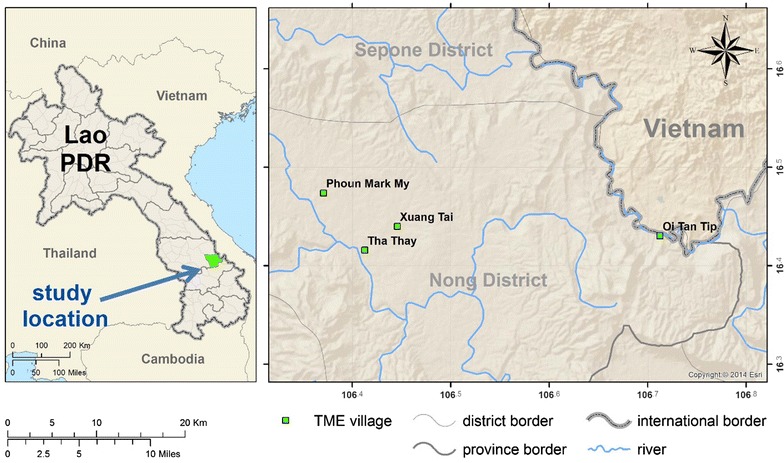
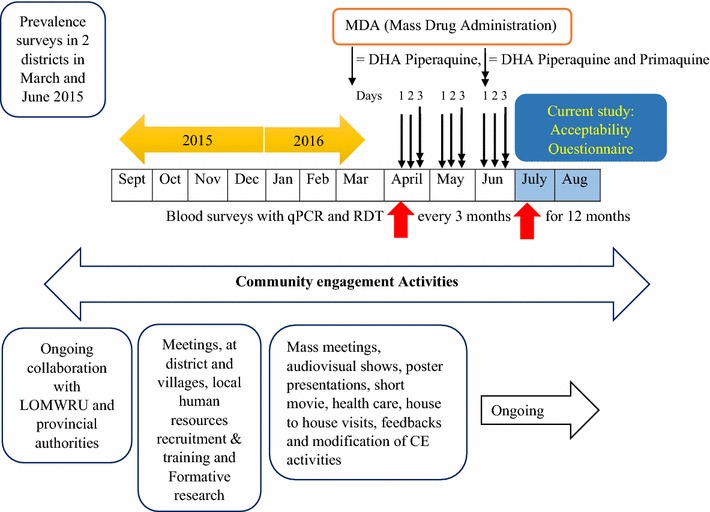
Targeted malaria elimination (TME) in Lao PDR (Laos) included three rounds of mass drug administrations (MDA) against malaria followed by quarterly blood surveys in two villages in Nong District at Savannakhet Province. The success of MDA largely depends upon the efficacy of the anti-malarial drug regimen, local malaria epidemiology and the population coverage. In order to explore the reasons for participation in TME, a quantitative survey was conducted after the completion of the three rounds of MDA.
The survey was conducted in two villages with a total of 158 households in July and August 2016. Among the 973 villagers eligible for participation in the MDA, 158 (16.2%) adults (> 18 years) were selected, one each from every household for the interviews using a quantitative questionnaire.
150/158 (94.9%) respondents participated at least in one activity (taking medicine or testing their blood) of TME. 141/150 (94.0%) respondents took part in the MDA and tested their blood in all three rounds. 17/158 (10.7%) were partial or non-participants in three rounds of MDA. Characteristics of respondents which were independently associated with completion of three rounds of MDA included: attending TME meetings [AOR = 12.0 (95% CI 1.1-20.5) (p = 0.03)], knowing that malaria can be diagnosed through blood tests [AOR = 5.6 (95% CI 1.0-32.3) (p = 0.05)], all members from household participated [AOR = 4.2 (95% CI 1.3-14.0) (p = 0.02)], liking all aspects of TME [AOR = 17.2 (95% CI 1.6-177.9) (p = 0.02)] and the perception that TME was important [AOR = 14.9 (95% CI 1.3-171.2) (p = 0.03)].
Complete participation in TME was significantly associated with participation in community engagement activities, knowledge that the blood tests were for malaria diagnosis, family members' participation at TME and perceptions that TME was worthwhile. A responsive approach to community engagement that includes formative research and the involvement of community members may increase the uptake of the intervention.
老挝的疟疾定点消除(TME)包括三轮大规模药物治疗(MDA),随后在沙拉湾省农区的两个村庄每季度进行一次血液调查。MDA 的成功在很大程度上取决于抗疟药物方案的疗效、当地疟疾流行病学和人群覆盖率。为了探讨参与 TME 的原因,在三轮 MDA 完成后进行了一项定量调查。
该调查于 2016 年 7 月至 8 月在两个村庄进行,共有 158 户家庭。在有资格参加 MDA 的 973 名村民中,从每个家庭中各选择了 158 名(18 岁以上)成年人进行访谈,使用定量问卷进行调查。
158 名受访者中有 150 名(94.9%)至少参加了 TME 的一项活动(服药或检测血液)。141 名受访者(94.0%)参加了三轮 MDA,并在三轮中均检测了血液。17 名受访者(10.7%)是三轮 MDA 的部分或非参与者。与完成三轮 MDA 独立相关的受访者特征包括:参加 TME 会议(AOR=12.0(95%CI 1.1-20.5)(p=0.03))、知道疟疾可以通过血液检测诊断(AOR=5.6(95%CI 1.0-32.3)(p=0.05))、家庭所有成员都参加(AOR=4.2(95%CI 1.3-14.0)(p=0.02))、喜欢 TME 的所有方面(AOR=17.2(95%CI 1.6-177.9)(p=0.02))和认为 TME 很重要(AOR=14.9(95%CI 1.3-171.2)(p=0.03))。
完全参与 TME 与社区参与活动的参与、知道血液检测是为了诊断疟疾、家庭成员参与 TME 以及认为 TME 值得参与显著相关。对社区参与采取响应式方法,包括开展形成性研究和让社区成员参与,可能会提高干预措施的接受程度。