Pell Christopher, Tripura Rupam, Nguon Chea, Cheah Phaikyeong, Davoeung Chan, Heng Chhouen, Dara Lim, Sareth Ma, Dondorp Arjen, von Seidlein Lorenz, Peto Thomas J
Centre for Social Science and Global Health, University of Amsterdam, Amsterdam, The Netherlands.
Amsterdam Institute for Global Health and Development, Amsterdam, The Netherlands.
Malar J. 2017 May 19;16(1):206. doi: 10.1186/s12936-017-1854-4.
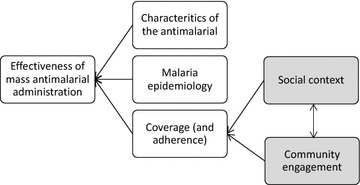
Mass anti-malarial administration has been proposed as a key component of the Plasmodium falciparum malaria elimination strategy in the Greater Mekong sub-Region. Its effectiveness depends on high levels of coverage in the target population. This article explores the factors that influenced mass anti-malarial administration coverage within a clinical trial in Battambang Province, western Cambodia.
Qualitative data were collected through semi-structured interviews and focus group discussions with villagers, in-depth interviews with study staff, trial drop-outs and refusers, and observations in the communities. Interviews were audio-recorded, transcribed and translated from Khmer to English for qualitative content analysis using QSR NVivo.
Malaria was an important health concern and villagers reported a demand for malaria treatment. This was in spite of a fall in incidence over the previous decade and a lack of familiarity with asymptomatic malaria. Participants generally understood the overall study aim and were familiar with study activities. Comprehension of the study rationale was however limited. After the first mass anti-malarial administration, seasonal health complaints that participants attributed to the anti-malarial as "side effects" contributed to a decrease of coverage in round two. Staff therefore adapted the community engagement approach, bringing to prominence local leaders in village meetings. This contributed to a subsequent increase in coverage.
Future mass anti-malarial administration must consider seasonal disease patterns and the importance of local leaders taking prominent roles in community engagement. Further research is needed to investigate coverage in scenarios that more closely resemble implementation i.e. without participation incentives, blood sampling and free healthcare.
大规模抗疟药物发放已被提议作为大湄公河次区域消除恶性疟原虫疟疾战略的关键组成部分。其有效性取决于目标人群的高覆盖率。本文探讨了柬埔寨西部马德望省一项临床试验中影响大规模抗疟药物发放覆盖率的因素。
通过与村民进行半结构化访谈和焦点小组讨论、对研究人员、试验退出者和拒绝者进行深入访谈以及在社区进行观察来收集定性数据。访谈进行了录音,转录后从高棉语翻译成英语,使用QSR NVivo进行定性内容分析。
疟疾是一个重要的健康问题,村民们表示有治疗疟疾的需求。尽管过去十年发病率有所下降,且对无症状疟疾缺乏了解,但情况依然如此。参与者总体上理解研究的总体目标,并熟悉研究活动。然而,对研究基本原理的理解有限。在首次大规模抗疟药物发放后,参与者将季节性健康问题归因于抗疟药物的“副作用”,这导致第二轮覆盖率下降。因此,工作人员调整了社区参与方式,在村民会议上突出当地领导人的作用。这促成了随后覆盖率的提高。
未来的大规模抗疟药物发放必须考虑季节性疾病模式以及当地领导人在社区参与中发挥突出作用的重要性。需要进一步研究以调查在更接近实际实施的情况下的覆盖率,即没有参与激励措施、血液采样和免费医疗的情况。