Thompson Jacqueline Yewande, Byrne Christopher, Williams Mark A, Keene David J, Schlussel Micheal Maia, Lamb Sarah E
Nuffield Department of Orthopaedics Rheumatology and Musculoskeletal Sciences, University of Oxford, Oxford, UK.
School of Health Professions, Faculty of Health and Human Sciences, Plymouth University, Plymouth, UK.
BMC Musculoskelet Disord. 2017 Oct 23;18(1):421. doi: 10.1186/s12891-017-1777-9.
One-third of individuals who sustain an acute lateral ankle ligament sprain suffer significant disability due to pain, functional instability, mechanical instability or recurrent sprain after recovery plateaus at 1 to 5 years post injury. The identification of early prognostic factors associated with poor recovery may provide an opportunity for early-targeted intervention and improve outcome.
We performed a comprehensive search of AMED, EMBASE, Psych Info, CINAHL, SportDiscus, PubMed, CENTRAL, PEDro, OpenGrey, abstracts and conference proceedings from inception to September 2016. Prospective studies investigating the association between baseline prognostic factors and recovery over time were included. Two independent assessors performed the study selection, data extraction and quality assessment of the studies. A narrative synthesis is presented due to inability to meta-analyse results due to clinical and statistical heterogeneity.
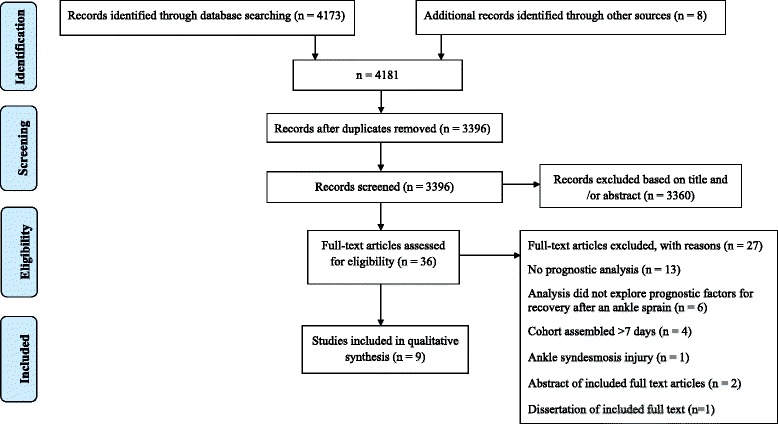
The search strategy yielded 3396 titles/abstracts after duplicates were removed. Thirty-six full text articles were then assessed, nine of which met the study inclusion criteria. Six were prospective cohorts, and three were secondary analyses of randomised controlled trials. Results are presented for nine studies that presented baseline prognostic factors for recovery after an acute ankle sprain. Age, female gender, swelling, restricted range of motion, limited weight bearing ability, pain (at the medial joint line and on weight-bearing dorsi-flexion at 4 weeks, and pain at rest at 3 months), higher injury severity rating, palpation/stress score, non-inversion mechanism injury, lower self-reported recovery, re-sprain within 3 months, MRI determined number of sprained ligaments, severity and bone bruise were found to be independent predictors of poor recovery. Age was one prognostic factor that demonstrated a consistent association with outcome in three studies, however cautious interpretation is advised.
The associations between prognostic factors and poor recovery after an acute lateral ankle sprain are largely inconclusive. At present, there is insufficient evidence to recommend any factor as an independent predictor of outcome. There is a need for well-conducted prospective cohort studies with adequate sample size and long-term follow-up to provide robust evidence on prognostic factors of recovery following an acute lateral ankle sprain.
Prospero registration: CRD42014014471.
在急性外侧踝关节韧带扭伤患者中,三分之一的人在受伤后1至5年恢复平稳期后,因疼痛、功能不稳定、机械性不稳定或反复扭伤而出现严重残疾。识别与恢复不佳相关的早期预后因素,可能为早期靶向干预提供机会并改善预后。
我们对AME D、EMBASE、Psych Info、CINAHL、SportDiscus、PubMed、CENTRAL、PEDro、OpenGrey以及自创建至2016年9月的摘要和会议记录进行了全面检索。纳入了调查基线预后因素与随时间恢复之间关联的前瞻性研究。两名独立评估人员对研究进行了选择、数据提取和质量评估。由于临床和统计异质性无法进行荟萃分析,因此进行了叙述性综合分析。
去除重复项后,检索策略产生了3396个标题/摘要。随后评估了36篇全文文章,其中9篇符合研究纳入标准。6项为前瞻性队列研究,3项为随机对照试验的二次分析。给出了9项研究的结果,这些研究呈现了急性踝关节扭伤后恢复的基线预后因素。年龄、女性性别、肿胀、活动范围受限、负重能力有限、疼痛(4周时在内侧关节线处及负重背屈时的疼痛,以及3个月时静息时的疼痛)、损伤严重程度评分较高、触诊/应力评分、非内翻机制损伤、自我报告的恢复情况较差、3个月内再次扭伤、MRI确定的扭伤韧带数量、严重程度和骨挫伤被发现是恢复不佳的独立预测因素。年龄是一个预后因素,在三项研究中与结果显示出一致的关联,但建议谨慎解读。
急性外侧踝关节扭伤后预后因素与恢复不佳之间的关联在很大程度上尚无定论。目前,没有足够的证据推荐任何因素作为结果的独立预测指标。需要进行样本量充足且长期随访的高质量前瞻性队列研究,以提供关于急性外侧踝关节扭伤后恢复预后因素的有力证据。
Prospero注册:CRD42014014471。