Sigma-Tau Industrie Farmaceutiche Riunite S.p.A., Rome, Italy.
Centro de Investigação em Saúde de Manhiça, Maputo, Mozambique.
Antimicrob Agents Chemother. 2017 Dec 21;62(1). doi: 10.1128/AAC.00596-17. Print 2018 Jan.
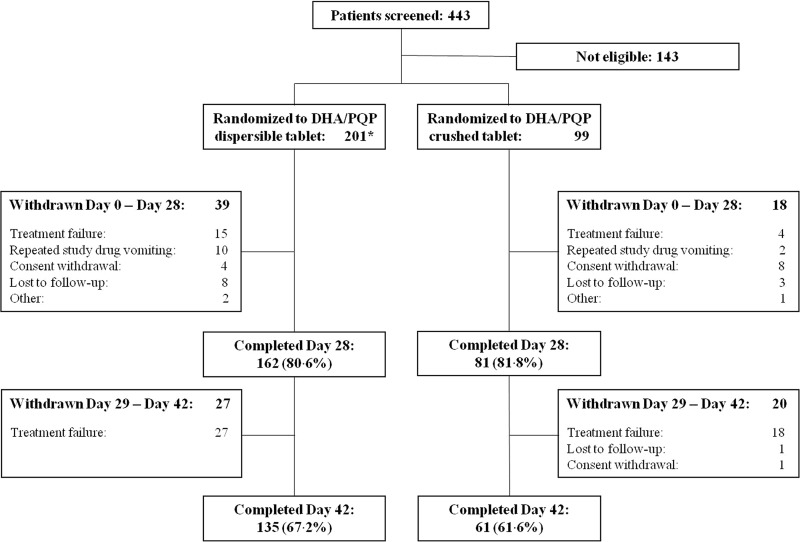
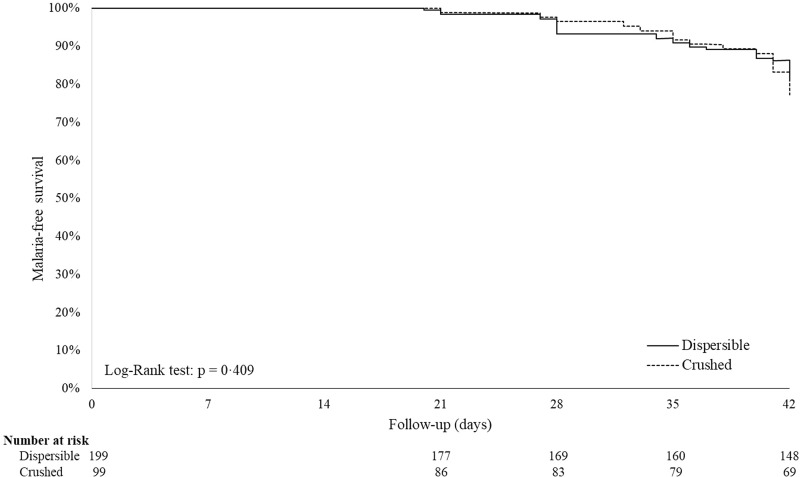
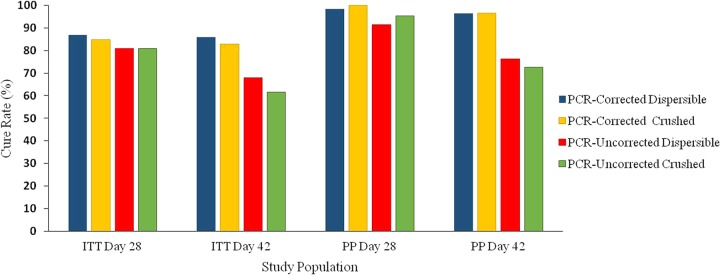
Artemisinin combination therapies are considered the mainstay of malaria treatment, but pediatric-friendly formulations for the treatment of infants are scarce. We sought to evaluate the efficacy and safety of a new dispersible-tablet formulation of dihydroartemisinin/piperaquine phosphate (DHA/PQP) in comparison to the marketed tablet (Eurartesim) in the treatment of infants with uncomplicated malaria. Reported here are the results of a large phase II, randomized, open-label, multicenter trial conducted in African infants (6 to 12 months of age) from Mozambique, Burkina Faso, The Gambia, the Democratic Republic of the Congo, and Tanzania. Primary efficacy endpoint was the PCR-corrected adequate clinical and parasitological response (ACPR) at day 28. Analysis was performed for the intention-to-treat (ITT) and per-protocol (PP) populations. A total of 201 patients received the dispersible-tablet formulation, and 99 received the conventional one administered as crushed tablets. At day 28, the PCR-corrected ACPRs were 86.9% (ITT) and 98.3% (PP) in the dispersible-tablet group and 84.9% (ITT) and 100% (PP) in the crushed-tablet group. At day 42, these values were 85.9% (ITT) and 96.5% (PP) in the dispersible-tablet group and 82.8% (ITT) and 96.4% (PP) in the crushed-tablet group. The comparison between survival curves for time to new infections showed no statistically significant differences ( = 0.409). The safety and tolerability profile for the two groups was similar in terms of type and frequency of adverse events and was consistent with that expected in African infants with malaria. A standard 3-day treatment with the new dispersible DHA/PQP formulation is as efficacious as the currently used tablet in African infants and has a comparable safety profile. (This trial was registered at ClinicalTrials.gov under registration no. NCT01992900.).
青蒿素联合疗法被认为是治疗疟疾的主要方法,但适合儿童使用的婴儿配方制剂却很少。我们旨在评估新型双氢青蒿素/磷酸哌喹分散片(DHA/PQP)与市售片剂(Eurartesim)在治疗患有无并发症疟疾的婴儿方面的疗效和安全性。这里报告的是在莫桑比克、布基纳法索、冈比亚、刚果民主共和国和坦桑尼亚进行的一项大型 II 期、随机、开放标签、多中心试验的结果,该试验纳入了来自这些国家的 6 至 12 个月大的婴儿。主要疗效终点是 28 天时聚合酶链反应(PCR)校正的适当临床和寄生虫学应答(ACPR)。分析采用意向治疗(ITT)和符合方案(PP)人群。共有 201 名患者接受了分散片制剂治疗,99 名患者接受了粉碎后片剂常规治疗。在第 28 天,分散片组的 PCR 校正 ACPR 为 86.9%(ITT)和 98.3%(PP),粉碎片剂组分别为 84.9%(ITT)和 100%(PP)。在第 42 天,分散片组的这些值分别为 85.9%(ITT)和 96.5%(PP),粉碎片剂组分别为 82.8%(ITT)和 96.4%(PP)。比较两组新感染时间的生存曲线,无统计学显著差异(=0.409)。两组的安全性和耐受性相似,表现在不良事件的类型和频率方面,这与在患有疟疾的非洲婴儿中预期的情况一致。新型 3 天 DHA/PQP 分散片标准治疗与目前使用的片剂在非洲婴儿中同样有效,具有相似的安全性。(本试验在 ClinicalTrials.gov 注册,注册号为 NCT01992900.)。