• 文献检索
  • 文档翻译
  • 深度研究
  • 学术资讯
  • Suppr Zotero 插件Zotero 插件
  • 邀请有礼
  • 套餐&价格
  • 历史记录
应用&插件
Suppr Zotero 插件Zotero 插件浏览器插件Mac 客户端Windows 客户端微信小程序
定价
高级版会员购买积分包购买API积分包
服务
文献检索文档翻译深度研究API 文档MCP 服务
关于我们
关于 Suppr公司介绍联系我们用户协议隐私条款
关注我们

Suppr 超能文献

核心技术专利:CN118964589B侵权必究
粤ICP备2023148730 号-1Suppr @ 2026

文献检索

告别复杂PubMed语法,用中文像聊天一样搜索,搜遍4000万医学文献。AI智能推荐,让科研检索更轻松。

立即免费搜索

文件翻译

保留排版,准确专业,支持PDF/Word/PPT等文件格式,支持 12+语言互译。

免费翻译文档

深度研究

AI帮你快速写综述,25分钟生成高质量综述,智能提取关键信息,辅助科研写作。

立即免费体验

益生菌预防机械通气患者呼吸机相关性肺炎:一项采用序贯试验分析的Meta分析

Probiotics for Preventing Ventilator-Associated Pneumonia in Mechanically Ventilated Patients: A Meta-Analysis with Trial Sequential Analysis.

作者信息

Weng Hong, Li Jian-Guo, Mao Zhi, Feng Ying, Wang Chao-Yang, Ren Xue-Qun, Zeng Xian-Tao

机构信息

Center of Evidence Based and Translational Medicine, Zhongnan Hospital of Wuhan University, Wuhan, China.

Department of Urology, Zhongnan Hospital of Wuhan University, Wuhan, China.

出版信息

Front Pharmacol. 2017 Oct 9;8:717. doi: 10.3389/fphar.2017.00717. eCollection 2017.

DOI:10.3389/fphar.2017.00717
PMID:29062279
原文链接:https://pmc.ncbi.nlm.nih.gov/articles/PMC5640711/
Abstract

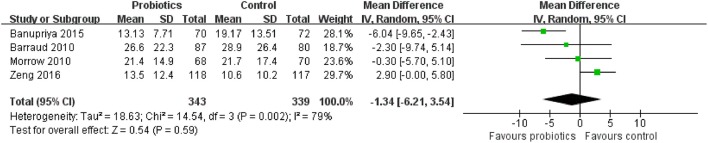
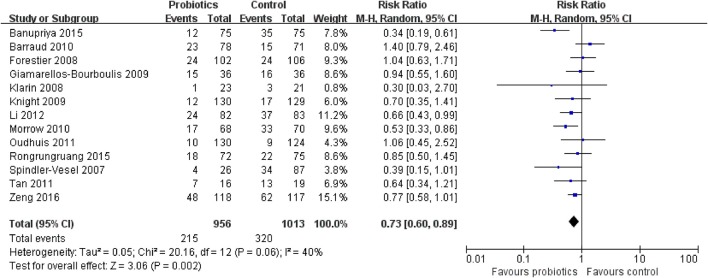
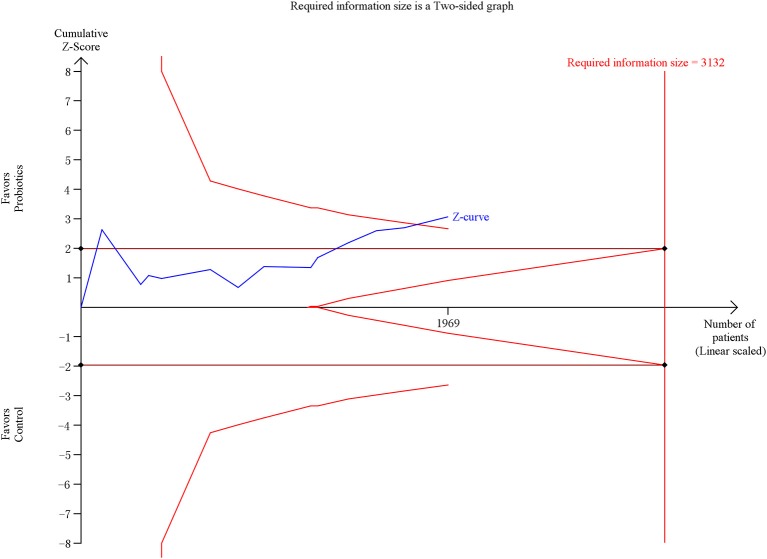
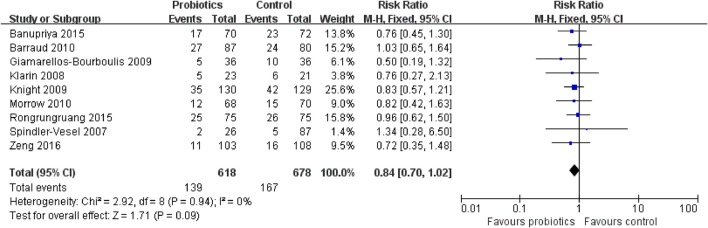
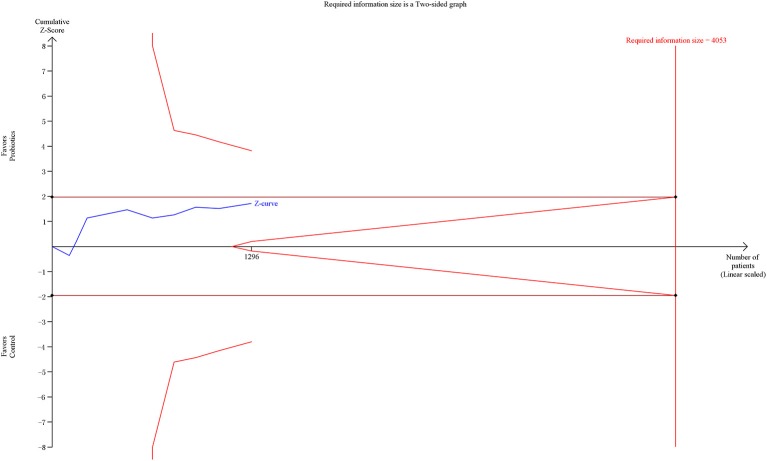
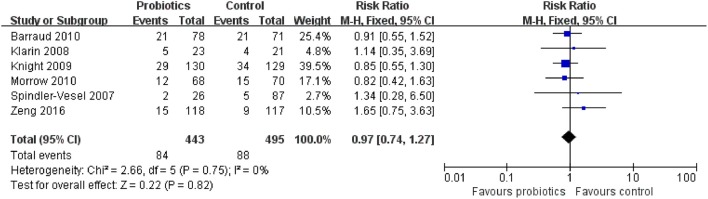
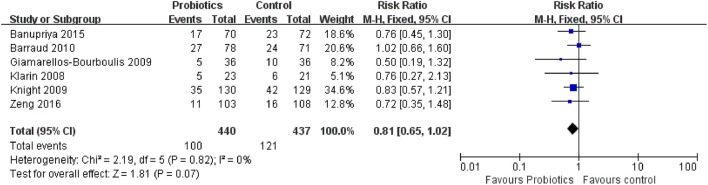
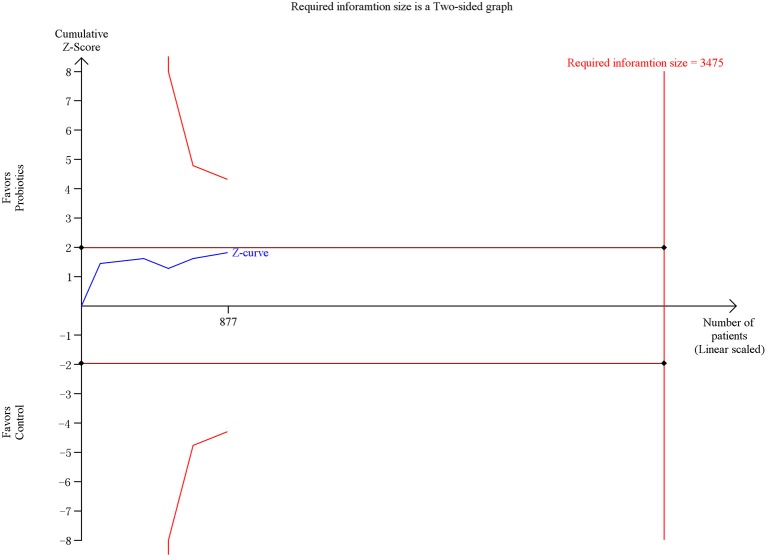
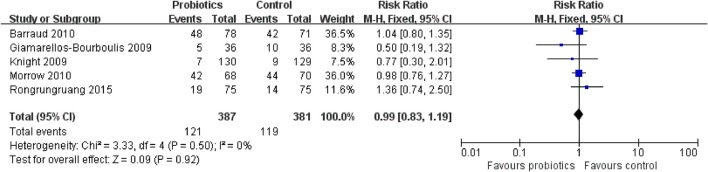
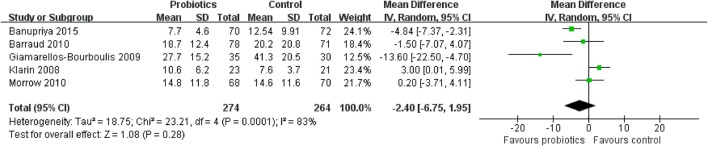
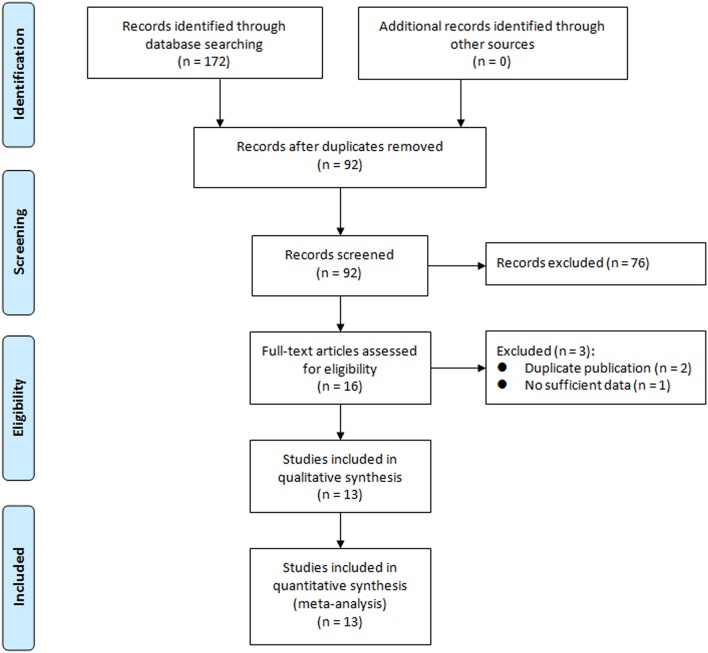
Ventilator-associated pneumonia (VAP) is still an important cause of morbidity and mortality in mechanically ventilated patients. The efficacy of the probiotics for preventing VAP is still controversial. Present study was conducted to comprehensively evaluate the effect of probiotics on VAP prevention in mechanically ventilated patients. PubMed, Embase, and CENTRAL were searched up to September 2016. Eligible trials designed with randomized controlled trials (RCTs) comparing probiotics with control in mechanically ventilated patients were included. Risk ratios (RRs) and mean differences (MDs) with 95% confidence intervals (CIs) were estimated with fixed or random effects models. Trial sequential analysis (TSA) was performed using TSA 0.9beta software. Thirteen RCTs ( = 1969) were included. Overall, probiotics were associated with reduced incidence of VAP (RR = 0.73, 95% CI = 0.60-0.89; = 0.002), which was confirmed by TSA (TSA adjusted 95% CI = 0.55-0.96). However, no significant difference was observed in 90-day mortality (RR = 1.00, 95% CI = 0.72-1.37; = 0.99), overall mortality (RR = 0.84, 95% CI = 0.70-1.02; = 0.09), 28-day mortality (RR = 1.06, 95% CI = 0.72-1.57; = 0.99), intensive care unit (ICU) mortality (RR = 0.97, 95% CI = 0.74-1.27; = 0.82), hospital mortality (RR = 0.81, 95% CI = 0.65-1.02; = 0.07), diarrhea (RR = 0.99, 95% CI = 0.83-1.19; = 0.92), length of ICU stay (MD = -2.40 days, 95% CI = -6.75 to 1.95; = 0.28), length of hospital stay (MD = -1.34 days, 95% CI = -6.21 to 3.54; = 0.59), and duration of mechanical ventilation (MD = -3.32 days, 95% CI = -6.74 to 0.09; = 0.06). In this meta-analysis, we found that probiotics could reduce the incidence of VAP in mechanically ventilated patients. It seems likely that probiotics provide clinical benefits for mechanically ventilated patients.

摘要

呼吸机相关性肺炎(VAP)仍然是机械通气患者发病和死亡的重要原因。益生菌预防VAP的疗效仍存在争议。本研究旨在全面评估益生菌对机械通气患者预防VAP的效果。检索了截至2016年9月的PubMed、Embase和CENTRAL数据库。纳入符合条件的随机对照试验(RCT),比较机械通气患者中益生菌与对照组的情况。采用固定或随机效应模型估计风险比(RRs)和95%置信区间(CIs)的平均差(MDs)。使用TSA 0.9beta软件进行试验序贯分析(TSA)。纳入了13项RCT(n = 1969)。总体而言,益生菌与VAP发病率降低相关(RR = 0.73,95% CI = 0.60 - 0.89;P = 0.002),TSA证实了这一点(TSA调整后的95% CI = 0.55 - 0.96)。然而,在90天死亡率(RR = 1.00,95% CI = 0.72 - 1.37;P = 0.99)、总体死亡率(RR = 0.84,95% CI = 0.70 - 1.02;P = 0.09)、28天死亡率(RR = 1.06,95% CI = 0.72 - 1.57;P = 0.99)、重症监护病房(ICU)死亡率(RR = 0.97, 95% CI = 0.74 - 1.27;P = 0.82)、医院死亡率(RR = 0.81, 95% CI = 0.65 - 1.02;P = 0.07)、腹泻(RR = 0.99, 95% CI = 0.83 - 1.19;P = 0.92)、ICU住院时间(MD = -2.40天,95% CI = -6.75至1.95;P = 0.28)、医院住院时间(MD = -1.34天,9
https://cdn.ncbi.nlm.nih.gov/pmc/blobs/1e7a/5640711/9c63a640dd9c/fphar-08-00717-g0015.jpg
https://cdn.ncbi.nlm.nih.gov/pmc/blobs/1e7a/5640711/08f5b258317e/fphar-08-00717-g0001.jpg
https://cdn.ncbi.nlm.nih.gov/pmc/blobs/1e7a/5640711/8a0f35913b8b/fphar-08-00717-g0002.jpg
https://cdn.ncbi.nlm.nih.gov/pmc/blobs/1e7a/5640711/ea771c8f7e33/fphar-08-00717-g0003.jpg
https://cdn.ncbi.nlm.nih.gov/pmc/blobs/1e7a/5640711/5fb80cc20368/fphar-08-00717-g0004.jpg
https://cdn.ncbi.nlm.nih.gov/pmc/blobs/1e7a/5640711/e8f0b7c39c43/fphar-08-00717-g0005.jpg
https://cdn.ncbi.nlm.nih.gov/pmc/blobs/1e7a/5640711/21278f81b39a/fphar-08-00717-g0006.jpg
https://cdn.ncbi.nlm.nih.gov/pmc/blobs/1e7a/5640711/3d2101acc208/fphar-08-00717-g0007.jpg
https://cdn.ncbi.nlm.nih.gov/pmc/blobs/1e7a/5640711/311f3d532598/fphar-08-00717-g0008.jpg
https://cdn.ncbi.nlm.nih.gov/pmc/blobs/1e7a/5640711/efa39bbea878/fphar-08-00717-g0009.jpg
https://cdn.ncbi.nlm.nih.gov/pmc/blobs/1e7a/5640711/05b90446a53a/fphar-08-00717-g0010.jpg
https://cdn.ncbi.nlm.nih.gov/pmc/blobs/1e7a/5640711/f6b446931f65/fphar-08-00717-g0011.jpg
https://cdn.ncbi.nlm.nih.gov/pmc/blobs/1e7a/5640711/1fc7e4b86aea/fphar-08-00717-g0012.jpg
https://cdn.ncbi.nlm.nih.gov/pmc/blobs/1e7a/5640711/319d8f803674/fphar-08-00717-g0013.jpg
https://cdn.ncbi.nlm.nih.gov/pmc/blobs/1e7a/5640711/d72fb6f7afe2/fphar-08-00717-g0014.jpg
https://cdn.ncbi.nlm.nih.gov/pmc/blobs/1e7a/5640711/9c63a640dd9c/fphar-08-00717-g0015.jpg
https://cdn.ncbi.nlm.nih.gov/pmc/blobs/1e7a/5640711/08f5b258317e/fphar-08-00717-g0001.jpg
https://cdn.ncbi.nlm.nih.gov/pmc/blobs/1e7a/5640711/8a0f35913b8b/fphar-08-00717-g0002.jpg
https://cdn.ncbi.nlm.nih.gov/pmc/blobs/1e7a/5640711/ea771c8f7e33/fphar-08-00717-g0003.jpg
https://cdn.ncbi.nlm.nih.gov/pmc/blobs/1e7a/5640711/5fb80cc20368/fphar-08-00717-g0004.jpg
https://cdn.ncbi.nlm.nih.gov/pmc/blobs/1e7a/5640711/e8f0b7c39c43/fphar-08-00717-g0005.jpg
https://cdn.ncbi.nlm.nih.gov/pmc/blobs/1e7a/5640711/21278f81b39a/fphar-08-00717-g0006.jpg
https://cdn.ncbi.nlm.nih.gov/pmc/blobs/1e7a/5640711/3d2101acc208/fphar-08-00717-g0007.jpg
https://cdn.ncbi.nlm.nih.gov/pmc/blobs/1e7a/5640711/311f3d532598/fphar-08-00717-g0008.jpg
https://cdn.ncbi.nlm.nih.gov/pmc/blobs/1e7a/5640711/efa39bbea878/fphar-08-00717-g0009.jpg
https://cdn.ncbi.nlm.nih.gov/pmc/blobs/1e7a/5640711/05b90446a53a/fphar-08-00717-g0010.jpg
https://cdn.ncbi.nlm.nih.gov/pmc/blobs/1e7a/5640711/f6b446931f65/fphar-08-00717-g0011.jpg
https://cdn.ncbi.nlm.nih.gov/pmc/blobs/1e7a/5640711/1fc7e4b86aea/fphar-08-00717-g0012.jpg
https://cdn.ncbi.nlm.nih.gov/pmc/blobs/1e7a/5640711/319d8f803674/fphar-08-00717-g0013.jpg
https://cdn.ncbi.nlm.nih.gov/pmc/blobs/1e7a/5640711/d72fb6f7afe2/fphar-08-00717-g0014.jpg
https://cdn.ncbi.nlm.nih.gov/pmc/blobs/1e7a/5640711/9c63a640dd9c/fphar-08-00717-g0015.jpg

相似文献

1
Probiotics for Preventing Ventilator-Associated Pneumonia in Mechanically Ventilated Patients: A Meta-Analysis with Trial Sequential Analysis.益生菌预防机械通气患者呼吸机相关性肺炎:一项采用序贯试验分析的Meta分析
Front Pharmacol. 2017 Oct 9;8:717. doi: 10.3389/fphar.2017.00717. eCollection 2017.
2
Probiotic in the prevention of ventilator-associated pneumonia in critically ill patients: evidence from meta-analysis and trial sequential analysis of randomized clinical trials.益生菌预防危重症患者呼吸机相关性肺炎的效果:来自随机临床试验的荟萃分析和序贯分析证据。
BMC Pulm Med. 2022 Apr 28;22(1):168. doi: 10.1186/s12890-022-01965-5.
3
Lack of efficacy of probiotics in preventing ventilator-associated pneumonia probiotics for ventilator-associated pneumonia: a systematic review and meta-analysis of randomized controlled trials.益生菌预防呼吸机相关性肺炎的疗效缺失:随机对照试验的系统评价和荟萃分析。
Chest. 2012 Oct;142(4):859-868. doi: 10.1378/chest.12-0679.
4
Probiotic Supplementation Prevents the Development of Ventilator-Associated Pneumonia for Mechanically Ventilated ICU Patients: A Systematic Review and Network Meta-analysis of Randomized Controlled Trials.补充益生菌可预防机械通气重症监护病房患者发生呼吸机相关性肺炎:一项随机对照试验的系统评价和网状Meta分析
Front Nutr. 2022 Jul 8;9:919156. doi: 10.3389/fnut.2022.919156. eCollection 2022.
5
Oral hygiene care for critically ill patients to prevent ventilator-associated pneumonia.重症患者的口腔卫生护理以预防呼吸机相关性肺炎。
Cochrane Database Syst Rev. 2013 Aug 13(8):CD008367. doi: 10.1002/14651858.CD008367.pub2.
6
Subglottic secretion suction for preventing ventilator-associated pneumonia: an updated meta-analysis and trial sequential analysis.声门下分泌物吸引预防呼吸机相关性肺炎:一项更新的荟萃分析和试验序贯分析
Crit Care. 2016 Oct 28;20(1):353. doi: 10.1186/s13054-016-1527-7.
7
Can routine oral care with antiseptics prevent ventilator-associated pneumonia in patients receiving mechanical ventilation? An update meta-analysis from 17 randomized controlled trials.使用抗菌剂进行常规口腔护理能否预防接受机械通气患者的呼吸机相关性肺炎?一项来自17项随机对照试验的最新荟萃分析。
Int J Clin Exp Med. 2015 Feb 15;8(2):1645-57. eCollection 2015.
8
Clinical Benefits From Administering Probiotics to Mechanical Ventilated Patients in Intensive Care Unit: A PRISMA-Guided Meta-Analysis.在重症监护病房对机械通气患者施用益生菌的临床益处:一项遵循PRISMA指南的荟萃分析。
Front Nutr. 2022 Jan 27;8:798827. doi: 10.3389/fnut.2021.798827. eCollection 2021.
9
Subglottic secretion drainage for preventing ventilator-associated pneumonia: an updated meta-analysis of randomized controlled trials.声门下分泌物引流预防呼吸机相关性肺炎的meta 分析:随机对照试验的更新研究
J Trauma Acute Care Surg. 2012 May;72(5):1276-85. doi: 10.1097/TA.0b013e318247cd33.
10
Probiotics for the Prevention of Ventilator-Associated Pneumonia: A Meta-Analysis of Randomized Controlled Trials.益生菌预防呼吸机相关性肺炎的Meta 分析:随机对照试验。
Respir Care. 2020 May;65(5):673-685. doi: 10.4187/respcare.07097. Epub 2020 Mar 3.

引用本文的文献

1
Probiotics for preventing or treating COVID-19; a systematic review of research evidence and meta-analyses of efficacy for preventing death, severe disease, or disease progression.用于预防或治疗新型冠状病毒肺炎的益生菌:研究证据的系统评价及预防死亡、重症或疾病进展疗效的荟萃分析
Wellcome Open Res. 2022 Dec 5;7:292. doi: 10.12688/wellcomeopenres.18526.1. eCollection 2022.
2
Prevention of ventilator-associated pneumonia with probiotics: an overview of systematic reviews.益生菌预防呼吸机相关性肺炎:系统评价概述
Front Microbiol. 2024 Feb 14;15:1345278. doi: 10.3389/fmicb.2024.1345278. eCollection 2024.
3
Optimization of Therapy and the Risk of Probiotic Use during Antibiotherapy in Septic Critically Ill Patients: A Narrative Review.

本文引用的文献

1
Trial Sequential Analysis in systematic reviews with meta-analysis.系统评价与Meta分析中的序贯试验分析。
BMC Med Res Methodol. 2017 Mar 6;17(1):39. doi: 10.1186/s12874-017-0315-7.
2
Trend in Ventilator-Associated Pneumonia Rates Between 2005 and 2013.2005年至2013年期间呼吸机相关性肺炎发生率的变化趋势
JAMA. 2016 Dec 13;316(22):2427-2429. doi: 10.1001/jama.2016.16226.
3
Probiotic and synbiotic therapy in critical illness: a systematic review and meta-analysis.危重症中的益生菌和合生制剂疗法:一项系统评价与荟萃分析。
优化治疗策略与益生菌在脓毒症危重症患者抗生素治疗期间应用的风险:一项叙述性综述。
Medicina (Kaunas). 2023 Feb 28;59(3):478. doi: 10.3390/medicina59030478.
4
[Immunomodulation by nutritional intervention in critically ill patients].[危重症患者营养干预的免疫调节作用]
Anaesthesiologie. 2023 Apr;72(4):229-244. doi: 10.1007/s00101-023-01258-4. Epub 2023 Feb 16.
5
In critically ill patients, anti-anaerobic antibiotics increase risk of adverse clinical outcomes.在危重症患者中,使用抗厌氧菌抗生素会增加不良临床结局的风险。
Eur Respir J. 2023 Feb 9;61(2). doi: 10.1183/13993003.00910-2022. Print 2023 Feb.
6
The role of bacterial translocation in sepsis: a new target for therapy.细菌移位在脓毒症中的作用:一个新的治疗靶点。
Therap Adv Gastroenterol. 2022 May 9;15:17562848221094214. doi: 10.1177/17562848221094214. eCollection 2022.
7
Probiotics in Critically Ill Patients: An Umbrella Review.危重症患者中的益生菌:一项系统综述
Indian J Crit Care Med. 2022 Mar;26(3):339-360. doi: 10.5005/jp-journals-10071-24129.
8
Probiotic in the prevention of ventilator-associated pneumonia in critically ill patients: evidence from meta-analysis and trial sequential analysis of randomized clinical trials.益生菌预防危重症患者呼吸机相关性肺炎的效果:来自随机临床试验的荟萃分析和序贯分析证据。
BMC Pulm Med. 2022 Apr 28;22(1):168. doi: 10.1186/s12890-022-01965-5.
9
Current Status of Probiotics as Supplements in the Prevention and Treatment of Infectious Diseases.益生菌作为补充剂在预防和治疗传染病中的现状。
Front Cell Infect Microbiol. 2022 Mar 14;12:789063. doi: 10.3389/fcimb.2022.789063. eCollection 2022.
10
Probiotics in the Intensive Care Unit.重症监护病房中的益生菌
Antibiotics (Basel). 2022 Feb 8;11(2):217. doi: 10.3390/antibiotics11020217.
Crit Care. 2016 Aug 19;19:262. doi: 10.1186/s13054-016-1434-y.
4
Effect of probiotics on the incidence of ventilator-associated pneumonia in critically ill patients: a randomized controlled multicenter trial.益生菌对重症患者呼吸机相关性肺炎发生率的影响:一项随机对照多中心试验。
Intensive Care Med. 2016 Jun;42(6):1018-28. doi: 10.1007/s00134-016-4303-x. Epub 2016 Apr 4.
5
Use of probiotics to prevent ventilator-associated pneumonia: A survey of pharmacists' attitudes.使用益生菌预防呼吸机相关性肺炎:药剂师态度调查。
J Crit Care. 2016 Feb;31(1):221-6. doi: 10.1016/j.jcrc.2015.10.016. Epub 2015 Oct 26.
6
The Vexing Problem of Ventilator-Associated Pneumonia: Observations on Pathophysiology, Public Policy, and Clinical Science.呼吸机相关性肺炎的棘手问题:关于病理生理学、公共政策和临床科学的观察
Respir Care. 2015 Oct;60(10):1495-508. doi: 10.4187/respcare.03774. Epub 2015 Jun 16.
7
Randomized controlled study of probiotics containing Lactobacillus casei (Shirota strain) for prevention of ventilator-associated pneumonia.含干酪乳杆菌(志贺田菌株)益生菌预防呼吸机相关性肺炎的随机对照研究
J Med Assoc Thai. 2015 Mar;98(3):253-9.
8
Determining the Ideal Strategy for Ventilator-associated Pneumonia Prevention. Cost-Benefit Analysis.确定呼吸机相关性肺炎预防的理想策略。成本效益分析。
Am J Respir Crit Care Med. 2015 Jul 1;192(1):57-63. doi: 10.1164/rccm.201412-2316OC.
9
Probiotic prophylaxis to prevent ventilator associated pneumonia (VAP) in children on mechanical ventilation: an open-label randomized controlled trial.益生菌预防机械通气儿童呼吸机相关性肺炎(VAP)的效果:一项开放标签随机对照试验。
Intensive Care Med. 2015 Apr;41(4):677-85. doi: 10.1007/s00134-015-3694-4. Epub 2015 Feb 24.
10
Probiotics for preventing ventilator-associated pneumonia.用于预防呼吸机相关性肺炎的益生菌
Cochrane Database Syst Rev. 2014 Oct 25;2014(10):CD009066. doi: 10.1002/14651858.CD009066.pub2.