Mothabeng David, Maruta Talkmore, Lebina Mathabo, Lewis Kim, Wanyoike Joe, Mengstu Yohannes
Ministry of Health and Social Welfare, Maseru, Lesotho.
Clinton Health Access Initiative, Maseru, Lesotho.
Afr J Lab Med. 2012 May 30;1(1):9. doi: 10.4102/ajlm.v1i1.9. eCollection 2012.
The Lesotho Ministry of Health and Social Welfare's (MOHSW) 5-year strategic plan, as well as their national laboratory policy and yearly operational plans, directly addresses issues of accreditation, indicating their commitment to fulfilling their mandate. As such, the MOHSW adopted the World Health Organization Regional Headquarters for Africa's Stepwise Laboratory Quality Improvement Toward Accreditation (WHO-AFRO-SLIPTA) process and subsequently rolled out the Strengthening Laboratory Management Towards Accreditation (SLMTA) programme across the whole country, becoming the first African country to do so.
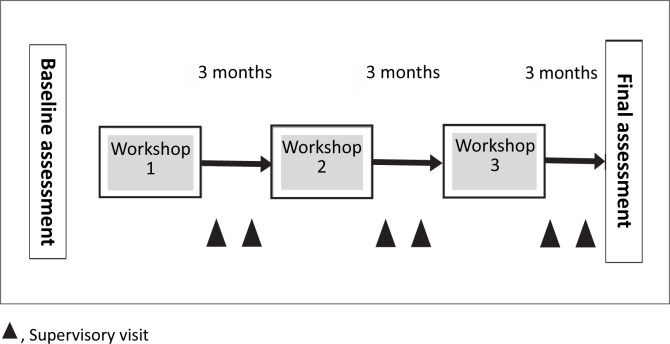
SLMTA in Lesotho was implemented in two cohorts. Twelve and nineteen laboratory supervisors and quality officers were enrolled in Cohort 1 and Cohort 2, respectively. These 31 participants represented 18 of the 19 laboratories nationwide. For the purposes of this programme, the Queen Elizabeth II (QE II) Central Laboratory had its seven sections of haematology, blood bank, cytology, blood transfusion, microbiology, tuberculosis laboratory and chemistry assessed as separate sections. Performance was tracked using the WHO-AFRO-SLIPTA checklist, with assessments carried out at baseline and at the end of SLMTA. Two methods were used to implement SLMTA: the traditional 'three workshops' approach and twinning SLMTA with mentorship. The latter, with intensive follow-up visits, was concluded in 9 months and the former in 11 months. A standard data collection tool was used for site visits.
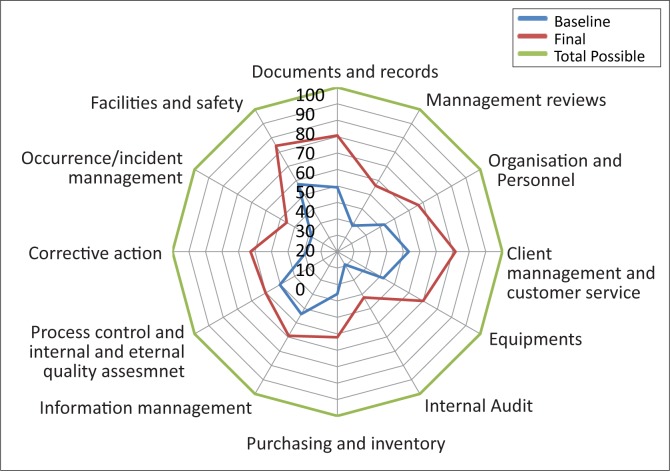
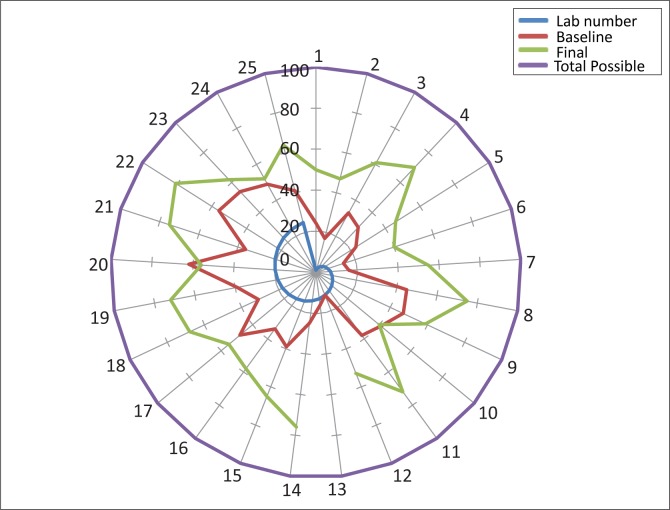
Of the 31 participants across both cohorts, 25 (81%) graduated (9 from Cohort 1 and 16 from Cohort 2). At baseline, all but one laboratory attained a rating of zero stars, with the exception attaining one star. At the final assessment, 7 of the 25 laboratories examined at baseline were still at a rating of zero stars, whilst 8 attained one star, 5 attained two stars and 4 attained three stars. None scored above three stars. The highest percentage improvement for any laboratory was 51%, whereas the least improved dropped by 6% when compared to its baseline assessment. The most improved areas were corrective actions (34%) and documents and records (32%). Process improvement demonstrated the least improvement (10%).
The SLMTA programme had an immediate, measurable and positive impact on laboratories in Lesotho. This success was possible because of the leadership and ownership of the programme by the MOHSW, as well as the coordination of partner support.
莱索托卫生与社会福利部(MOHSW)的5年战略计划以及其国家实验室政策和年度运营计划直接涉及认证问题,表明他们致力于履行其职责。因此,MOHSW采用了世界卫生组织非洲区域总部的逐步实验室质量改进以实现认证(WHO - AFRO - SLIPTA)流程,并随后在全国范围内推出了加强实验室管理以实现认证(SLMTA)计划,成为第一个这样做的非洲国家。
莱索托的SLMTA分两个批次实施。第一批和第二批分别有12名和19名实验室主管和质量官员参加。这31名参与者代表了全国19个实验室中的18个。为了该计划的目的,伊丽莎白二世女王(QE II)中央实验室的血液学、血库、细胞学、输血、微生物学、结核病实验室和化学这七个科室被作为单独的科室进行评估。使用WHO - AFRO - SLIPTA检查表跟踪绩效,在基线时和SLMTA结束时进行评估。实施SLMTA有两种方法:传统的“三个工作坊”方法以及将SLMTA与指导相结合。后者在9个月内完成并进行了密集的后续访问,前者在11个月内完成。使用标准数据收集工具进行现场访问。
两个批次的31名参与者中,25名(81%)毕业(第一批9名,第二批16名)。在基线时,除了一个实验室获得一星外,所有其他实验室的评级均为零星。在最终评估中,基线时接受检查的25个实验室中,7个仍为零星评级,8个获得一星,5个获得二星,4个获得三星。没有实验室得分超过三星。任何实验室的最高改进百分比为51%,而改进最少的实验室与基线评估相比下降了6%。改进最明显的领域是纠正措施(34%)和文件与记录(32%)。流程改进的改进幅度最小(10%)。
SLMTA计划对莱索托的实验室产生了直接、可衡量的积极影响。由于MOHSW对该计划的领导和主导以及合作伙伴支持的协调,才取得了这一成功。