Hirapara Hiren, Ghori Vishal, Anovadiya Ashish, Baxi Seema, Tripathi Chandrabhanu
GMERS Medical College, Junagadh , Gujarat, India.
Billev Pharma East, Ljubljana, Slovenia.
Avicenna J Phytomed. 2017 Sep-Oct;7(5):401-408.
To evaluate wound healing activity of ethanolic extract of Linn. () flowers in diabetic rats.
Streptozotocin-induced diabetic albino rats were divided into six groups (n=6).Three groups - diabetic control, positive control (that received Glibenclamide) and treatment (that received Linn. Flower extract) were operated for excision wounds (EW). These groups were evaluated for wound contraction and re-epithelization. The other three groups were operated for incision wounds (IW) and dead space wounds (DW). Incision and dead space wounds were produced in the same rats. IWs were analyzed for wound breaking strength and the granulation tissues from DWs were analyzed for dry weight, hydroxyproline content, and histology.
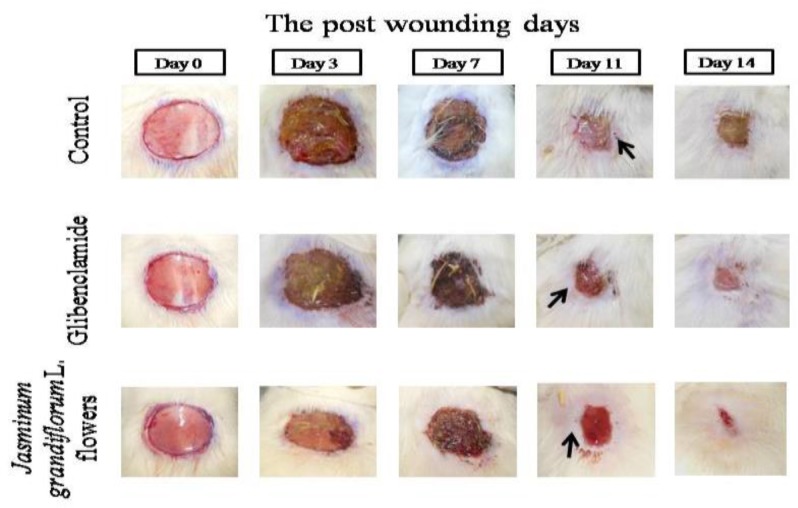
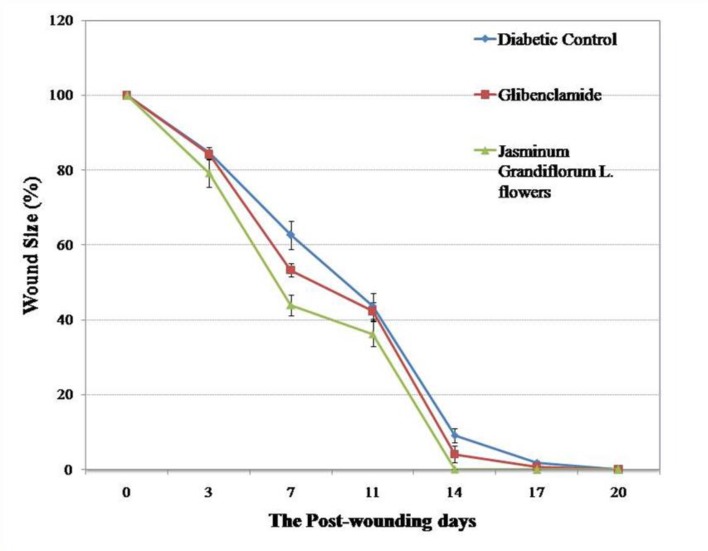
IWs and DWs showed significant improvement in wound breaking strength (265.8±10.4 vs 332.5±8.2; p<0.05), granulation tissue dry weight (26.1±0.6vs 40.4±0.3; p<0.01) and hydroxyproline content (19.3±0.5 vs 32.6±0.8; p<0.01) in treatment group as compared to control group. Neo-angiogenesis was also high in treatment group. Wound contraction was earlier (day 14) in treatment group compared to diabetic control (day 20). No significant improvement was seen in re-epithelization in treatment group.
Ethanolic extract of Linn. flowers increases granulation tissue formation as well as neo-angiogenesis. It also enhances wound contraction; however, re-epithelization was not significantly affected. Linn. flowers could be potentially effective in promotion of diabetic wounds healing by increasing granulation tissue formation and enhancing wound contraction; however, further studies are required for its clinical application.
评估[植物名称]花乙醇提取物对糖尿病大鼠伤口愈合的作用。
将链脲佐菌素诱导的糖尿病白化大鼠分为六组(n = 6)。三组——糖尿病对照组、阳性对照组(接受格列本脲)和治疗组(接受[植物名称]花提取物)进行切除伤口(EW)手术。对这些组进行伤口收缩和再上皮化评估。另外三组进行切口伤口(IW)和死腔伤口(DW)手术。在同一批大鼠身上制造切口和死腔伤口。对IW分析伤口抗张强度,对DW的肉芽组织分析干重、羟脯氨酸含量和组织学。
与对照组相比,治疗组的IW和DW在伤口抗张强度(265.8±10.4对332.5±8.2;p<0.05)、肉芽组织干重(26.1±0.6对40.4±0.3;p<0.01)和羟脯氨酸含量(19.3±0.5对32.6±0.8;p<0.01)方面有显著改善。治疗组的新血管生成也较高。治疗组的伤口收缩比糖尿病对照组更早(第14天)(第20天)。治疗组在再上皮化方面未见显著改善。
[植物名称]花乙醇提取物增加肉芽组织形成以及新血管生成。它还增强伤口收缩;然而,再上皮化未受到显著影响。[植物名称]花通过增加肉芽组织形成和增强伤口收缩可能对促进糖尿病伤口愈合有潜在效果;然而,其临床应用还需要进一步研究。