Neubert Miranda J, Dahlmann Elizabeth A, Ambrose Andrew, Johnson Michael D L
Department of Immunobiology, University of Arizona, Tucson, Arizona, USA.
Department of Pharmaceutical Sciences, University of Arizona, Tucson, Arizona, USA.
mSphere. 2017 Oct 18;2(5). doi: 10.1128/mSphere.00372-17. eCollection 2017 Sep-Oct.
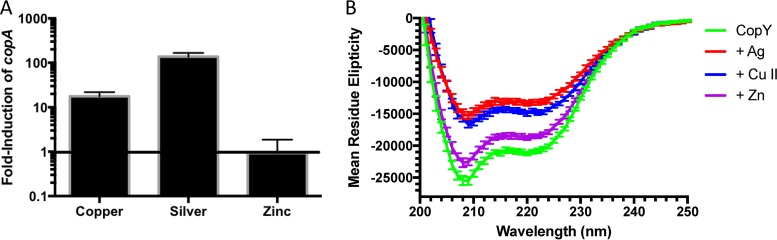
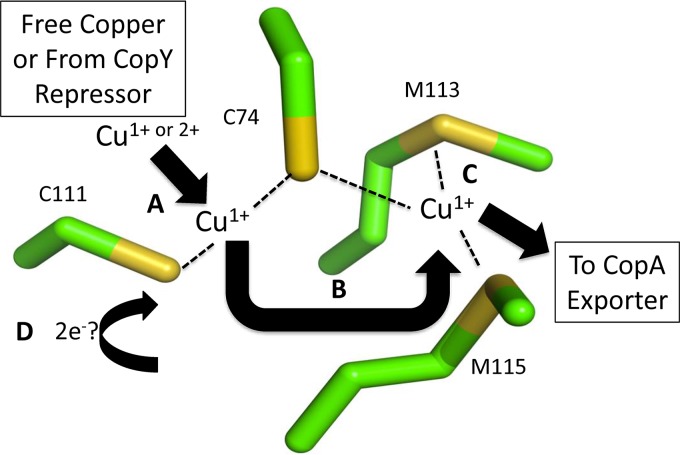
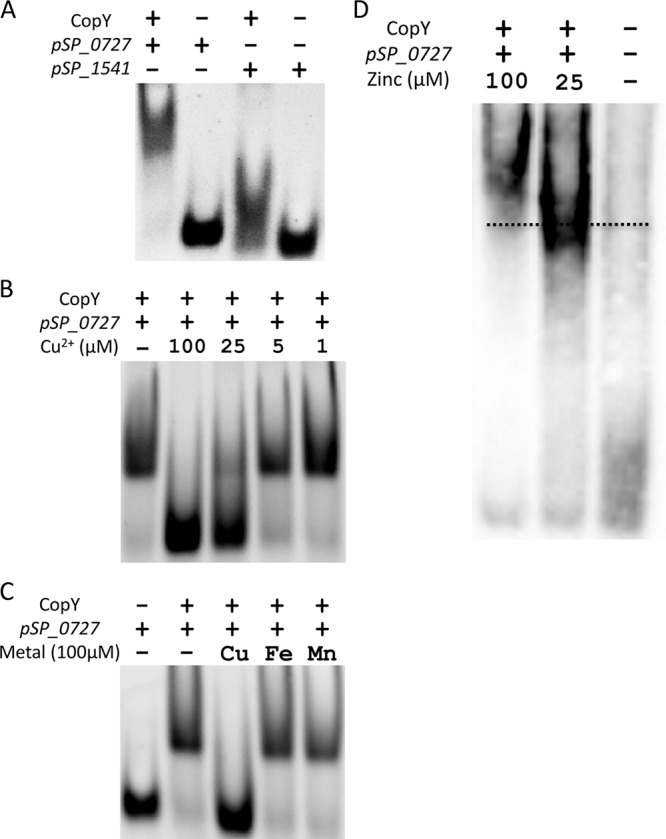
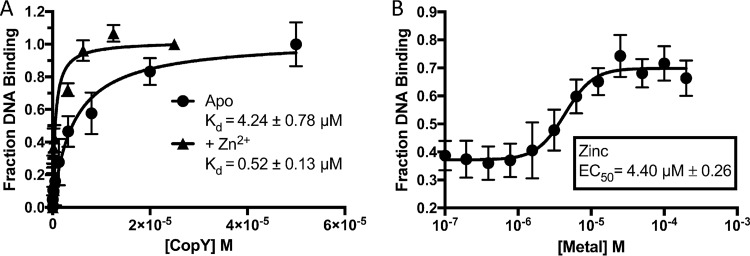
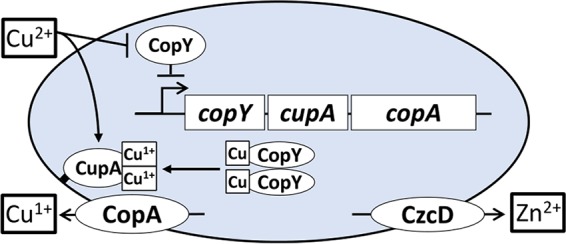
Any metal in excess can be toxic; therefore, metal homeostasis is critical to bacterial survival. Bacteria have developed specialized metal import and export systems for this purpose. For broadly toxic metals such as copper, bacteria have evolved only export systems. The copper export system ( operon) usually consists of the operon repressor, the copper chaperone, and the copper exporter. In , the causative agent of pneumonia, otitis media, sepsis, and meningitis, little is known about operon regulation. This is partly due to the repressor, CopY, and copper chaperone, CupA, sharing limited homology to proteins of putative related function and confirmed established systems. In this study, we examined CopY metal crosstalk, CopY interactions with CupA, and how CupA can control the oxidation state of copper. We found that CopY bound zinc and increased the DNA-binding affinity of CopY by roughly an order of magnitude over that of the apo form of CopY. Once copper displaced zinc in CopY, resulting in operon activation, CupA chelated copper from CopY. After copper was acquired from CopY or other sources, if needed, CupA facilitated the reduction of Cu to Cu, which is the exported copper state. Taken together, these data show novel mechanisms for copper processing in . As mechanisms of copper toxicity are emerging, bacterial processing of intracellular copper, specifically inside , remains unclear. In this study, we investigated two proteins encoded by the copper export operon: the repressor, CopY, and the copper chaperone, CupA. Zinc suppressed transcription of the copper export operon by increasing the affinity of CopY for DNA. Furthermore, CupA was able to chelate copper from CopY not bound to DNA and reduce it from Cu to Cu. This reduced copper state is essential for bacterial copper export via CopA. In view of the fact that innate immune cells use copper to kill pathogenic bacteria, understanding the mechanisms of copper export could expose new small-molecule therapeutic targets that could work synergistically with copper against pathogenic bacteria.
任何过量的金属都可能具有毒性;因此,金属稳态对细菌的生存至关重要。细菌为此已开发出专门的金属导入和输出系统。对于像铜这样具有广泛毒性的金属,细菌仅进化出了输出系统。铜输出系统(操纵子)通常由操纵子阻遏物、铜伴侣蛋白和铜输出蛋白组成。在引起肺炎、中耳炎、败血症和脑膜炎的病原体中,关于操纵子调控知之甚少。部分原因是该操纵子的阻遏物CopY和铜伴侣蛋白CupA与假定相关功能及已确定的成熟系统的蛋白质具有有限的同源性。在本研究中,我们研究了CopY的金属串扰、CopY与CupA的相互作用,以及CupA如何控制铜的氧化态。我们发现CopY结合锌并使CopY的DNA结合亲和力比其无辅基形式提高了大约一个数量级。一旦铜在CopY中取代了锌,导致操纵子激活,CupA就会从CopY中螯合铜。从CopY或其他来源获取铜后,如果需要,CupA会促进Cu还原为Cu,这是输出的铜状态。综上所述,这些数据揭示了在该病原体中铜处理的新机制。随着铜毒性机制的不断涌现,细菌对细胞内铜的处理,特别是在该病原体内部的处理,仍不清楚。在本研究中,我们研究了铜输出操纵子编码的两种蛋白质:阻遏物CopY和铜伴侣蛋白CupA。锌通过增加CopY对DNA的亲和力来抑制铜输出操纵子的转录。此外,CupA能够从未与DNA结合的CopY中螯合铜,并将其从Cu还原为Cu。这种还原的铜状态对于细菌通过CopA输出铜至关重要。鉴于先天免疫细胞利用铜来杀死病原菌,了解铜输出机制可能会揭示新的小分子治疗靶点,这些靶点可以与铜协同对抗病原菌。