Bleackley Mark R, Dawson Charlotte S, McKenna James A, Quimbar Pedro, Hayes Brigitte M E, van der Weerden Nicole L, Anderson Marilyn A
Department of Biochemistry and Genetics, La Trobe Institute for Molecular Science, La Trobe University, Bundoora, Victoria, Australia.
mSphere. 2017 Oct 18;2(5). doi: 10.1128/mSphere.00390-17. eCollection 2017 Sep-Oct.
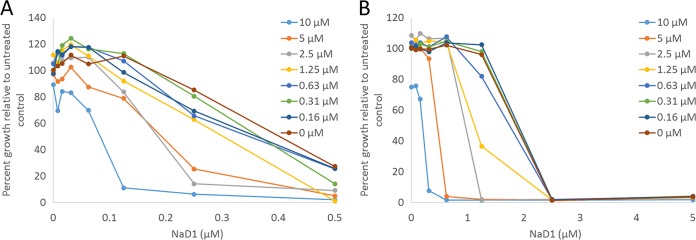
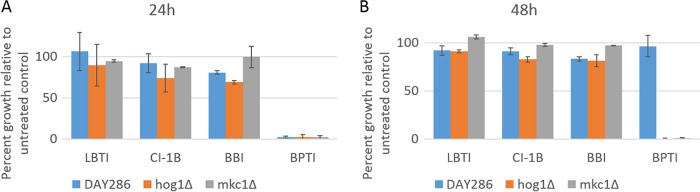
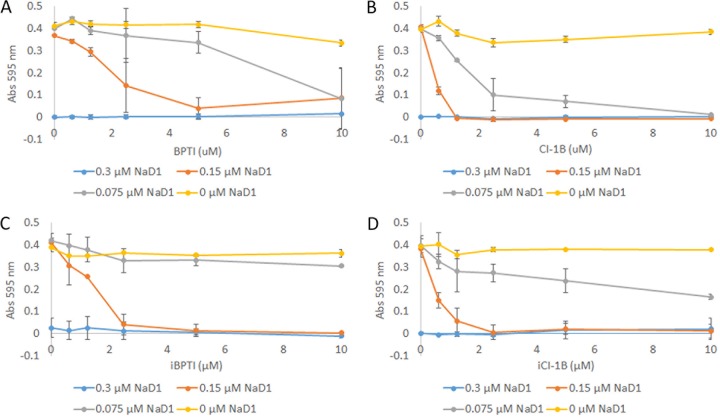
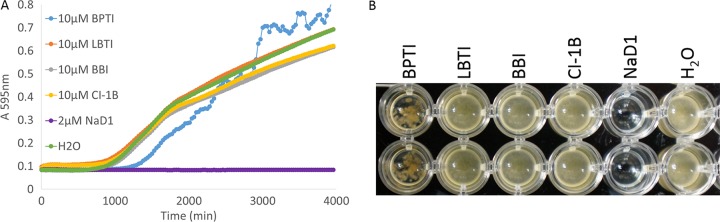
Defensins are a large family of small, cationic, cysteine-rich proteins that are part of the defense arsenal that plants use for protection against potentially damaging fungal infections. The plant defensin NaD1 from is a potent antifungal protein that inhibits growth and kills a variety of fungal pathogens that affect both plant and animal (human) hosts. Some serine protease inhibitors have also been reported to be antifungal molecules, while others have no inhibitory activity against fungi. Here we describe the synergistic activity of the plant defensin NaD1 with a selection of serine protease inhibitors against the plant pathogens and and the animal pathogen . The synergistic activity was not related to the protease inhibitory activity of these molecules but may arise from activation of fungal stress response pathways. The bovine pancreatic trypsin inhibitor (BPTI) displayed the most synergy with NaD1. BPTI also acted synergistically with several other antifungal molecules. The observation that NaD1 acts synergistically with protease inhibitors provides the foundation for the design of transgenic plants with improved resistance to fungal disease. It also supports the possibility of naturally occurring accessory factors that function to enhance the activity of innate immunity peptides in biological systems. This work describes the increased activity of a natural antifungal peptide in the presence of another antifungal peptide from a different family. This is termed antifungal synergy. Synergy is important for decreasing the amount of antifungal molecule needed to control the disease. Traditionally, naturally occurring antifungal molecules are assayed in isolation. Identification of synergistic interactions between antifungal peptides means that their activities in a complex biological system are likely to be different from what we observe when examining them individually. This study identified synergy between an antifungal peptide and a group of peptides that do not affect fungal growth . This provides the foundation for generation of transgenic plants with increased resistance to fungal disease and identification of antifungal accessory factors that enhance the activity of innate immune molecules but do not have an antifungal effect on their own.
防御素是一大类小的、阳离子性的、富含半胱氨酸的蛋白质,它们是植物用于抵御潜在破坏性真菌感染的防御武器库的一部分。来自[具体来源未提及]的植物防御素NaD1是一种有效的抗真菌蛋白,可抑制多种影响植物和动物(人类)宿主的真菌病原体的生长并将其杀死。据报道,一些丝氨酸蛋白酶抑制剂也是抗真菌分子,而其他一些则对真菌没有抑制活性。在这里,我们描述了植物防御素NaD1与一系列丝氨酸蛋白酶抑制剂对植物病原体[具体病原体未提及]和[具体病原体未提及]以及动物病原体[具体病原体未提及]的协同活性。这种协同活性与这些分子的蛋白酶抑制活性无关,可能源于真菌应激反应途径的激活。牛胰蛋白酶抑制剂(BPTI)与NaD1表现出最强的协同作用。BPTI还与其他几种抗真菌分子协同作用。NaD1与蛋白酶抑制剂协同作用的观察结果为设计对真菌病害具有更高抗性的转基因植物奠定了基础。这也支持了在生物系统中存在天然辅助因子以增强先天免疫肽活性的可能性。 这项工作描述了一种天然抗真菌肽在存在来自不同家族的另一种抗真菌肽时活性增加的情况。这被称为抗真菌协同作用。协同作用对于减少控制疾病所需的抗真菌分子数量很重要。传统上,天然存在的抗真菌分子是单独进行检测的。抗真菌肽之间协同相互作用的鉴定意味着它们在复杂生物系统中的活性可能与我们单独检测时观察到的不同。这项研究确定了一种抗真菌肽与一组不影响真菌生长的肽之间的协同作用。这为培育对真菌病害具有更高抗性的转基因植物以及鉴定增强先天免疫分子活性但自身没有抗真菌作用的抗真菌辅助因子提供了基础。