Michaelian Karo
Department of Nuclear Physics and Application of Radiations, Instituto de Física, Universidad Nacional Autónoma de México, Apartado Postal 20-364, Cuidad de México, Mexico.
Heliyon. 2017 Oct 13;3(10):e00424. doi: 10.1016/j.heliyon.2017.e00424. eCollection 2017 Oct.
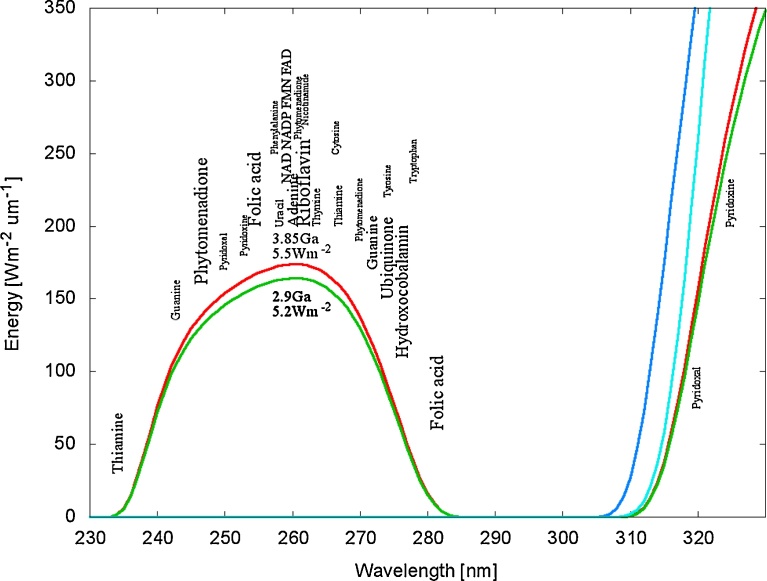
Some fundamental molecules of life are suggested to have been formed, proliferated, and evolved through photochemical microscopic dissipative structuring and autocatalytic proliferation under the UV-C/UV-B solar environment prevalent at Earth's surface throughout the Archean. Evidence is given in the numerous salient characteristics of these, including their strong absorption in this spectral region and their rapid non-radiative excited state decay through inherent conical intersections. The examples of the dissipative structuring and dissipative proliferation of the purines and of single strand DNA are given. UV-C and UV-B-induced stationary state isomerizations and tautomerizations are shown to be crucial to the formation of the purines from hydrogen cyanide in an aqueous environment under UV-C light, while UV-C induced phosphorylation of nucleosides and denaturing of double helix RNA and DNA are similarly important to the production and proliferation of single strand DNA. This thermodynamic dissipation perspective provides a physical-chemical foundation for understanding the origin and evolution of life.
一些基本的生命分子被认为是在太古代地球表面普遍存在的紫外线C/紫外线B太阳环境下,通过光化学微观耗散结构和自催化增殖而形成、增殖和进化的。文中给出了这些分子的众多显著特征作为证据,包括它们在该光谱区域的强烈吸收以及通过固有锥形交叉点的快速非辐射激发态衰变。文中给出了嘌呤和单链DNA的耗散结构和耗散增殖的例子。紫外线C和紫外线B诱导的稳态异构化和互变异构被证明对于在紫外线C光下的水环境中由氰化氢形成嘌呤至关重要,而紫外线C诱导的核苷磷酸化以及双链RNA和DNA的变性对于单链DNA的产生和增殖同样重要。这种热力学耗散观点为理解生命的起源和进化提供了物理化学基础。