Xiang Yu-Juan, Fu Qin-Ye, Ma Zhong-Bing, Gao De-Zong, Zhang Qiang, Li Yu-Yang, Li Liang, Liu Lu, Ye Chun-Miao, Yu Zhi-Gang, Guo Ming-Ming
Department of Breast Surgery, The Second Hospital of Shandong University, Jinan, Shandong 250033, China.
Chronic Dis Transl Med. 2015 Mar 5;1(2):65-72. doi: 10.1016/j.cdtm.2015.02.001. eCollection 2015 Jun.
The aim of this study was to reveal the exact changes during the occurrence of breast cancer to explore significant new and promising genes or factors related to this disease.
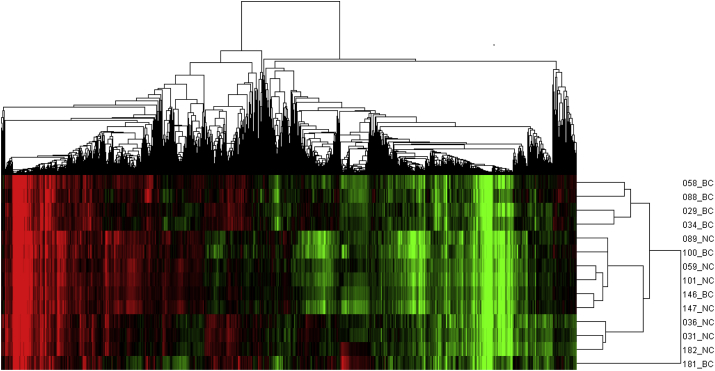
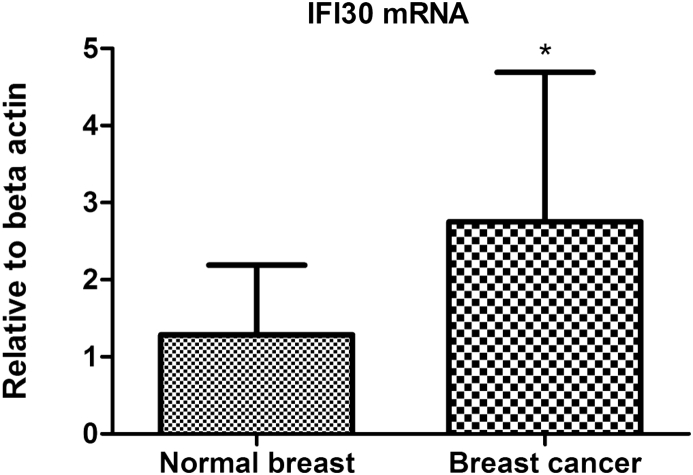
We compared the gene expression profiles of breast cancer tissues with its uninvolved normal breast tissues as controls using the cDNA microarray analysis in seven breast cancer patients. Further, one representative gene, named IFI30, was quantitatively analyzed by real-time PCR to confirm the result of the cDNA microarray analysis.
A total of 427 genes were identified with significantly differential expression, 221 genes were up-regulated and 206 genes were down-regulated. And the result of cDNA microarray analysis was validated by detection of IFI30 mRNA level changes by real-time PCR. Genes for cell proliferation, cell cycle, cell division, mitosis, apoptosis, and immune response were enriched in the up-regulated genes, while genes for cell adhesion, proteolysis, and transport were significantly enriched in the down-regulated genes in breast cancer tissues compared with normal breast tissues by a gene ontology analysis.
Our present study revealed a range of differentially expressed genes between breast cancer tissues and normal breast tissues, and provide candidate genes for further study focusing on the pathogenesis and new biomarkers for breast cancer.
本研究旨在揭示乳腺癌发生过程中的具体变化,以探索与该疾病相关的重要新基因或因素。
我们使用cDNA微阵列分析技术,对7例乳腺癌患者的癌组织及其未受累的正常乳腺组织作为对照进行基因表达谱比较。此外,对一个名为IFI30的代表性基因进行实时PCR定量分析,以验证cDNA微阵列分析的结果。
共鉴定出427个基因表达有显著差异,其中221个基因上调,206个基因下调。通过实时PCR检测IFI30 mRNA水平变化,验证了cDNA微阵列分析的结果。基因本体分析显示,与正常乳腺组织相比,上调基因中富集了细胞增殖、细胞周期、细胞分裂、有丝分裂、凋亡和免疫反应相关基因,而下调基因中显著富集了细胞黏附、蛋白水解和转运相关基因。
本研究揭示了乳腺癌组织与正常乳腺组织之间一系列差异表达基因,为进一步研究乳腺癌的发病机制提供了候选基因,并为乳腺癌提供了新的生物标志物。