Patrick Molly, Steenland Maria, Dismer Amber, Pierre-Louis Jocelyne, Murphy Jennifer L, Kahler Amy, Mull Bonnie, Etheart Melissa D, Rossignol Emmanuel, Boncy Jacques, Hill Vincent, Handzel Thomas
Division of Global Health Protection, Center for Global Health, Centers for Disease Control and Prevention Atlanta, Georgia.
Division of Foodborne, Waterborne and Environmental Diseases, National Center for Emerging and Zoonotic Infectious Diseases, Centers for Disease Control and Prevention, Atlanta, Georgia.
Am J Trop Med Hyg. 2017 Oct;97(4_Suppl):84-91. doi: 10.4269/ajtmh.16-0692.
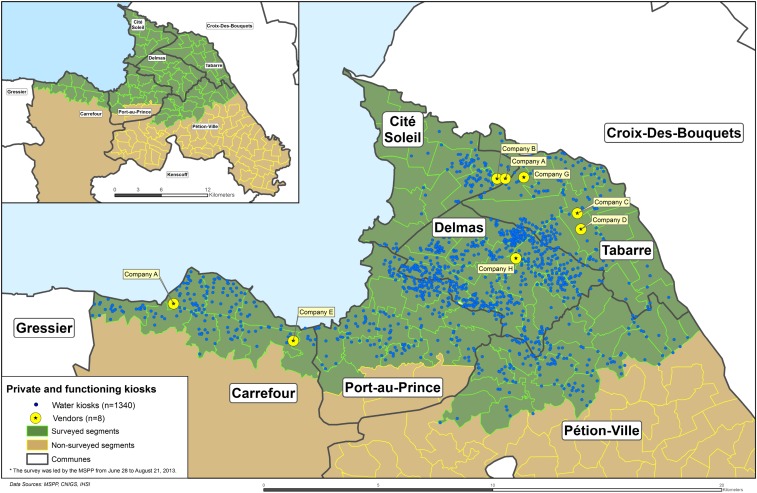
Consumption of drinking water from private vendors has increased considerably in Port-au-Prince, Haiti, in recent decades. A major type of vendor is private kiosks, advertising reverse osmosis-treated water for sale by volume. To describe the scale and geographical distribution of private kiosks in metropolitan Port-au-Prince, an inventory of private kiosks was conducted from July to August 2013. Coordinates of kiosks were recorded with global positioning system units and a brief questionnaire was administered with the operator to document key kiosk characteristics. To assess the quality of water originating from private kiosks, water quality analyses were also conducted on a sample of those inventoried as well as from the major provider company sites. The parameters tested were , free chlorine residual, pH, turbidity, and total dissolved solids. More than 1,300 kiosks were inventoried, the majority of which were franchises of four large provider companies. Approximately half of kiosks reported opening within 12 months of the date of the inventory. The kiosk treatment chain and sales price was consistent among a majority of the kiosks. Of the 757 kiosks sampled for water quality, 90.9% of samples met World Health Organization (WHO) microbiological guideline at the point of sale for nondetectable in a 100-mL sample. Of the eight provider company sites tested, all samples met the WHO microbiological guideline. Because of the increasing role of the private sector in drinking water provision in Port-au-Prince and elsewhere in Haiti, this assessment was an important first step for government regulation of this sector.
近几十年来,海地太子港从私人摊贩处购买饮用水的情况大幅增加。一种主要的摊贩类型是私人售货亭,它们按体积销售经反渗透处理的水。为了描述太子港大都市地区私人售货亭的规模和地理分布,于2013年7月至8月对私人售货亭进行了清查。使用全球定位系统设备记录售货亭的坐标,并向经营者发放一份简短问卷,以记录售货亭的关键特征。为了评估私人售货亭供应的水的质量,还对清查的一部分样本以及主要供水公司站点的水进行了水质分析。测试的参数有游离氯残留量、pH值、浊度和总溶解固体。清查了1300多个售货亭,其中大多数是四家大型供水公司的特许经营点。大约一半的售货亭报告称是在清查日期的12个月内开业的。大多数售货亭的水处理环节和销售价格是一致的。在抽取的757个进行水质检测的售货亭中,90.9%的样本在销售点达到了世界卫生组织(WHO)的微生物准则,即100毫升样本中检测不到 。在测试的八个供水公司站点中,所有样本均符合WHO的微生物准则。由于私营部门在太子港及海地其他地区的饮用水供应中所起的作用日益增加,此次评估是政府对该部门进行监管的重要第一步。