Fitter David L, Delson Daphnée Benoit, Guillaume Florence D, Schaad Angela Wood, Moffett Daphne B, Poncelet Jean-Luc, Lowrance David, Gelting Richard
Centers for Disease Control and Prevention, Port-au-Prince, Haiti.
Ministry of Public Health and Population, Port-au-Prince, Haiti.
Am J Trop Med Hyg. 2017 Oct;97(4_Suppl):4-11. doi: 10.4269/ajtmh.16-0862.
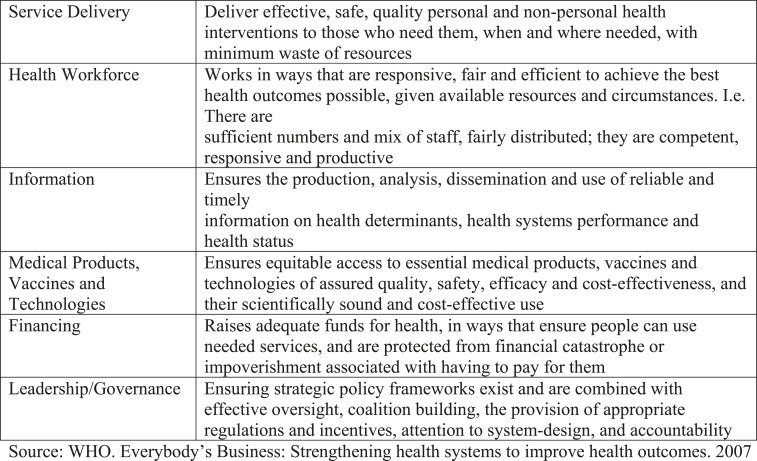
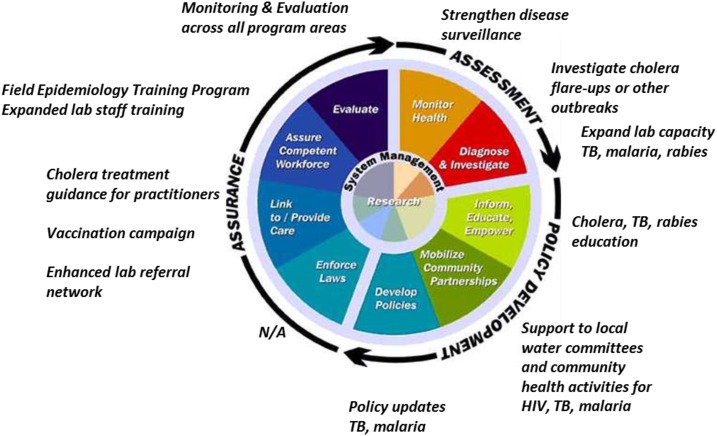
Emergencies can often directly impact health systems of an affected region or country, especially in resource-constrained areas. Health system recovery following an emergency is a complex and dynamic process. Health system recovery efforts have often been structured around the World Health Organization's health systems building blocks as demonstrated by the Post-Disaster Needs Assessment. Although this structure is valuable and well known, it can overlook the intricacies of public health systems. We retrospectively examine public health systems recovery, a subset of the larger health system, following the 2010 Haiti earthquake and cholera outbreak, through the lens of the 10 essential public health services. This framework illustrates the comprehensive nature of and helps categorize the activities necessary for a well-functioning public health system and can complement other assessments. Outlining the features of a public health system for recovery in structured manner can also help lay the foundation for sustainable long-term development leading to a more robust and resilient health system.
紧急情况往往会直接影响受灾地区或国家的卫生系统,在资源匮乏地区尤其如此。紧急情况过后卫生系统的恢复是一个复杂且动态的过程。正如灾后需求评估所表明的那样,卫生系统恢复工作通常围绕世界卫生组织的卫生系统构建模块展开。尽管这种结构很有价值且广为人知,但它可能会忽略公共卫生系统的复杂性。我们通过10项基本公共卫生服务这一视角,对2010年海地地震和霍乱疫情后作为更大卫生系统一部分的公共卫生系统恢复情况进行了回顾性研究。该框架说明了运作良好的公共卫生系统所需活动的全面性,并有助于对这些活动进行分类,还能补充其他评估。以结构化方式概述公共卫生系统恢复的特征,也有助于为可持续的长期发展奠定基础,从而打造出更强大、更具韧性的卫生系统。