*Division of Neurotology and Skull Base Surgery, Department of Otolaryngology-Head and Neck Surgery †Department of Biomedical Engineering, University of California, Irvine, California.
Otol Neurotol. 2017 Dec;38(10):1500-1504. doi: 10.1097/MAO.0000000000001596.
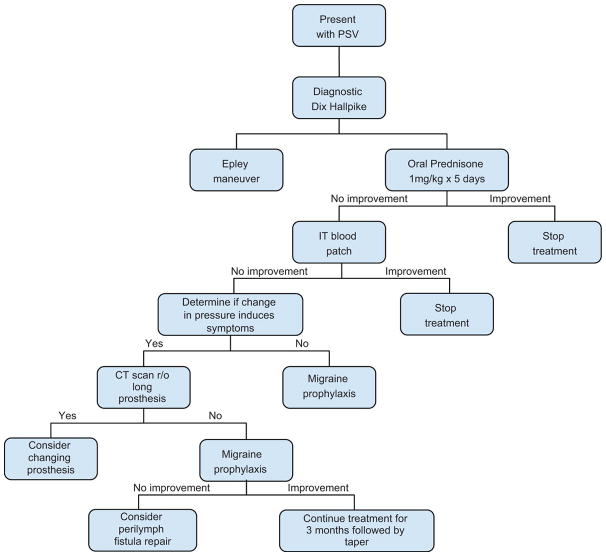
To describe persistent post-stapedotomy vertigo (PSV) and its treatment using migraine prophylaxis.
A retrospective review of all patients with persistent PSV spanning 10 years at a tertiary academic hospital was performed. Patients who experienced persistent vertigo for a minimum of 3 months after surgery were included. Those with possible perilymph fistula, long prosthesis, and benign paroxysmal positional vertigo were excluded.
All patients received instructions on migraine dietary and lifestyle changes and Vitamin B2 and magnesium. In addition, prophylactic treatment with nortriptyline, verapamil, or a combination thereof was started.
Changes in vertigo frequency was the main outcome variable. The secondary outcome variables included the time period and medications necessary to achieve symptomatic resolution.
Four women and one man with an average age of 53 years were identified that met criteria for persistent PSV indicating an incidence of 0.9% at our institution. The onset of vertigo symptoms was on average 20 days postoperatively. All five patients had daily vertigo episodes and experienced complete resolution with no vertigo episodes after treatment. Symptomatic resolution was achieved over an average of 9 weeks after initiating treatments.
Persistent PSV beyond 3 months is a rare occurrence and its treatment can be challenging when there is no evidence of an underlying pathology. This subset of patients may be suffering from migraine, which was triggered postoperatively. Treatment with migraine prophylaxis in this cohort of patients may result in resolution of vertigo.
描述持久性镫骨术后眩晕(PSV)及其使用偏头痛预防治疗的方法。
对一家三级学术医院 10 年间所有持续性 PSV 患者进行回顾性研究。纳入术后至少持续 3 个月存在眩晕的患者。排除可能存在迷路瘘管、长假体和良性阵发性位置性眩晕的患者。
所有患者均接受偏头痛饮食和生活方式改变以及维生素 B2 和镁的指导。此外,开始预防性应用去甲替林、维拉帕米或两者联合治疗。
眩晕频率的变化是主要观察指标。次要观察指标包括达到症状缓解所需的时间和药物。
发现 4 名女性和 1 名男性患者,平均年龄 53 岁,符合持续性 PSV 标准,表明本机构的发生率为 0.9%。眩晕症状平均在术后 20 天出现。所有 5 名患者均有每日眩晕发作,治疗后完全缓解,无眩晕发作。开始治疗后平均 9 周达到症状缓解。
3 个月以上的持续性 PSV 是一种罕见情况,当无潜在病理学证据时,其治疗可能具有挑战性。这组患者可能患有偏头痛,偏头痛是术后触发的。在这部分患者中使用偏头痛预防治疗可能会导致眩晕缓解。