ImmunoConcept, UMR CNRS 5164, Université de Bordeaux, Bordeaux, France.
Department of Internal Medicine and Clinical Immunology, Saint-Andre Hospital, Bordeaux, France.
Arthritis Res Ther. 2017 Oct 24;19(1):238. doi: 10.1186/s13075-017-1442-6.
The aim of this study was to identify the most reliable biomarkers in the literature that could be used as flare predictors in systemic lupus erythematosus (SLE).
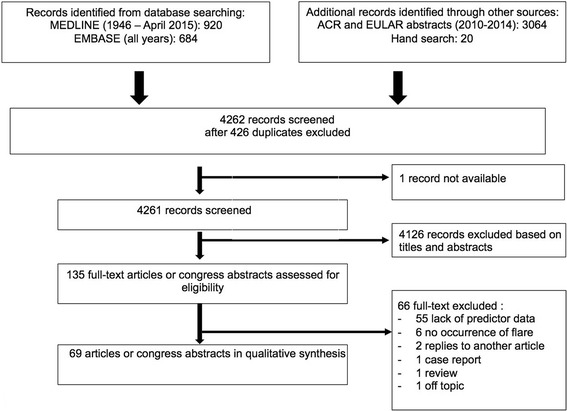
A systematic review of the literature was performed using two databases (MEDLINE and EMBASE) through April 2015 and congress abstracts from the American College of Rheumatology and the European League Against Rheumatism were reviewed from 2010 to 2014. Two independent reviewers screened titles and abstracts and analysed selected papers in detail, using a specific questionnaire. Reports addressing the relationships between one or more defined biological test(s) and the occurrence of disease exacerbation were included in the systematic review.
From all of the databases, 4668 records were retrieved, of which 69 studies or congress abstracts were selected for the systematic review. The performance of seven types of biomarkers performed routinely in clinical practice and nine types of novel biological markers was evaluated. Despite some encouraging results for anti-double-stranded DNA antibodies, anti-C1q antibodies, B-lymphocyte stimulator and tumour necrosis factor-like weak inducer of apoptosis, none of the biomarkers stood out from the others as a potential gold standard for flare prediction. The results were heterogeneous, and a lack of standardized data prevented us from identifying a powerful biomarker.
No powerful conclusions could be drawn from this systematic review due to a lack of standardized data. Efforts should be undertaken to optimize future research on potential SLE biomarkers to develop validated candidates. Thus, we propose a standardized pattern for future studies.
本研究旨在确定文献中最可靠的生物标志物,以便用于预测系统性红斑狼疮(SLE)的病情加重。
通过 2015 年 4 月前的 MEDLINE 和 EMBASE 两个数据库进行文献系统性回顾,并对 2010 年至 2014 年美国风湿病学会和欧洲抗风湿病联盟的会议摘要进行回顾。两名独立的审查员筛选标题和摘要,并使用特定的问卷详细分析选定的论文。本系统性回顾纳入了报告中探讨一种或多种定义明确的生物学检测与疾病加重之间关系的研究。
从所有数据库中检索到 4668 条记录,其中有 69 项研究或会议摘要被选入系统性回顾。评估了七种常规临床实践中使用的生物标志物和九种新型生物标志物的性能。尽管抗双链 DNA 抗体、抗 C1q 抗体、B 淋巴细胞刺激因子和肿瘤坏死因子样凋亡弱诱导剂的结果令人鼓舞,但没有一种生物标志物能从其他标志物中脱颖而出,成为病情加重预测的潜在金标准。结果存在异质性,且缺乏标准化数据,使我们无法确定强大的生物标志物。
由于缺乏标准化数据,本系统性回顾无法得出有力的结论。应努力优化潜在 SLE 生物标志物的未来研究,以开发经过验证的候选物。因此,我们提出了一个标准化的未来研究模式。