Jefferson L, Brealey S, Handoll H, Keding A, Kottam L, Sbizzera I, Rangan A
Department of Health Sciences, University of York, Heslington, York YO10 5DD, UK.
York Trials Unit, University of York, Lower Ground Floor, ARRC Building, Heslington, York YO10 5DD, UK
Bone Joint Res. 2017 Oct;6(10):590-599. doi: 10.1302/2046-3758.610.BJR-2017-0170.
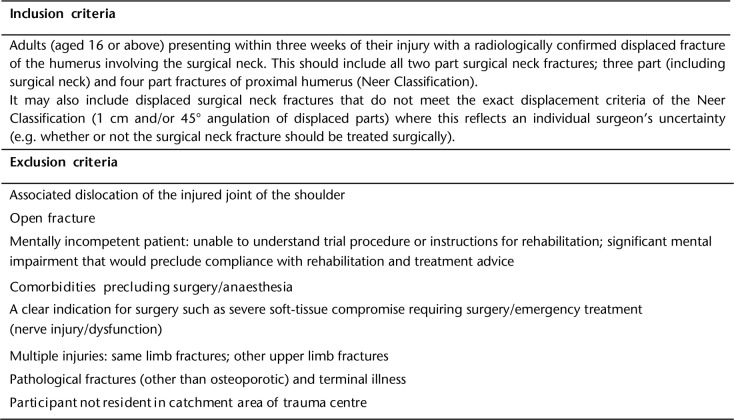
To explore whether orthopaedic surgeons have adopted the Proximal Fracture of the Humerus: Evaluation by Randomisation (PROFHER) trial results routinely into clinical practice.
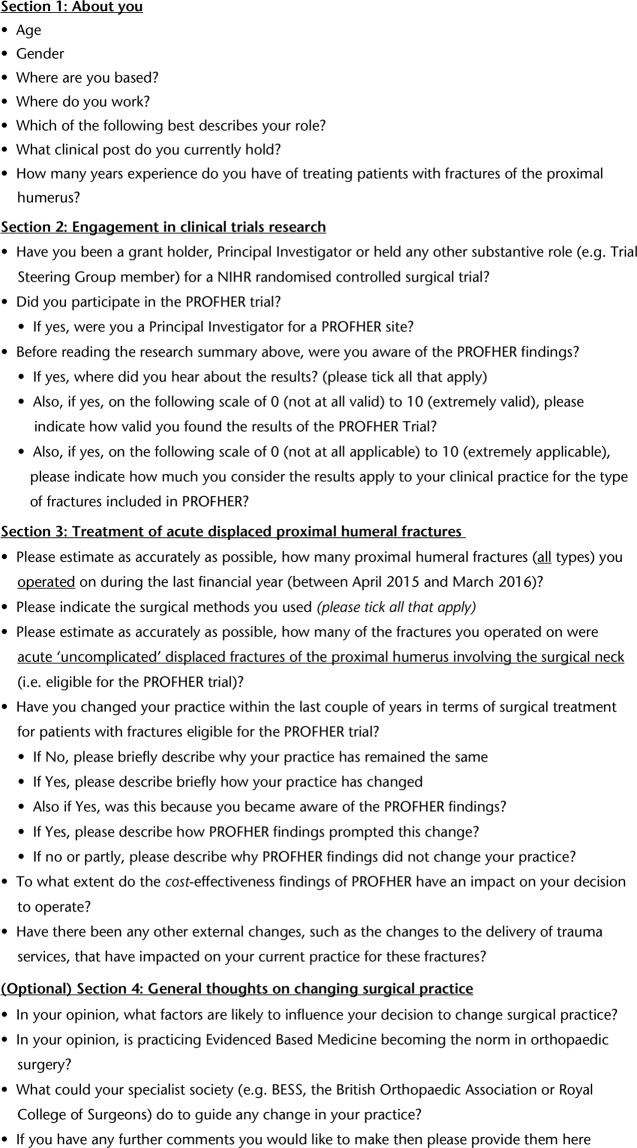
A questionnaire was piloted with six orthopaedic surgeons using a 'think aloud' process. The final questionnaire contained 29 items and was distributed online to surgeon members of the British Orthopaedic Association and British Elbow and Shoulder Society. Descriptive statistics summarised the sample characteristics and fracture treatment of respondents overall, and grouped them by whether they changed practice based on PROFHER trial findings. Free-text responses were analysed qualitatively for emerging themes using Framework Analysis principles.
There were complete responses from 265 orthopaedic and trauma surgeons who treat patients with proximal humeral fractures. Around half (137) had changed practice to various extents because of PROFHER, by operating on fewer PROFHER-eligible fractures. A third (43) of the 128 respondents who had not changed practice were already managing patients non-operatively. Those who changed practice were more likely to be younger, work in a trauma unit rather than a major trauma centre, be specialist shoulder surgeons and treat fewer PROFHER-eligible fractures surgically. This group gave higher scores when assessing validity and applicability of PROFHER. In contrast, a quarter of the non-changers were critical, sometimes emphatically, of PROFHER. The strongest theme that emerged overall was the endorsement of evidence-based practice.
PROFHER has had an impact on surgeons' clinical practice, both through changing it, and through underpinning existing non-operative practice. Although some respondents expressed reservations about the trial, evidence from such trials was found to be the most important influence on surgeons' decisions to change practice.: L. Jefferson, S. Brealey, H. Handoll, A. Keding, L. Kottam, I. Sbizzera, A. Rangan. Impact of the PROFHER trial findings on surgeons' clinical practice: An online questionnaire survey. 2017;6:590-599. DOI: 10.1302/2046-3758.610.BJR-2017-0170.
探讨骨科医生是否已将肱骨近端骨折:随机评估(PROFHER)试验结果常规应用于临床实践。
采用“边思考边说”的方式,对6名骨科医生进行了问卷预测试。最终问卷包含29个项目,并在线分发给英国骨科协会和英国肘与肩协会的外科医生成员。描述性统计总结了受访者的样本特征和总体骨折治疗情况,并根据他们是否根据PROFHER试验结果改变临床实践进行分组。使用框架分析原则对自由文本回复进行定性分析,以找出新出现的主题。
265名治疗肱骨近端骨折患者的骨科和创伤外科医生给出了完整回复。约一半(137名)医生因PROFHER试验而在不同程度上改变了临床实践,即减少了对符合PROFHER标准的骨折进行手术的例数。在128名未改变临床实践的受访者中,三分之一(43名)已经在对患者进行非手术治疗。改变临床实践的医生更可能较年轻,在创伤科而非重大创伤中心工作,是肩外科专科医生,且手术治疗的符合PROFHER标准的骨折例数较少。在评估PROFHER试验的有效性和适用性时,这组医生给出的分数更高。相比之下,四分之一未改变临床实践的医生对PROFHER试验持批评态度,有时甚至言辞激烈。总体而言,出现的最强烈主题是对循证医学实践的认可。
PROFHER试验对医生的临床实践产生了影响,既体现在改变了临床实践,也体现在支持了现有的非手术治疗实践。尽管一些受访者对该试验表示保留意见,但此类试验的证据被认为是影响医生改变临床实践决策的最重要因素。:L.杰斐逊、S.布雷利、H.汉多尔、A.凯丁、L.科塔姆、I.斯比泽拉、A.兰根。PROFHER试验结果对医生临床实践的影响:一项在线问卷调查。2017年;6:590 - 599。DOI:10.1302/2046 - 3758.610.BJR - 2017 - 0170。