Department of Plant Pathology and Microbiology, Iowa State University, Ames, Iowa, USA.
Department of Plant Pathology and Microbiology, Iowa State University, Ames, Iowa, USA
mBio. 2017 Oct 24;8(5):e01178-17. doi: 10.1128/mBio.01178-17.
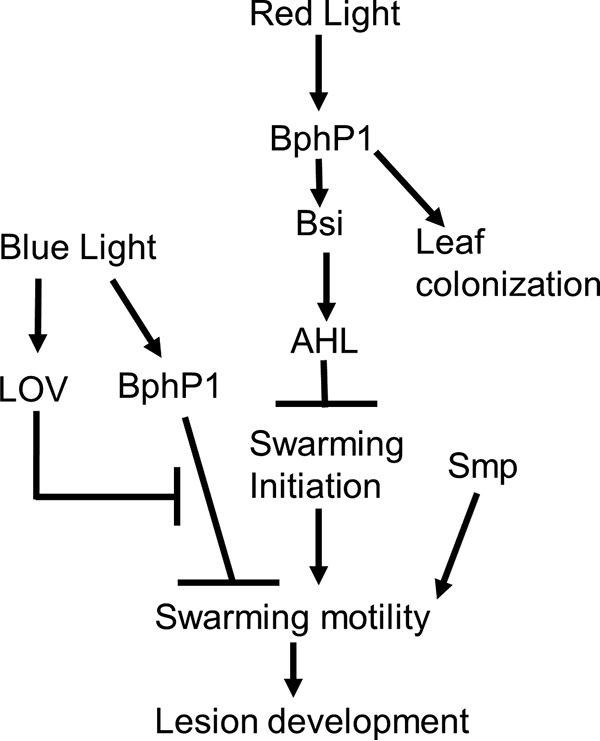
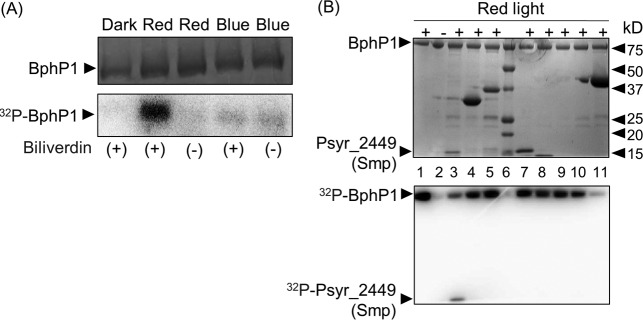
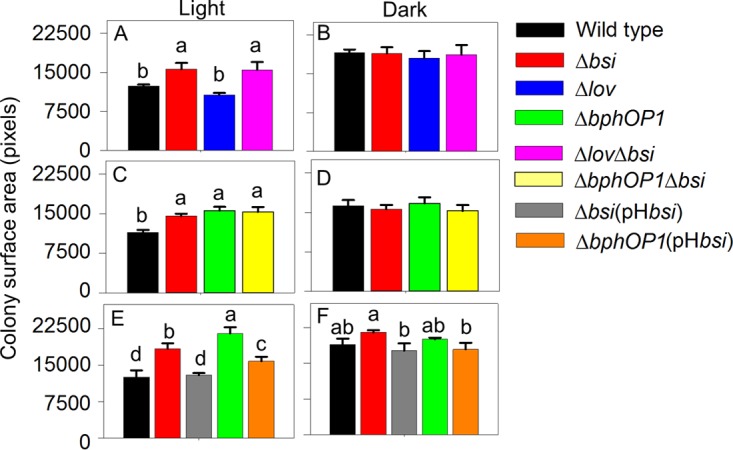
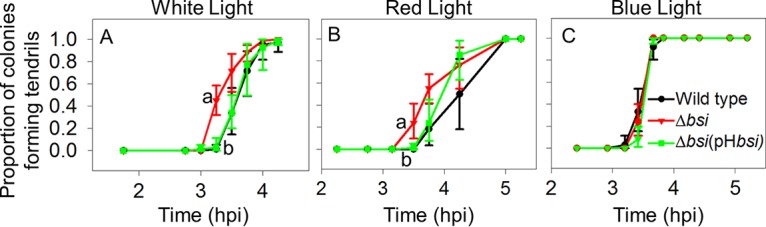
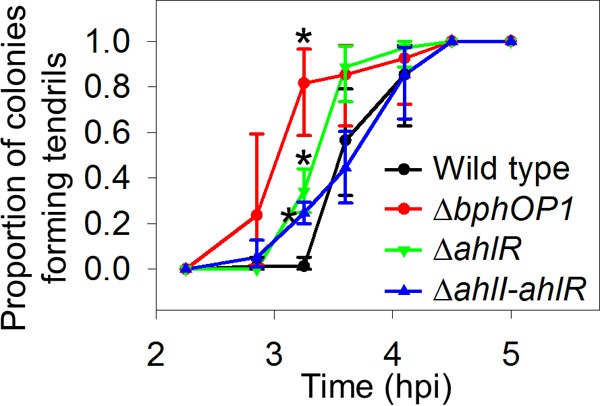
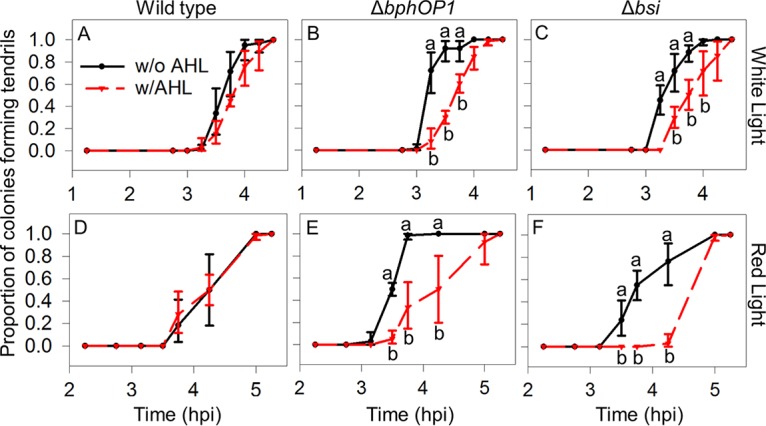
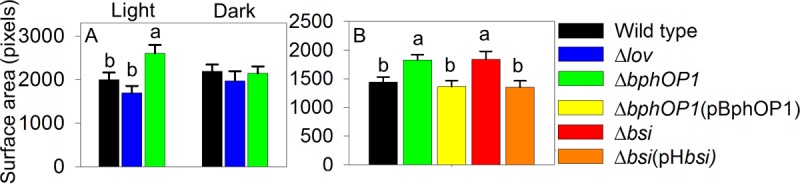
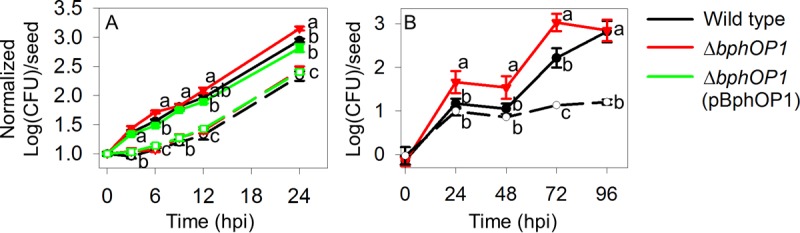
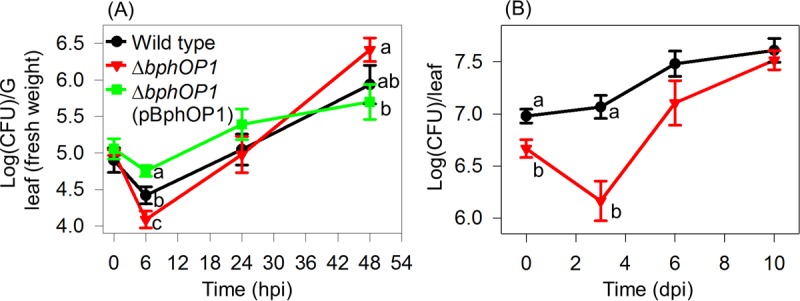
Light may be an important environmental signal for plant-associated bacteria, particularly those that live on leaves. An integrated network of red/far-red- and blue-light-responsive photosensory proteins is known to inhibit swarming motility in the foliar plant pathogen pv. syringae B728a. Here we elucidated factors in the red/far-red-light-sensing bacteriophytochrome BphP1 signal transduction pathway and report evidence for a role of BphP1 in multiple stages of the B728a life cycle. We report that BphP1 signaling involves the downstream regulator Bsi (bacteriophytochrome-regulated swarming inhibitor) and an acyl-homoserine lactone (AHL) signal. Loss of or resulted in the early initiation of swarm tendrils during swarming motility, a phenotype that was dependent on red/far-red light and reversed by exogenous AHL, illustrating that the BphP1-Bsi-AHL pathway inhibits the transition from a sessile state to a motile state. Loss of or resulted in larger water-soaked lesions induced on bean () pods and enhanced movement from soil and buried plant tissues to seeds, demonstrating that BphP1 and Bsi negatively regulate virulence and bacterial movement through soil to seeds. Moreover, BphP1, but not Bsi, contributed to leaf colonization; loss of reduced survival on leaves immediately following inoculation but enhanced the size of the subsequently established populations. Neither Bsi nor Smp, a swarm motility-promoting regulator identified here, affected leaf colonization, indicating that BphP1-mediated contributions to leaf colonization are, at least in part, independent of swarming motility. These results demonstrate that B728a red-light sensing involves a multicomponent, branched regulatory pathway that affects several stages of its life cycle. Microbes on plants are particularly well positioned to exploit light cues based on the importance of light to plant growth. Photosensory proteins enable organisms to sense light and respond to light, but their roles in the life cycles of plant microbes are poorly understood. This study investigated the cellular components and ecological roles of red/far-red-light sensing in the foliar bacterial pathogen The study demonstrated that a bacteriophytochrome photosensory protein functions via a multicomponent, branched regulatory pathway that operates primarily through red/far-red-light-mediated inhibition. This pathway negatively regulates the transition from sessile to motile states under conditions conducive to swarming motility. It also negatively regulates virulence on bean pods, movement through soil to seeds, and survival following inoculation on leaves, but it positively contributes to the eventual establishment of leaf-borne populations. These results provide strong evidence that light sensing modulates behaviors at multiple stages in the life cycle of a nonphotosynthetic, plant microbe.
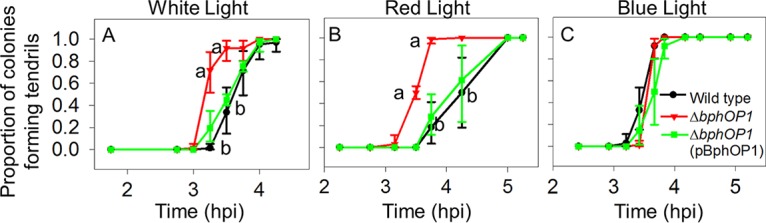
光可能是植物相关细菌的重要环境信号,尤其是那些生活在叶子上的细菌。人们已知,一个整合的红光/远红光和蓝光响应型光敏蛋白网络可抑制叶际植物病原菌 pv. syringae B728a 的群集运动。在这里,我们阐明了红光/远红光感应细菌菌视紫红质 BphP1 信号转导途径中的因素,并报告了 BphP1 在 B728a 生命周期多个阶段的作用证据。我们报告说,BphP1 信号涉及下游调节剂 Bsi(菌视紫红质调节的群集抑制剂)和酰基高丝氨酸内酯(AHL)信号。缺失 或 导致在群集运动中早期开始出现群集卷须,这一表型依赖于红光/远红光,并可被外源 AHL 逆转,这表明 BphP1-Bsi-AHL 途径抑制了从静止状态到运动状态的转变。缺失 或 导致在豆类()豆荚上产生更大的水渍损伤,并增强了从土壤和埋藏的植物组织向种子的运动,表明 BphP1 和 Bsi 通过土壤负调控毒力和细菌运动到种子。此外,BphP1 但不是 Bsi,有助于叶片定殖;缺失 减少了接种后立即在叶片上的存活,但增加了随后建立的种群大小。既不是 Bsi 也不是在这里鉴定的促进群集运动的 Smp 影响叶片定殖,表明 BphP1 介导的叶片定殖贡献至少部分独立于群集运动。这些结果表明, B728a 的红光感应涉及一个多组分、分支的调节途径,影响其生命周期的几个阶段。植物上的微生物特别适合利用基于光对植物生长的重要性的光线索。光敏蛋白使生物体能够感知光并对光做出反应,但它们在植物微生物生命周期中的作用知之甚少。本研究调查了叶际细菌病原体 中红光/远红光感应的细胞成分和生态作用。研究表明,一种细菌菌视紫红质光敏蛋白通过一个多组分、分支的调节途径发挥作用,该途径主要通过红光/远红光介导的抑制作用来运作。该途径负调控有利于群集运动的条件下从静止到运动状态的转变。它还负调控在豆类豆荚上的毒力、通过土壤向种子的运动以及接种后在叶片上的存活,但它对最终建立叶载种群有积极贡献。这些结果提供了强有力的证据,表明光感应在非光合植物微生物的生命周期的多个阶段调节行为。