College of Forestry, Northwest A&F University, Yangling, Shaanxi, 712100, China.
Guangxi University, Forestry College, Nanning, Guangxi, 530004, China.
Sci Rep. 2017 Oct 24;7(1):13866. doi: 10.1038/s41598-017-14425-6.
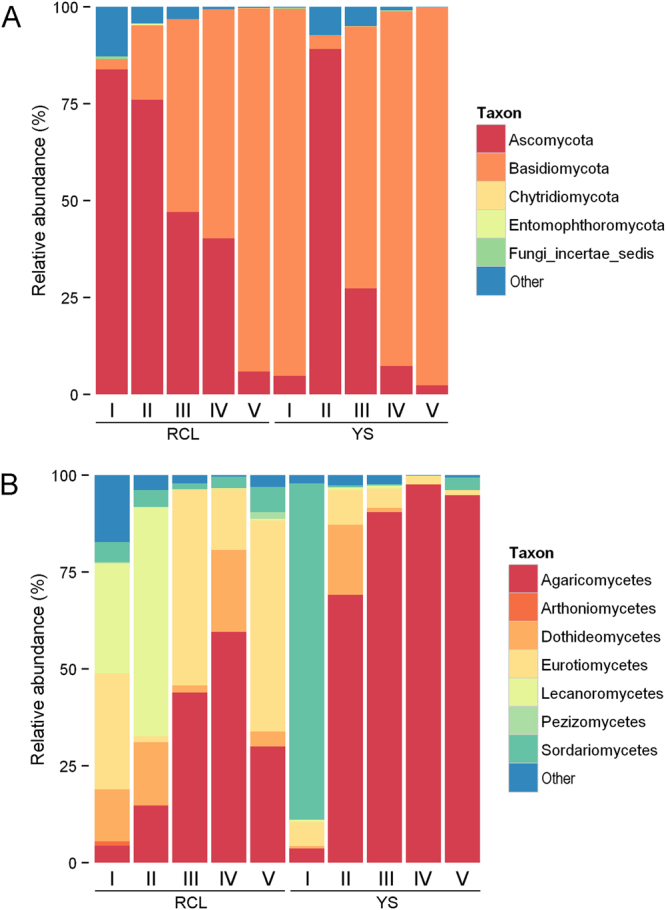
Historically, intense forest hazards have resulted in an increase in the quantity of fallen wood in the Qinling Mountains. Fallen wood has a decisive influence on the nutrient cycling, carbon budget and ecosystem biodiversity of forests, and fungi are essential for the decomposition of fallen wood. Moreover, decaying dead wood alters fungal communities. The development of high-throughput sequencing methods has facilitated the ongoing investigation of relevant molecular forest ecosystems with a focus on fungal communities. In this study, fallen wood and its associated fungal communities were compared at different stages of decomposition to evaluate relative species abundance and species diversity. The physical and chemical factors that alter fungal communities were also compared by performing correspondence analysis according to host tree species across all stages of decomposition. Tree species were the major source of differences in fungal community diversity at all decomposition stages, and fungal communities achieved the highest levels of diversity at the intermediate and late decomposition stages. Interactions between various physical and chemical factors and fungal communities shared the same regulatory mechanisms, and there was no tree species-specific influence. Improving our knowledge of wood-inhabiting fungal communities is crucial for forest ecosystem conservation.
从历史上看,剧烈的森林灾害导致秦岭南坡林区枯落物数量增加。枯落物对森林养分循环、碳预算和生态系统生物多样性具有决定性影响,真菌是枯落物分解的关键因素。此外,腐朽的枯木会改变真菌群落。高通量测序方法的发展促进了对相关分子森林生态系统的持续研究,重点是真菌群落。在这项研究中,比较了不同分解阶段的枯落物及其相关真菌群落,以评估相对物种丰度和物种多样性。还根据所有分解阶段的宿主树种,通过对应分析比较了改变真菌群落的物理和化学因素。在所有分解阶段,树种都是真菌群落多样性差异的主要来源,真菌群落的多样性在中晚期分解阶段达到最高水平。各种物理和化学因素与真菌群落之间的相互作用具有相同的调控机制,而树种没有特异性影响。提高对木材栖息真菌群落的认识对森林生态系统的保护至关重要。