Satlin Andrew, Wang Jinping, Logovinsky Veronika, Berry Scott, Swanson Chad, Dhadda Shobha, Berry Donald A
Neuroscience & General Medicine, Eisai Inc., Woodcliff Lake, NJ, USA.
Berry Consultants, LLC, Austin, TX, USA.
Alzheimers Dement (N Y). 2016 Feb 4;2(1):1-12. doi: 10.1016/j.trci.2016.01.001. eCollection 2016 Jan.
Recent failures in phase 3 clinical trials in Alzheimer's disease (AD) suggest that novel approaches to drug development are urgently needed. Phase 3 risk can be mitigated by ensuring that clinical efficacy is established before initiating confirmatory trials, but traditional phase 2 trials in AD can be lengthy and costly.
We designed a Bayesian adaptive phase 2, proof-of-concept trial with a clinical endpoint to evaluate BAN2401, a monoclonal antibody targeting amyloid protofibrils. The study design used dose response and longitudinal modeling. Simulations were used to refine study design features to achieve optimal operating characteristics.
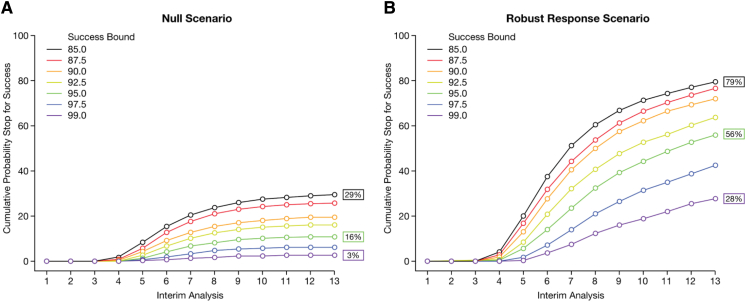
The study design includes five active treatment arms plus placebo, a clinical outcome, 12-month primary endpoint, and a maximum sample size of 800. The average overall probability of success is ≥80% when at least one dose shows a treatment effect that would be considered clinically meaningful. Using frequent interim analyses, the randomization ratios are adapted based on the clinical endpoint, and the trial can be stopped for success or futility before full enrollment.
Bayesian statistics can enhance the efficiency of analyzing the study data. The adaptive randomization generates more data on doses that appear to be more efficacious, which can improve dose selection for phase 3. The interim analyses permit stopping as soon as a predefined signal is detected, which can accelerate decision making. Both features can reduce the size and duration of the trial. This study design can mitigate some of the risks associated with advancing to phase 3 in the absence of data demonstrating clinical efficacy. Limitations to the approach are discussed.
近期阿尔茨海默病(AD)三期临床试验的失败表明,迫切需要新的药物研发方法。在启动确证性试验之前确保建立临床疗效,可减轻三期试验的风险,但AD传统的二期试验可能耗时且成本高昂。
我们设计了一项贝叶斯适应性二期概念验证试验,以临床终点评估靶向淀粉样原纤维的单克隆抗体BAN2401。研究设计采用剂量反应和纵向建模。通过模拟优化研究设计特征,以实现最佳操作特性。
研究设计包括五个活性治疗组加安慰剂组、一个临床结局、12个月的主要终点以及最大样本量800。当至少有一个剂量显示出具有临床意义的治疗效果时,成功的平均总体概率≥80%。通过频繁的中期分析,根据临床终点调整随机化比例,试验可在全部入组前因成功或无效而停止。
贝叶斯统计可提高研究数据分析的效率。适应性随机化可生成更多关于似乎更有效的剂量的数据,这有助于改善三期试验的剂量选择。中期分析允许一旦检测到预定义信号就停止试验,从而加快决策。这两个特征都可减少试验的规模和持续时间。这种研究设计可减轻在缺乏临床疗效数据的情况下推进到三期试验相关的一些风险。文中讨论了该方法的局限性。