Cummings Jeffrey, Lee Garam, Mortsdorf Travis, Ritter Aaron, Zhong Kate
Cleveland Clinic Lou Ruvo Center for Brain Health, Las Vegas, NV, USA.
Touro University Nevada, Henderson, NV, USA.
Alzheimers Dement (N Y). 2017 May 24;3(3):367-384. doi: 10.1016/j.trci.2017.05.002. eCollection 2017 Sep.
There is an urgent need to develop new treatments for Alzheimer's disease (AD) and to understand the drug development process for new AD therapies.
We assessed the agents in the AD pipeline as documented in clinicaltrials.gov for phase I, phase II, and phase III, accessed 1/5/2017.
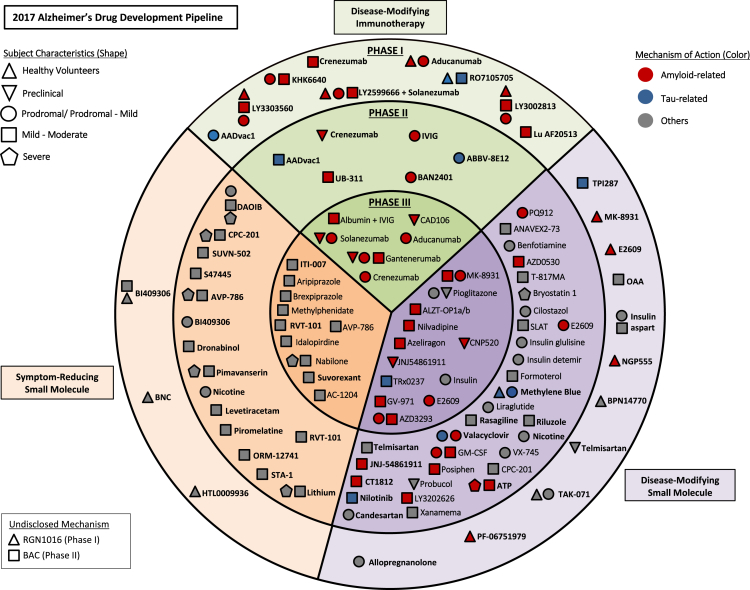
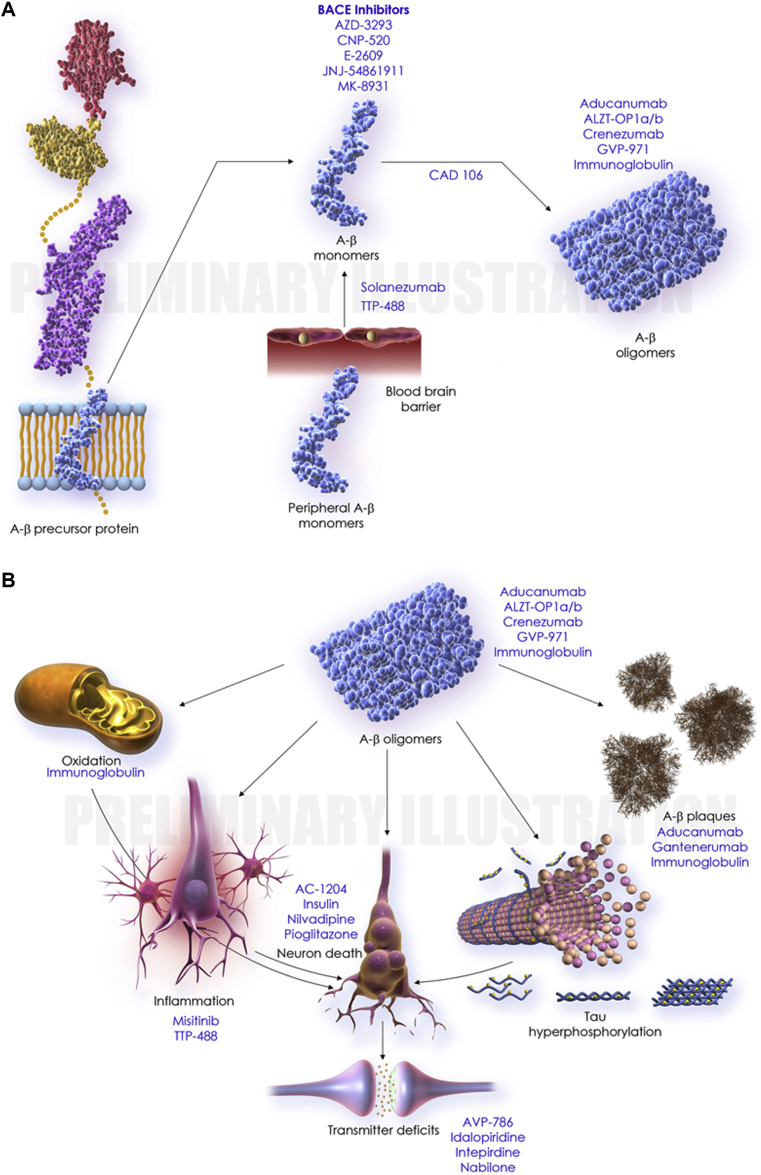
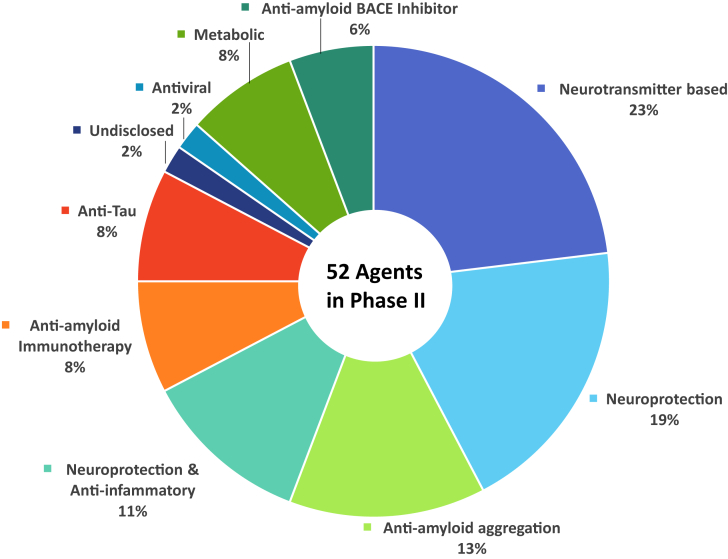
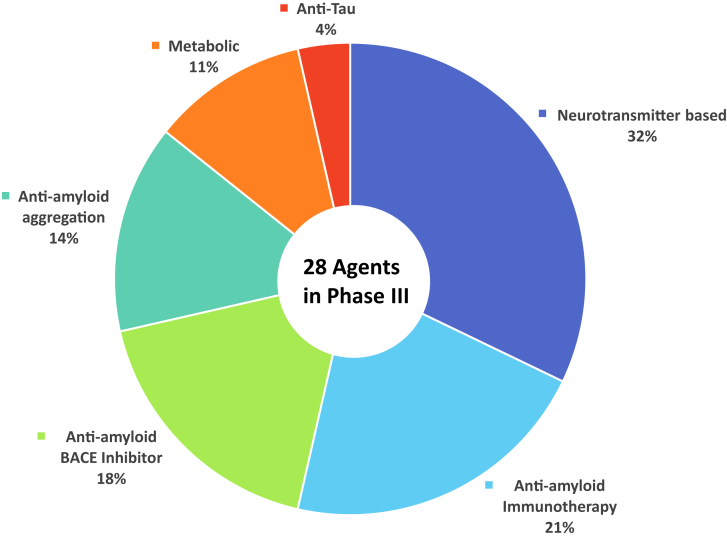
There are 105 agents in the AD treatment development pipeline, of which 25 agents are in 29 trials in phase I, 52 agents are in 68 trials in phase II, and 28 agents are in 42 trials in phase III. Seventy percent of drugs in the AD pipeline are disease-modifying therapies (DMTs). Fourteen percent are symptomatic cognitive enhancers, and 13% are symptomatic agents addressing neuropsychiatric and behavioral changes (2% have undisclosed mechanisms). Most trials are sponsored by the biopharmaceutical industry. Trials include patients with preclinical AD (cognitively normal with biomarker evidence of AD), prodromal AD (mild cognitive symptoms and biomarker evidence of AD), and AD dementia. Biomarkers are included in many drug development programs particularly those for DMTs. Thirteen of 46 phase II DMT trials have amyloid imaging as an entry criterion, and 10 of 28 phase III trials incorporate amyloid imaging for diagnosis and entry. A large number of participants are needed for AD clinical trials; in total, 54,073 participants are required for trials spanning preclinical AD to AD dementia. When compared with the 2016 pipeline, there are eight new agents in phase I, 16 in phase II, and five in phase III.
The AD drug development pipeline has 105 agents divided among phase I, phase II, and phase III. The trials include a wide range of clinical trial populations, many mechanisms of action, and require a substantial number of clinical trial participants. Biomarkers are increasingly used in patient identification and as outcome measures, particularly in trials of DMTs.
迫切需要开发治疗阿尔茨海默病(AD)的新疗法,并了解新型AD疗法的药物研发过程。
我们评估了clinicaltrials.gov上记录的处于I期、II期和III期的AD研发管线中的药物,访问时间为2017年1月5日。
AD治疗研发管线中有105种药物,其中25种药物处于29项I期试验中,52种药物处于68项II期试验中,28种药物处于42项III期试验中。AD研发管线中70%的药物为疾病修饰疗法(DMTs)。14%为有症状的认知增强剂,13%为针对神经精神和行为变化的有症状药物(2%作用机制未公开)。大多数试验由生物制药行业赞助。试验纳入了临床前期AD患者(认知正常但有AD生物标志物证据)、前驱期AD患者(有轻度认知症状和AD生物标志物证据)以及AD痴呆患者。生物标志物被纳入许多药物研发项目,尤其是DMTs的项目。46项II期DMT试验中有13项将淀粉样蛋白成像作为入组标准,28项III期试验中有10项将淀粉样蛋白成像用于诊断和入组。AD临床试验需要大量参与者;从临床前期AD到AD痴呆的试验总共需要54,073名参与者。与2016年的研发管线相比,I期有8种新药,II期有16种,III期有5种。
AD药物研发管线中有105种药物分布在I期、II期和III期。试验涵盖了广泛的临床试验人群、多种作用机制,并且需要大量的临床试验参与者。生物标志物越来越多地用于患者识别和作为疗效指标,尤其是在DMTs试验中。