Beyer Kyle S, Stout Jeffrey R, Fukuda David H, Jajtner Adam R, Townsend Jeremy R, Church David D, Wang Ran, Riffe Joshua J, Muddle Tyler W D, Herrlinger Kelli A, Hoffman Jay R
1Department of Educational and Human Sciences, Institute of Exercise Physiology and Wellness, University of Central Florida, Orlando, Florida;2Department of Exercise Physiology, Kent State University, Kent, Ohio;3Department of Kinesiology, Lipscomb University, Nashville, Tennessee; and4Kemin Foods, L.C., Des Moines, Iowa.
J Strength Cond Res. 2017 Nov;31(11):2945-2954. doi: 10.1519/JSC.0000000000002104.
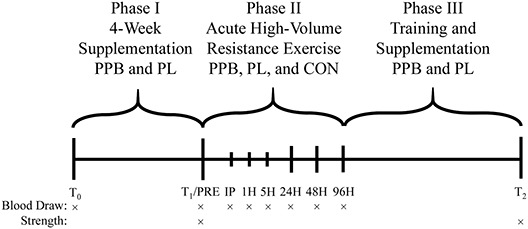
Beyer, KS, Stout, JR, Fukuda, DH, Jajtner, AR, Townsend, JR, Church, DD, Wang, R, Riffe, JJ, Muddle, TWD, Herrlinger, KA, and Hoffman, JR. Impact of polyphenol supplementation on acute and chronic response to resistance training. J Strength Cond Res 31(11): 2945-2954, 2017-This study investigated the effect of a proprietary polyphenol blend (PPB) on acute and chronic adaptations to resistance exercise. Forty untrained men were assigned to control, PPB, or placebo. Participants in PPB or placebo groups completed a 4-week supplementation period (phase I), an acute high-volume exercise bout (phase II), and a 6-week resistance training program (phase III); whereas control completed only testing during phase II. Blood draws were completed during phases I and II. Maximal strength in squat, leg press, and leg extension were assessed before and after phase III. The exercise protocol during phase II consisted of squat, leg press, and leg extension exercises using 70% of the participant's strength. The resistance training program consisted of full-body exercises performed 3 d·wk. After phase I, PPB (1.56 ± 0.48 mM) had greater total antioxidant capacity than placebo (1.00 ± 0.90 mM). Changes in strength from phase III were similar between PPB and placebo. Polyphenol blend supplementation may be an effective strategy to increase antioxidant capacity without limiting strength gains from training.
拜尔,KS;斯托特,JR;福田,DH;亚伊特纳,AR;汤森德,JR;丘奇,DD;王,R;里夫,JJ;马德尔,TWD;赫林格,KA;霍夫曼,JR。补充多酚对阻力训练急性和慢性反应的影响。《力量与体能研究杂志》31(11): 2945 - 2954,2017年——本研究调查了一种专利多酚混合物(PPB)对阻力运动急性和慢性适应的影响。40名未经训练的男性被分配到对照组、PPB组或安慰剂组。PPB组或安慰剂组的参与者完成了为期4周的补充期(第一阶段)、一次急性大运动量运动 bout(第二阶段)和一个为期6周的阻力训练计划(第三阶段);而对照组仅在第二阶段进行测试。在第一阶段和第二阶段完成采血。在第三阶段前后评估深蹲、腿举和腿伸展的最大力量。第二阶段的运动方案包括使用参与者70%力量进行的深蹲、腿举和腿伸展运动。阻力训练计划包括每周3天进行的全身运动。在第一阶段后,PPB(1.56±0.48 mM)的总抗氧化能力高于安慰剂(1.00±0.90 mM)。PPB组和安慰剂组在第三阶段的力量变化相似。补充多酚混合物可能是一种有效的策略,可增加抗氧化能力而不限制训练带来的力量增长。