Department of Gynecology and Obstetrics, Shanghai Pudong Hospital, Fudan University Pudong Medical Center, Shanghai, China (mainland).
Department of Urology, Shanghai Jiao Tong University Affiliated Sixth People's Hospital, Shanghai, China (mainland).
Med Sci Monit. 2017 Oct 26;23:5096-5105. doi: 10.12659/msm.903552.
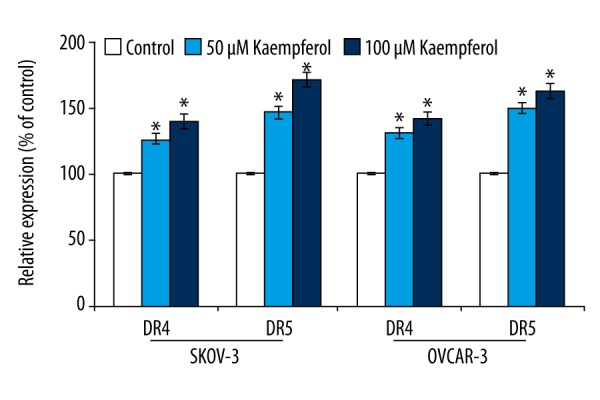
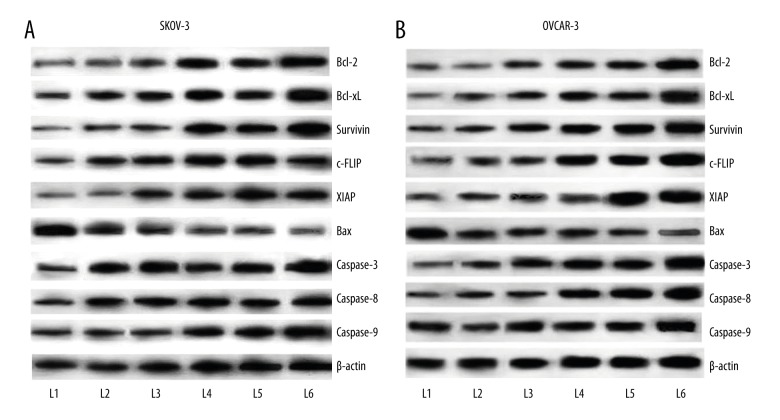
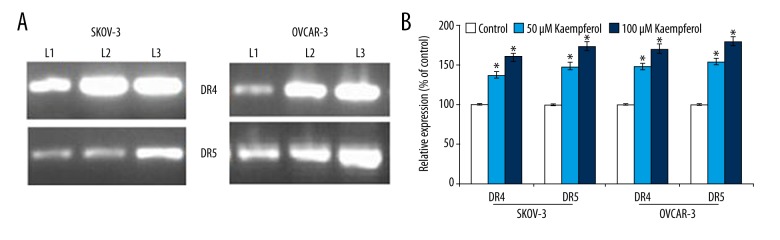
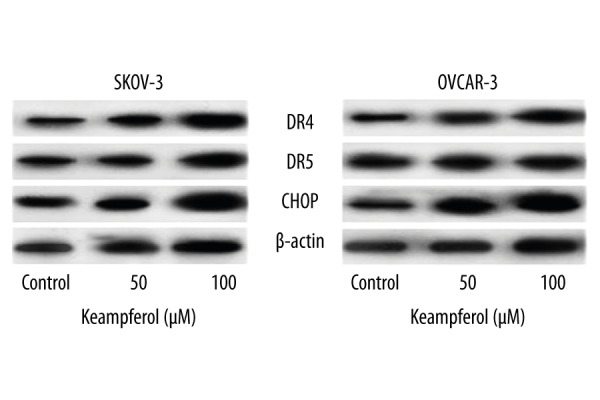
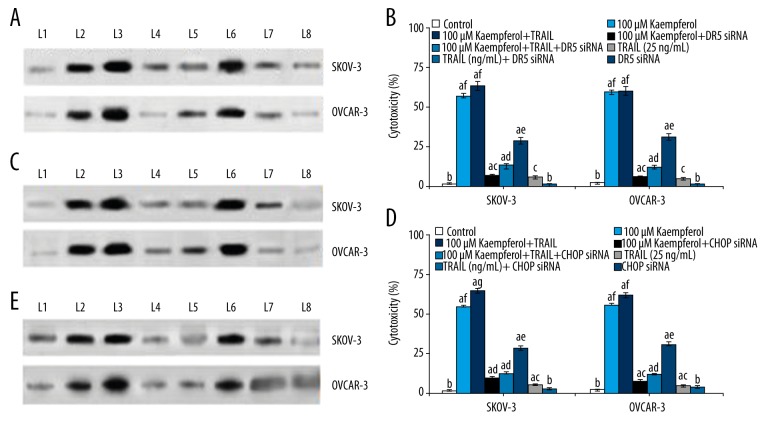
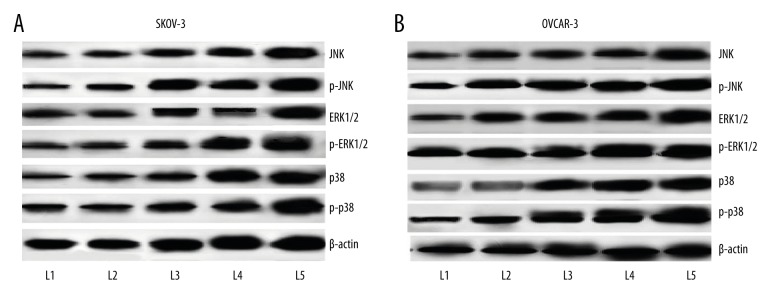
BACKGROUND Ovarian cancer is the most common gynecological malignancies in women, with high mortality rates worldwide. Tumor necrosis factor-related apoptosis-inducing ligand (TRAIL) is a member of the tumor necrosis factor (TNF) superfamily which preferentially induces apoptosis of cancer cells. However, acquired resistance to TRAIL hampers its therapeutic application. Identification of compounds that sensitize cancer cells to TRAIL is vital in combating resistance to TRAIL. The effect of kaempferol, a flavonoid enhancing TRAIL-induced apoptosis in ovarian cancer cells, was investigated in this study. MATERIAL AND METHODS The cytotoxic effects of TRAIL (25 ng/mL) and kaempferol (20-100 µM) on human ovarian cancer cells OVCAR-3 and SKOV-3 were assessed. Effect of kaempferol on the expression patterns of cell survival proteins (Bcl-xL, Bcl-2, survivin, XIAP, c-FLIP) and apoptotic proteins (caspase-3, caspase-8, caspase-9, Bax) were studied. The influence of kaempferol on expression of DR4 and DR5 death receptors on the cell surface and protein and mRNA levels was also analyzed. Apoptosis following silencing of DR5 and CHOP by small interfering RNA (siRNA), and activation of MAP kinases were analyzed as well. RESULTS Kaempferol enhanced apoptosis and drastically up-regulated DR4, DR5, CHOP, JNK, ERK1/2, p38 and apoptotic protein expression with decline in the expression of anti-apoptotic proteins. Further transfection with siRNA specific to CHOP and DR5 indicated the involvement of CHOP in DR5 up-regulation and also the contribution of DR5 in kaempferol-enhanced TRAIL-induced apoptosis. CONCLUSIONS Kaempferol sensitized ovarian cancer cells to TRAIL-induced apoptosis via up-regulation of DR4 and DR5 through ERK/JNK/CHOP pathways.
卵巢癌是女性最常见的妇科恶性肿瘤,全球死亡率较高。肿瘤坏死因子相关凋亡诱导配体(TRAIL)是肿瘤坏死因子(TNF)超家族的一员,它优先诱导癌细胞凋亡。然而,获得性对 TRAIL 的耐药性阻碍了其治疗应用。鉴定能使癌细胞对 TRAIL 敏感的化合物对于对抗 TRAIL 耐药性至关重要。本研究探讨了黄酮类化合物山奈酚增强卵巢癌细胞中 TRAIL 诱导凋亡的作用。
检测 TRAIL(25ng/mL)和山奈酚(20-100μM)对人卵巢癌细胞 OVCAR-3 和 SKOV-3 的细胞毒性作用。研究山奈酚对细胞存活蛋白(Bcl-xL、Bcl-2、survivin、XIAP、c-FLIP)和凋亡蛋白(caspase-3、caspase-8、caspase-9、Bax)表达模式的影响。分析山奈酚对细胞表面死亡受体 DR4 和 DR5 的表达以及蛋白和 mRNA 水平的影响。还分析了通过小干扰 RNA(siRNA)沉默 DR5 和 CHOP 以及激活 MAP 激酶后细胞凋亡的情况。
山奈酚增强了细胞凋亡,并明显上调了 DR4、DR5、CHOP、JNK、ERK1/2、p38 和凋亡蛋白的表达,同时下调了抗凋亡蛋白的表达。进一步用特异性针对 CHOP 和 DR5 的 siRNA 转染表明,CHOP 参与了 DR5 的上调,DR5 也参与了山奈酚增强的 TRAIL 诱导的凋亡。
山奈酚通过 ERK/JNK/CHOP 途径上调 DR4 和 DR5,使卵巢癌细胞对 TRAIL 诱导的凋亡敏感。