Civil Engineering, Indian Institute of Technology Gandhinagar, Gujarat, 382355, India.
Earth, Atmospheric and Planetary Sciences, Purdue University, West Lafayette, IN 47907, USA.
Sci Rep. 2017 Oct 25;7(1):14054. doi: 10.1038/s41598-017-14213-2.
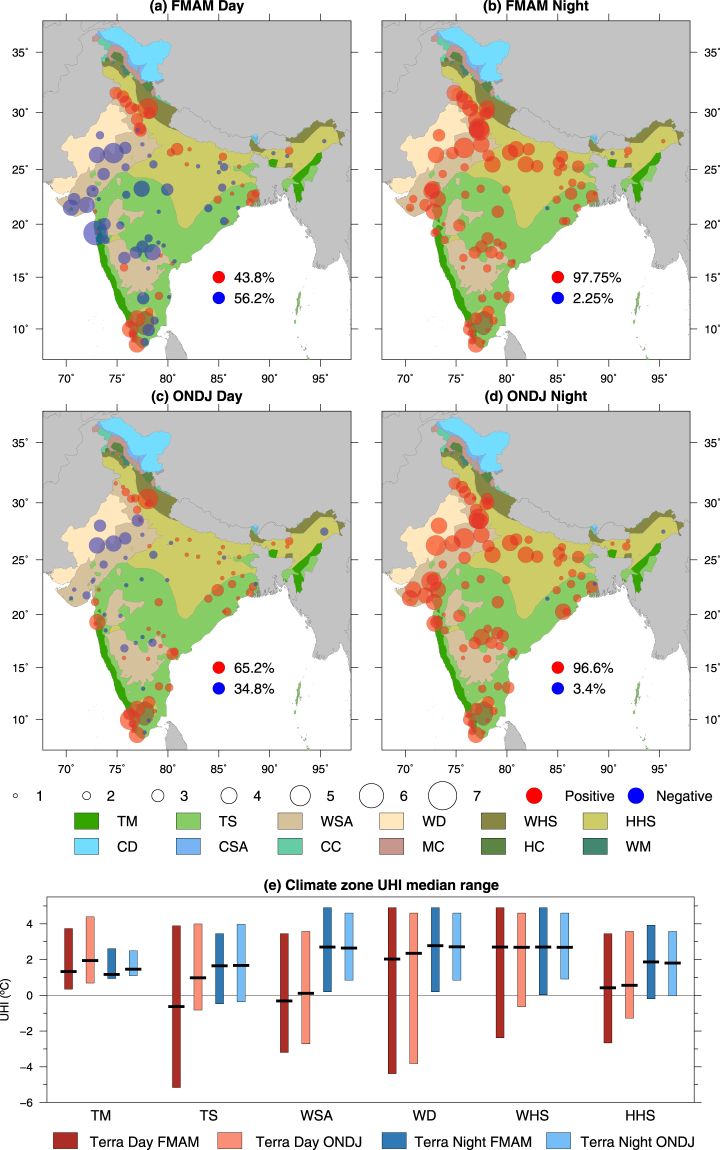
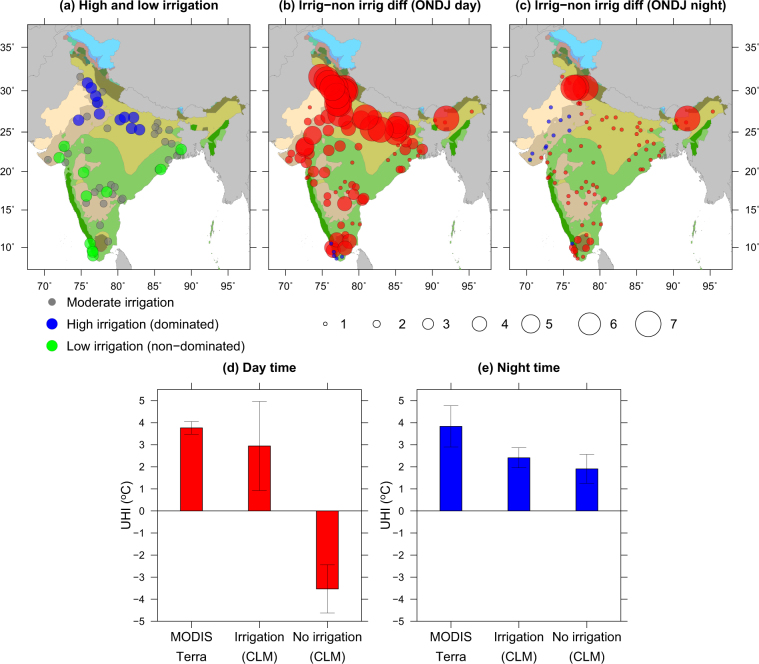
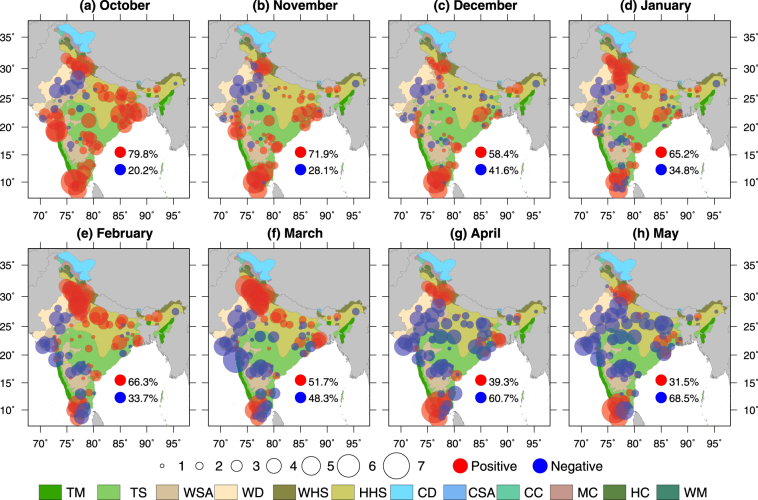
As is true in many regions, India experiences surface Urban Heat Island (UHI) effect that is well understood, but the causes of the more recently discovered Urban Cool Island (UCI) effect remain poorly constrained. This raises questions about our fundamental understanding of the drivers of rural-urban environmental gradients and hinders development of effective strategies for mitigation and adaptation to projected heat stress increases in rapidly urbanizing India. Here we show that more than 60% of Indian urban areas are observed to experience a day-time UCI. We use satellite observations and the Community Land Model (CLM) to identify the impact of irrigation and prove for the first time that UCI is caused by lack of vegetation and moisture in non-urban areas relative to cities. In contrast, urban areas in extensively irrigated landscapes generally experience the expected positive UHI effect. At night, UHI warming intensifies, occurring across a majority (90%) of India's urban areas. The magnitude of rural-urban temperature contrasts is largely controlled by agriculture and moisture availability from irrigation, but further analysis of model results indicate an important role for atmospheric aerosols. Thus both land-use decisions and aerosols are important factors governing, modulating, and even reversing the expected urban-rural temperature gradients.
与许多地区一样,印度也经历着地表城市热岛(UHI)效应,这一现象已被充分了解,但最近发现的城市冷岛(UCI)效应的成因仍难以确定。这使得我们对农村到城市环境梯度的驱动因素的基本理解产生了疑问,并阻碍了在印度快速城市化背景下,制定缓解和适应预期热压力增加的有效策略。在这里,我们发现超过 60%的印度城市地区存在日间 UCI 现象。我们利用卫星观测和通用陆面模式(CLM)来识别灌溉的影响,并首次证明 UCI 是由于非城市地区相对于城市缺乏植被和水分造成的。相比之下,在广泛灌溉的景观中,城市地区通常会出现预期的正 UHI 效应。到了晚上,UHI 变暖加剧,印度大部分(90%)城市地区都出现了这种情况。城乡温差的大小主要受农业和灌溉水分供应的影响,但对模型结果的进一步分析表明,大气气溶胶也起着重要作用。因此,土地利用决策和气溶胶都是影响、调节甚至反转城乡预期温度梯度的重要因素。