Department of Mechanical, Aerospace and Civil Engineering, University of Manchester, Oxford Road, Manchester, M13 9PL, UK.
Centre for Crisis Studies and Mitigation, University of Manchester, Oxford Road, Manchester, M13 9PL, UK.
Int J Biometeorol. 2022 Aug;66(8):1531-1545. doi: 10.1007/s00484-022-02295-1. Epub 2022 Jun 17.
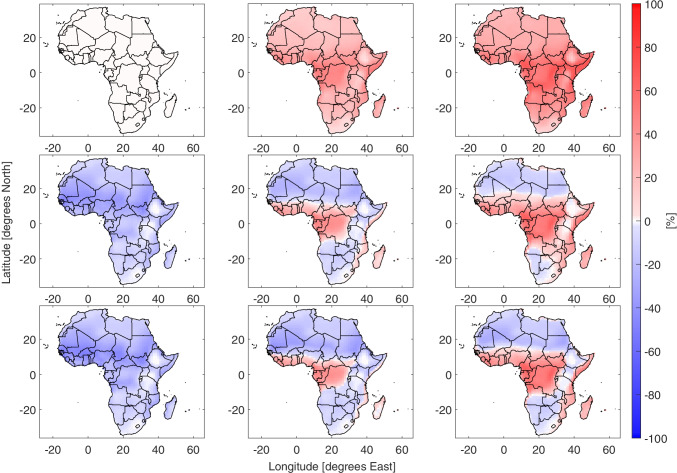
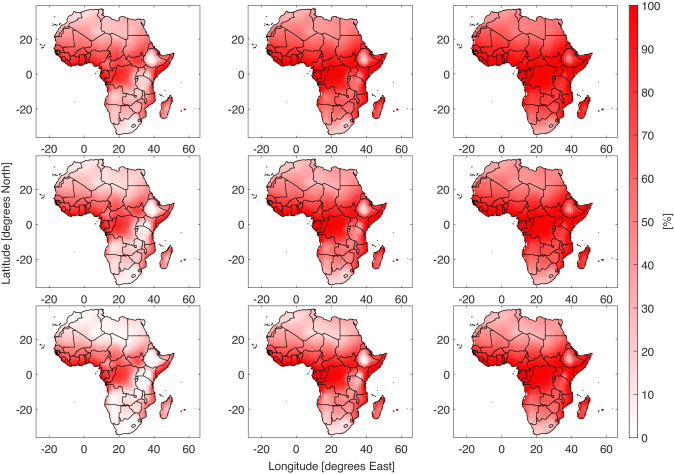
Extreme weather events are major causes of loss of life and damage infrastructure worldwide. High temperatures cause heat stress on humans, livestock, crops and infrastructure. Heat stress exposure is projected to increase with ongoing climate change. Extremes of temperature are common in Africa and infrastructure is often incapable of providing adequate cooling. We show how easily accessible cooling technology, such as evaporative coolers, prevent heat stress in historic timescales but are unsuitable as a solution under climate change. As temperatures increase, powered cooling, such as air conditioning, is necessary to prevent overheating. This will, in turn, increase demand on already stretched infrastructure. We use high temporal resolution climate model data to estimate the demand for cooling according to two metrics, firstly the apparent temperature and secondly the discomfort index. For each grid cell we calculate the heat stress value and the amount of cooling required to turn a heat stress event into a non heat stress event. We show the increase in demand for cooling in Africa is non uniform and that equatorial countries are exposed to higher heat stress than higher latitude countries. We further show that evaporative coolers are less effective in tropical regions than in the extra tropics. Finally, we show that neither low nor high efficiency coolers are sufficient to return Africa to current levels of heat stress under climate change.
极端天气事件是全球范围内造成生命损失和基础设施破坏的主要原因。高温会给人类、牲畜、农作物和基础设施带来热应激。随着气候变化的持续,预计热应激暴露的情况将会增加。高温在非洲很常见,而基础设施通常无法提供足够的冷却。我们展示了如何轻松获得冷却技术,例如蒸发式冷却器,可以在历史时间尺度上防止热应激,但在气候变化下并不适合作为解决方案。随着温度的升高,需要使用电力冷却,例如空调,以防止过热。这反过来又会增加对已经紧张的基础设施的需求。我们使用高时间分辨率气候模型数据根据两个指标来估计冷却需求,首先是表观温度,其次是不适指数。对于每个网格单元,我们计算热应激值和所需的冷却量,以使热应激事件转变为非热应激事件。我们表明,非洲对冷却的需求增加是不均匀的,赤道国家比高纬度国家面临更高的热应激。我们进一步表明,在热带地区,蒸发式冷却器的效果不如在亚热带地区好。最后,我们表明,无论是低效还是高效的冷却器,都不足以使非洲在气候变化下回到当前的热应激水平。