• 文献检索
  • 文档翻译
  • 深度研究
  • 学术资讯
  • Suppr Zotero 插件Zotero 插件
  • 邀请有礼
  • 套餐&价格
  • 历史记录
应用&插件
Suppr Zotero 插件Zotero 插件浏览器插件Mac 客户端Windows 客户端微信小程序
定价
高级版会员购买积分包购买API积分包
服务
文献检索文档翻译深度研究API 文档MCP 服务
关于我们
关于 Suppr公司介绍联系我们用户协议隐私条款
关注我们

Suppr 超能文献

核心技术专利:CN118964589B侵权必究
粤ICP备2023148730 号-1Suppr @ 2026

文献检索

告别复杂PubMed语法,用中文像聊天一样搜索,搜遍4000万医学文献。AI智能推荐,让科研检索更轻松。

立即免费搜索

文件翻译

保留排版,准确专业,支持PDF/Word/PPT等文件格式,支持 12+语言互译。

免费翻译文档

深度研究

AI帮你快速写综述,25分钟生成高质量综述,智能提取关键信息,辅助科研写作。

立即免费体验

黄芪属(Astragalus)节毛组的分子系统发育和分化时间:豆科一个快速多样化物种群的分析。

Molecular phylogeny and divergence times of Astragalus section Hymenostegis: An analysis of a rapidly diversifying species group in Fabaceae.

机构信息

Department of Biology, Faculty of Sciences, University of Isfahan, Isfahan, 81746-73441, Iran.

Botany Research Division, Research Institute of Forests and Rangelands, Agricultural Research, Education and Extension Organization (AREEO), 13185-116, Tehran, Iran.

出版信息

Sci Rep. 2017 Oct 25;7(1):14033. doi: 10.1038/s41598-017-14614-3.

DOI:10.1038/s41598-017-14614-3
PMID:29070910
原文链接:https://pmc.ncbi.nlm.nih.gov/articles/PMC5656595/
Abstract

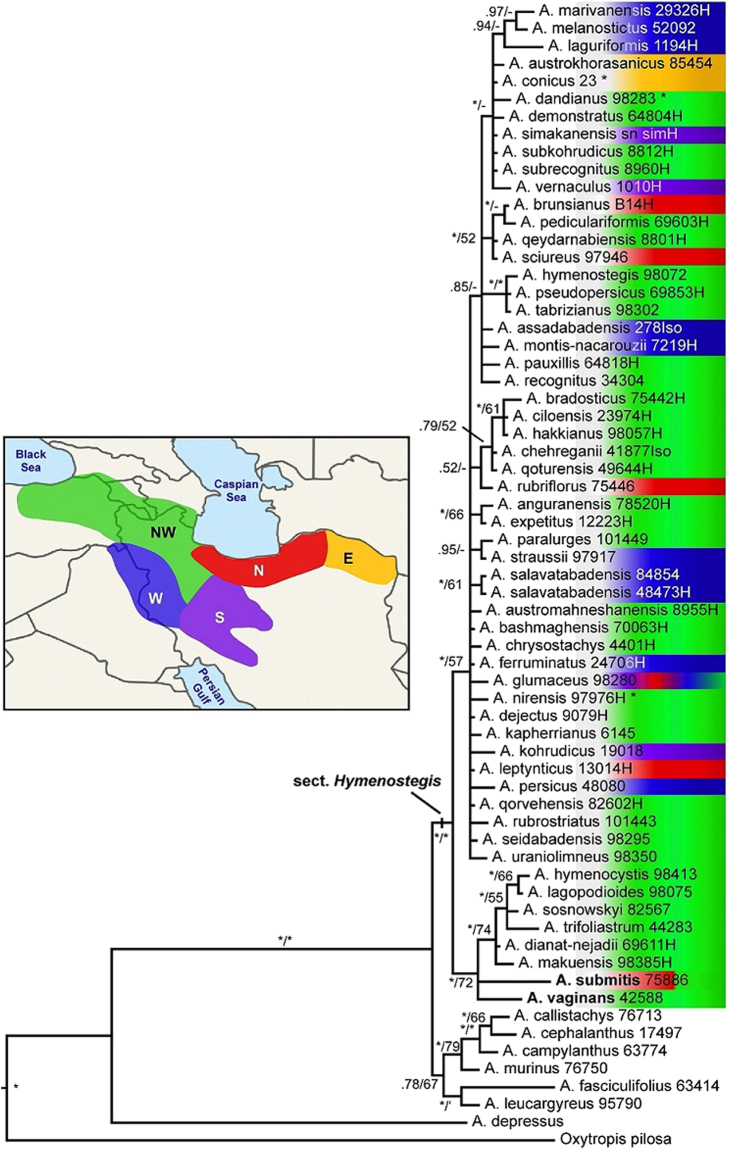
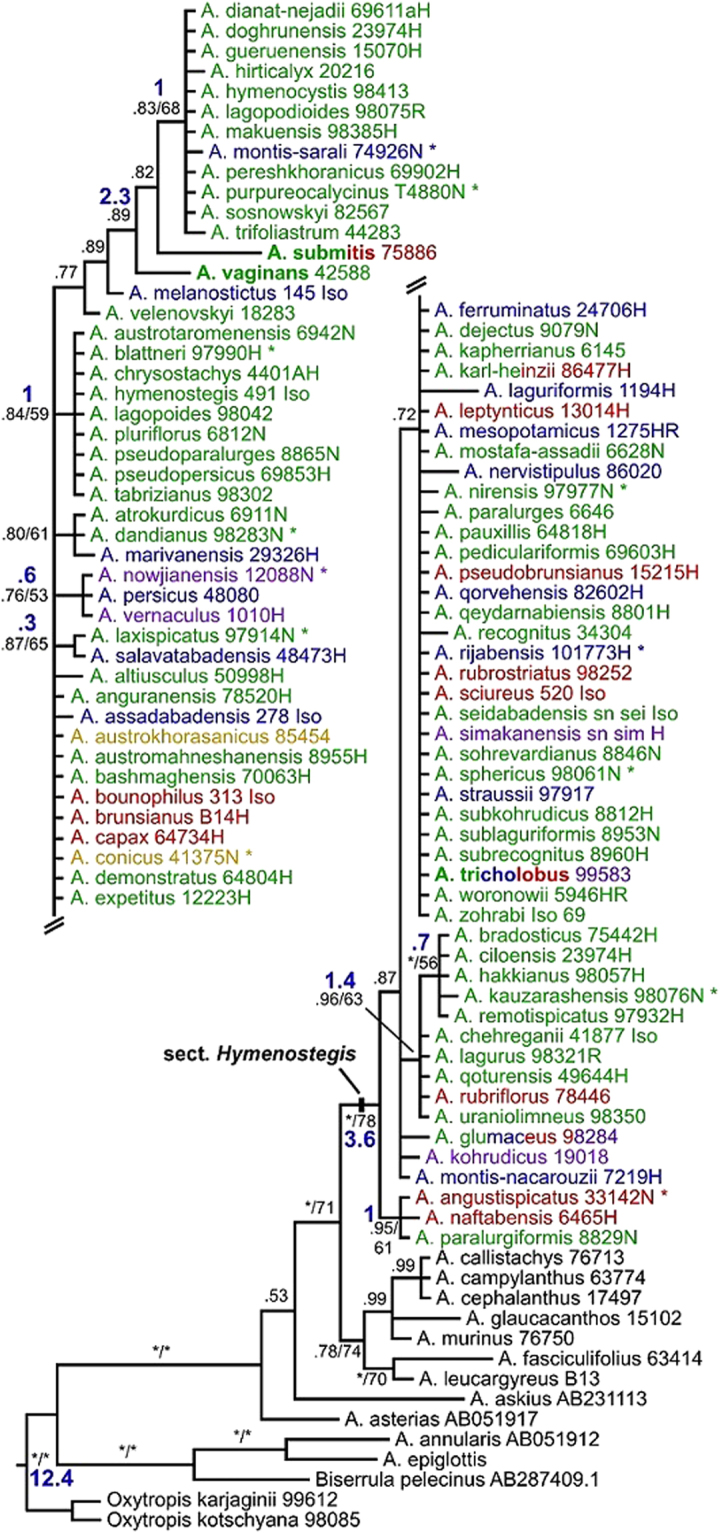
The taxa of Astragalus section Hymenostegis are an important element of mountainous and steppe habitats in Southwest Asia. A phylogenetic hypothesis of sect. Hymenostegis has been obtained from nuclear ribosomal DNA internal transcribed spacer (ITS) and plastid ycf1 sequences of up to 303 individuals from 106 species, including all 89 taxa currently assigned to sect. Hymenostegis, 14 species of other Astragalus sections, and two species of Oxytropis and one Biserrula designated as outgroups. Bayesian phylogenetic inference and parsimony analyses reveal that three species from two other closely related sections group within sect. Hymenostegis, making the section paraphyletic. DNA sequence diversity is generally very low among Hymenostegis taxa, which is consistent with recent diversification of the section. We estimate that diversification in sect. Hymenostegis occurred in the middle to late Pleistocene, with many species arising only during the last one million years, when environmental conditions in the mountain regions of Southwest and Central Asia cycled repeatedly between dry and more humid conditions.

摘要

紫云英属(Astragalus)节段密花组的分类群是亚洲西南部山地和草原生境的重要组成部分。通过对核核糖体 DNA 内转录间隔区(ITS)和多达 303 个个体的质体 ycf1 序列的分析,获得了节段密花组的系统发育假说,其中包括目前分配给节段密花组的 89 个分类群、14 个其他紫云英属节段的物种以及作为外群的两种 Oxytropis 和一种 Biserrula。贝叶斯系统发育推断和简约分析表明,来自两个其他密切相关节段的三个物种属于节段密花组,使得该组为并系群。节段密花组的 DNA 序列多样性通常非常低,这与该组最近的多样化是一致的。我们估计,节段密花组的多样化发生在更新世中期至晚期,许多物种仅在过去 100 万年中出现,当时亚洲西南部和中部山区的环境条件在干燥和更湿润的条件之间反复循环。
https://cdn.ncbi.nlm.nih.gov/pmc/blobs/545a/5656595/c003c847b355/41598_2017_14614_Fig3_HTML.jpg
https://cdn.ncbi.nlm.nih.gov/pmc/blobs/545a/5656595/436ad4e357e9/41598_2017_14614_Fig1_HTML.jpg
https://cdn.ncbi.nlm.nih.gov/pmc/blobs/545a/5656595/f9845b61203f/41598_2017_14614_Fig2_HTML.jpg
https://cdn.ncbi.nlm.nih.gov/pmc/blobs/545a/5656595/c003c847b355/41598_2017_14614_Fig3_HTML.jpg
https://cdn.ncbi.nlm.nih.gov/pmc/blobs/545a/5656595/436ad4e357e9/41598_2017_14614_Fig1_HTML.jpg
https://cdn.ncbi.nlm.nih.gov/pmc/blobs/545a/5656595/f9845b61203f/41598_2017_14614_Fig2_HTML.jpg
https://cdn.ncbi.nlm.nih.gov/pmc/blobs/545a/5656595/c003c847b355/41598_2017_14614_Fig3_HTML.jpg

相似文献

1
Molecular phylogeny and divergence times of Astragalus section Hymenostegis: An analysis of a rapidly diversifying species group in Fabaceae.黄芪属(Astragalus)节毛组的分子系统发育和分化时间:豆科一个快速多样化物种群的分析。
Sci Rep. 2017 Oct 25;7(1):14033. doi: 10.1038/s41598-017-14614-3.
2
Genome Size and Chromosome Number Evaluation of L. sect. Bunge (Fabaceae).豆科黄耆属扁荚组的基因组大小与染色体数目评估
Plants (Basel). 2022 Feb 5;11(3):435. doi: 10.3390/plants11030435.
3
Dated Phylogeny of Section (Fabaceae) and Allied Taxa in the Hypoglottis Clade.下珠豆分支中豆科下珠豆组及近缘类群的年代系统发育
Biology (Basel). 2023 Jan 16;12(1):138. doi: 10.3390/biology12010138.
4
Geographical isolation caused the diversification of the Mediterranean thorny cushion-like Astragalus L. sect. Tragacantha DC. (Fabaceae).地理隔离导致了地中海地区具刺垫状黄芪属(豆科)的多样化。
Mol Phylogenet Evol. 2016 Apr;97:187-195. doi: 10.1016/j.ympev.2016.01.006. Epub 2016 Jan 22.
5
Phylogeny of Caragana (Fabaceae) based on DNA sequence data from rbcL, trnS-trnG, and ITS.基于rbcL、trnS-trnG和ITS的DNA序列数据构建的锦鸡儿属(豆科)系统发育
Mol Phylogenet Evol. 2009 Mar;50(3):547-59. doi: 10.1016/j.ympev.2008.12.001. Epub 2008 Dec 8.
6
Breeding system diversification and evolution in American Poa supersect. Homalopoa (Poaceae: Poeae: Poinae).美洲早熟禾超组扁鞘早熟禾亚组的繁育系统多样化与进化(禾本科:早熟禾族:早熟禾亚族)
Ann Bot. 2016 Aug;118(2):281-303. doi: 10.1093/aob/mcw108. Epub 2016 Jul 3.
7
Molecular phylogeny and genetic variation in the genus Lilium native to China based on the internal transcribed spacer sequences of nuclear ribosomal DNA.基于核核糖体 DNA 内转录间隔区序列的中国百合属的分子系统发育和遗传变异。
J Plant Res. 2014 Mar;127(2):249-63. doi: 10.1007/s10265-013-0600-4. Epub 2013 Nov 9.
8
Molecular Phylogeny and Morphological Analysis Support a New Species and New Synonymy in Iranian Astragalus (Leguminosae).分子系统发育和形态学分析支持伊朗黄芪属(豆科)中的一个新物种和新异名。
PLoS One. 2016 Mar 9;11(3):e0149726. doi: 10.1371/journal.pone.0149726. eCollection 2016.
9
Phylogeny of Astragalus in China: molecular evidence from the DNA sequences of 5S rRNA spacer, ITS, and 18S rRNA.中国黄芪属植物系统发育:来自5S rRNA间隔区、ITS和18S rRNA DNA序列的分子证据
J Agric Food Chem. 2003 Nov 5;51(23):6709-14. doi: 10.1021/jf034278x.
10
Molecular evolution and phylogenetic implications of internal transcribed spacer sequences of nuclear ribosomal DNA in the Phaseolus-Vigna complex.菜豆-豇豆复合体中核糖体DNA内转录间隔区序列的分子进化及系统发育意义
Mol Phylogenet Evol. 2002 Jan;22(1):1-19. doi: 10.1006/mpev.2001.1037.

引用本文的文献

1
Molecular Insights into the Diversification and Biogeographic History of Six L. Sections in the Turkish Flora.土耳其植物区系中六个百合属组多样化及生物地理历史的分子见解
Plants (Basel). 2025 Jul 18;14(14):2226. doi: 10.3390/plants14142226.
2
Comparative analysis of chloroplast genomes reveals molecular evolution and phylogenetic relationships within the Papilionoideae of Fabaceae.叶绿体基因组的比较分析揭示了豆科蝶形花亚科内的分子进化和系统发育关系。
BMC Plant Biol. 2025 Feb 6;25(1):157. doi: 10.1186/s12870-025-06138-0.
3
A new species of Astragalus (Fabaceae) from the Irano-Turanian biodiversity hotspot: an integrative approach.

本文引用的文献

1
EVOLUTIONARY SIGNIFICANCE OF THE LOSS OF THE CHLOROPLAST-DNA INVERTED REPEAT IN THE LEGUMINOSAE SUBFAMILY PAPILIONOIDEAE.豆科蝶形花亚科叶绿体DNA反向重复序列缺失的进化意义
Evolution. 1990 Mar;44(2):390-402. doi: 10.1111/j.1558-5646.1990.tb05207.x.
2
High density, genome-wide markers and intra-specific replication yield an unprecedented phylogenetic reconstruction of a globally significant, speciose lineage of Eucalyptus.高密度、全基因组标记和种内复制为全球重要的、物种丰富的桉属谱系带来了前所未有的系统发育重建。
Mol Phylogenet Evol. 2016 Dec;105:63-85. doi: 10.1016/j.ympev.2016.08.009. Epub 2016 Aug 12.
3
来自伊朗 - 图兰生物多样性热点地区的黄芪属(豆科)一新物种:一种综合研究方法
Bot Stud. 2025 Jan 8;66(1):1. doi: 10.1186/s40529-024-00448-6.
4
Evolutionary history of an Irano-Turanian cushion-forming legume (Onobrychis cornuta).伊朗-图兰垫状豆科植物(苦马豆)的进化历史。
BMC Plant Biol. 2024 Mar 20;24(1):204. doi: 10.1186/s12870-024-04895-y.
5
Characterization and comparative analysis of the complete plastid genomes of four Astragalus species.四种黄芪属植物完整质体基因组的特征描述与比较分析。
PLoS One. 2023 May 23;18(5):e0286083. doi: 10.1371/journal.pone.0286083. eCollection 2023.
6
Phylogenomics and morphological evolution of the mega-diverse genus Artemisia (Asteraceae: Anthemideae): implications for its circumscription and infrageneric taxonomy.大基因属 Artemisia(菊科:春黄菊族)的系统基因组学和形态进化:对其范围和种下分类学的启示。
Ann Bot. 2023 May 15;131(5):867-883. doi: 10.1093/aob/mcad051.
7
Dated Phylogeny of Section (Fabaceae) and Allied Taxa in the Hypoglottis Clade.下珠豆分支中豆科下珠豆组及近缘类群的年代系统发育
Biology (Basel). 2023 Jan 16;12(1):138. doi: 10.3390/biology12010138.
8
Interplay of Ecological Opportunities and Functional Traits Drives the Evolution and Diversification of Millettiod Legumes (Fabaceae).生态机遇与功能特征的相互作用驱动了米列提豆科植物(豆科)的进化和多样化。
Genes (Basel). 2022 Nov 27;13(12):2220. doi: 10.3390/genes13122220.
9
The Maternal Donor of Cultivars Revealed by Comparative Analysis of the Chloroplast Genome.通过叶绿体基因组比较分析揭示品种的母本供体
Front Plant Sci. 2022 Jun 2;13:923442. doi: 10.3389/fpls.2022.923442. eCollection 2022.
10
Phylogeny and Historical Biogeography of Subgenus (Plantaginaceae): Evidence for Its Origin and Subsequent Dispersal.车前科(Plantaginaceae)[某]亚属的系统发育与历史生物地理学:关于其起源及后续扩散的证据
Biology (Basel). 2022 Apr 21;11(5):639. doi: 10.3390/biology11050639.
The abiotic and biotic drivers of rapid diversification in Andean bellflowers (Campanulaceae).
安第斯风铃草(桔梗科)快速多样化的非生物和生物驱动因素。
New Phytol. 2016 Jun;210(4):1430-42. doi: 10.1111/nph.13920. Epub 2016 Mar 14.
4
Molecular Phylogeny and Morphological Analysis Support a New Species and New Synonymy in Iranian Astragalus (Leguminosae).分子系统发育和形态学分析支持伊朗黄芪属(豆科)中的一个新物种和新异名。
PLoS One. 2016 Mar 9;11(3):e0149726. doi: 10.1371/journal.pone.0149726. eCollection 2016.
5
Species-Level Phylogeny and Polyploid Relationships in Hordeum (Poaceae) Inferred by Next-Generation Sequencing and In Silico Cloning of Multiple Nuclear Loci.基于下一代测序和多个核基因座的电子克隆推断的大麦属(禾本科)物种水平系统发育和多倍体关系
Syst Biol. 2015 Sep;64(5):792-808. doi: 10.1093/sysbio/syv035. Epub 2015 Jun 5.
6
Oligocene niche shift, Miocene diversification - cold tolerance and accelerated speciation rates in the St. John's Worts (Hypericum, Hypericaceae).渐新世生态位转移,中新世多样化——金丝桃属植物(金丝桃科金丝桃属)的耐寒性与加速的物种形成速率
BMC Evol Biol. 2015 May 6;15:80. doi: 10.1186/s12862-015-0359-4.
7
BEAST 2: a software platform for Bayesian evolutionary analysis.BEAST 2:用于贝叶斯进化分析的软件平台。
PLoS Comput Biol. 2014 Apr 10;10(4):e1003537. doi: 10.1371/journal.pcbi.1003537. eCollection 2014 Apr.
8
RAxML version 8: a tool for phylogenetic analysis and post-analysis of large phylogenies.RAxML 版本 8:用于系统发育分析和大型系统发育后分析的工具。
Bioinformatics. 2014 May 1;30(9):1312-3. doi: 10.1093/bioinformatics/btu033. Epub 2014 Jan 21.
9
Inferring phylogeny and introgression using RADseq data: an example from flowering plants (Pedicularis: Orobanchaceae).使用 RADseq 数据推断系统发育和基因渗入:以开花植物(列当科:玄参科)为例。
Syst Biol. 2013 Sep;62(5):689-706. doi: 10.1093/sysbio/syt032. Epub 2013 May 7.
10
MrBayes 3.2: efficient Bayesian phylogenetic inference and model choice across a large model space.MrBayes 3.2:在大型模型空间中进行高效的贝叶斯系统发育推断和模型选择。
Syst Biol. 2012 May;61(3):539-42. doi: 10.1093/sysbio/sys029. Epub 2012 Feb 22.