Sarma Usha, Biswas Ira, Das Alakananda, Das Gokul Chandra, Saikia Chandan, Sarma Bidula
Pathology Department, Tezpur Medical College, Tezpur, India. Email:
Asian Pac J Cancer Prev. 2017 Oct 26;18(10):2643-2647. doi: 10.22034/APJCP.2017.18.10.2643.
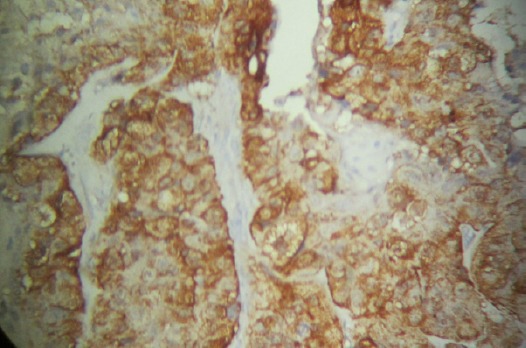
p16INK4a is a tumor-suppressor protein and cyclin-dependent kinase (cdk) inhibitor that blocks cdk4- and cdk6-mediated pRb phosphorylation to inhibit E2F-dependent transcription and cell-cycle progression. Because the E7 protein of high-risk HPVs inactivates pRB, the resulting overexpression of p16INK4a may be a good marker for infection with high risk HPV types. Immunostaining of p16INK4a allows precise identification of even small CIN or cervical cancer lesions in biopsy sections and can help reduce inter-observer variation in the histopathological interpretation of cervical biopsy specimens. The aims of the present study were to evaluate the expression of p16 INK4a in cervical biopsies and to compare the grade of cervical neoplasia with intensity of staining. The study covered 110 cervical biopsy tissue blocks over a period of 2 years, (85 cases of CIN of varying grade and invasive cervical cancers and 25 of non-neoplastic lesions). Immunostaining with p16INK4a antibodies followed standard operating procedures. The results showed an increasing trend for p16INK4a immunoreactivity from benign to higher grade lesions. Out of 25 cases of non dysplasia (15 cervicitis &10 immature squamous metaplasia), 8%(2/25) showed P16INK4a expression (grade 1). Among low grade lesions like CIN1, 32% (8/25) cases demonstrated P16INK4a expression (grade 1). Some 52.3% (11/21) of CIN2 cases proved positive. The intensity of p16INK4a expression in CIN 2 was grade 1 in 33%, grade 2 in 14% and grade 3 in 4.7% of cases. All the CIN3 lesions and cervical squamous cell carcinomas exhibited grade 3 anti p16INK4a antibody staining. The association of p16INK4a expression with histologic grade of cervical pathology was highly significant (χ2-value:51.81, p<0.0001). The staining intensity increase with higher grade disease was also statistically significant (χ2-value :133.95, p<0.0001).
p16INK4a是一种肿瘤抑制蛋白和细胞周期蛋白依赖性激酶(cdk)抑制剂,它可阻断cdk4和cdk6介导的pRb磷酸化,从而抑制E2F依赖性转录和细胞周期进程。由于高危型人乳头瘤病毒(HPV)的E7蛋白可使pRB失活,因此p16INK4a的过度表达可能是高危型HPV感染的良好标志物。对p16INK4a进行免疫染色可在活检切片中精确识别甚至微小的宫颈上皮内瘤变(CIN)或宫颈癌病变,并有助于减少宫颈活检标本组织病理学解读中观察者之间的差异。本研究的目的是评估p16INK4a在宫颈活检中的表达,并比较宫颈肿瘤形成的分级与染色强度。该研究在2年时间内涵盖了110个宫颈活检组织块(85例不同分级的CIN和浸润性宫颈癌以及25例非肿瘤性病变)。使用p16INK4a抗体进行免疫染色遵循标准操作程序。结果显示,从良性病变到高级别病变,p16INK4a免疫反应性呈上升趋势。在25例无发育异常的病例(15例宫颈炎和10例未成熟鳞状化生)中,8%(2/25)显示出P16INK4a表达(1级)。在CIN1等低级别病变中,32%(8/25)的病例显示出P16INK4a表达(1级)。约52.3%(11/21)的CIN2病例结果呈阳性。在CIN 2中,p16INK4a表达强度为1级的病例占33%,2级的占14%,3级的占4.7%。所有CIN3病变和宫颈鳞状细胞癌均表现为3级抗p16INK4a抗体染色。p16INK4a表达与宫颈病理组织学分级之间的关联具有高度显著性(χ2值:51.81,p<0.0001)。染色强度随疾病级别升高而增加也具有统计学显著性(χ2值:133.95,p<0.0001)。