Fontes Adriele, Andreoli Maria Antonieta, Villa Luisa Lina, Assone Tatiane, Gaester Karen, Fonseca Luiz A M, Duarte Alberto Js, Casseb Jorge
Laboratório de Dermatologia e Imunodeficiências, Departamento de Dermatologia, Faculdade de Medicina da Universidade de São Paulo, Brazil; Instituto de Medicina Tropical de São Paulo, São Paulo, SP, Brazil.
HPV Institute, Santa Casa de São Paulo, Brazil.
Papillomavirus Res. 2016 Dec;2:17-20. doi: 10.1016/j.pvr.2016.01.001. Epub 2016 Jan 7.
Infection with Human papillomavirus (HPV) has been reported as one of the most prevalent agent sexually transmitted diseases, but its true prevalence in men is not precisely known, mainly due to the near absence of symptoms. Moreover, few studies evaluating the post-vaccination immune response have been performed to date in men, hence the hypotheses tested in this study can be important to enable a better understanding of both the immunopathogenesis and the response to vaccination in HIV-infected patients, and to help in the elaboration of strategies of vaccination against HPV in the HIV-infected population.
To analyze the specific response to antigens of HPV vaccine in HIV-infected men.
A total of 25 HIV-infected male patients who met the inclusion criteria during the data collection period were vaccinated; however, six (30%) had anti-HPV at baseline, and were not considered further in the analysis. Therefore, 19 HIV-infected individuals were included in the study, along with five healthy, HPV-seronegative controls.
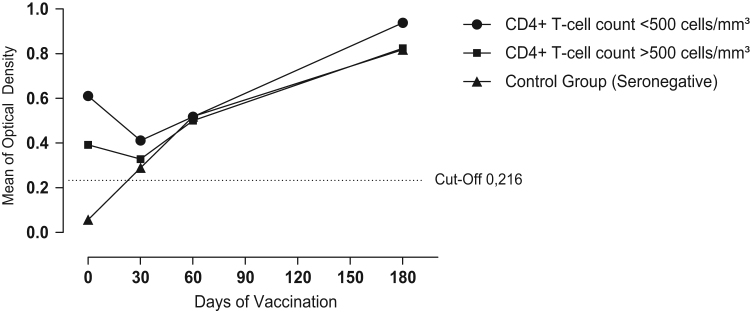
Patients infected with HIV-1 were subdivided into two groups, A and B, according to their T CD4 cells count at the time of vaccination, namely: Group A: CD4>500; Group B: CD4<500. The proportion of seroconversion after immunization with three doses of a bivalent anti-HPV vaccine was 92%.
HIV-infected patients as well as HIV negative controls responded to anti-HPV vaccination, regardless of their T CD4 cells count and HIV plasma viral load. These results demonstrate that anti-HPV immunization in HIV-infected males is effective and should be encouraged, thus helping to decrease the risk of infection, mortality and morbidity of diseases associated with HPV in men.
据报道,人乳头瘤病毒(HPV)感染是最常见的性传播疾病之一,但由于几乎没有症状,其在男性中的实际感染率尚不清楚。此外,迄今为止,针对男性接种疫苗后的免疫反应进行评估的研究很少,因此本研究中所检验的假设对于更好地理解HIV感染患者的免疫发病机制和疫苗接种反应,以及帮助制定针对HIV感染人群的HPV疫苗接种策略可能具有重要意义。
分析HIV感染男性对HPV疫苗抗原的特异性反应。
在数据收集期间,共有25名符合纳入标准的HIV感染男性患者接种了疫苗;然而,其中6人(30%)在基线时就有抗HPV抗体,在分析中不再进一步考虑。因此,本研究纳入了19名HIV感染个体,以及5名健康的、HPV血清学阴性的对照者。
感染HIV-1的患者根据接种疫苗时的T CD4细胞计数分为A组和B组,即:A组:CD4>500;B组:CD4<500。接种三剂二价抗HPV疫苗后的血清转化率为92%。
无论T CD4细胞计数和HIV血浆病毒载量如何,HIV感染患者以及HIV阴性对照者均对HPV疫苗接种有反应。这些结果表明,HIV感染男性接种HPV疫苗是有效的,应予以鼓励,从而有助于降低男性感染HPV相关疾病的风险、死亡率和发病率。