Guangdong Provincial Key Laboratory of Protein Function and Regulation in Agricultural Organisms, College of Life Sciences, South China Agricultural University, Guangzhou, 510642, China.
Department of Organismal Biology, Uppsala University, Norbyvägen 18D, 752 36, Uppsala, Sweden.
Nat Commun. 2017 Oct 26;8(1):1140. doi: 10.1038/s41467-017-01317-6.
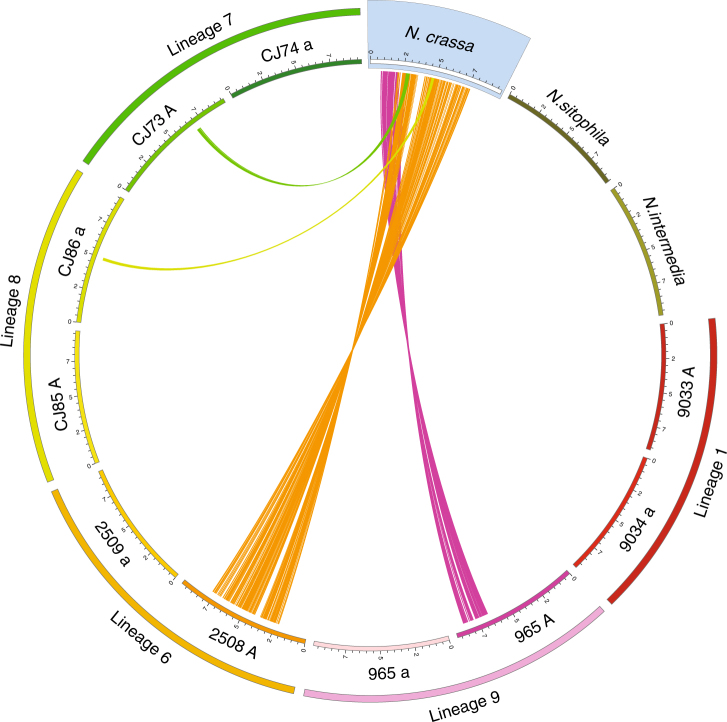
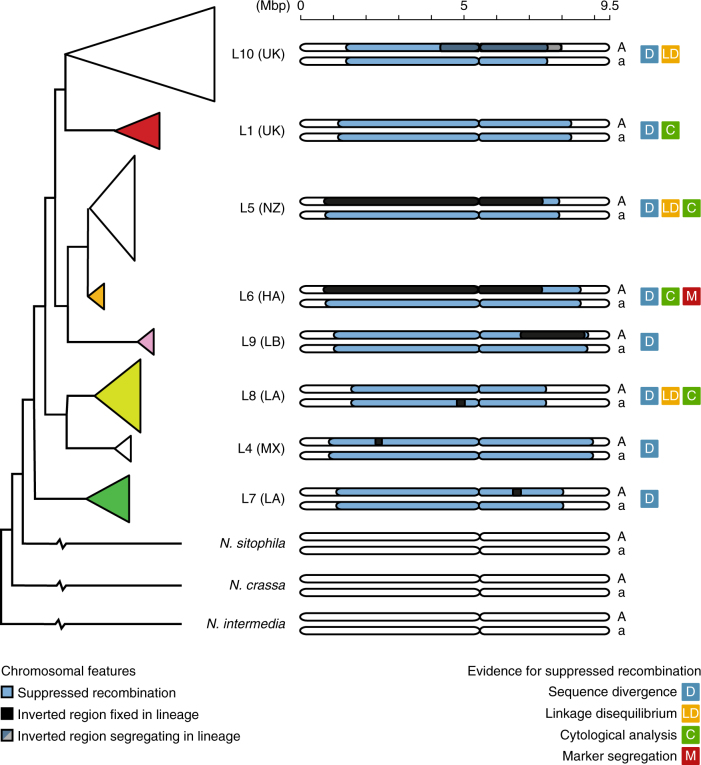
A common feature of eukaryote genomes is large chromosomal regions where recombination is absent or strongly reduced, but the factors that cause this reduction are not well understood. Genomic rearrangements have often been implicated, but they may also be a consequence of recombination suppression rather than a cause. In this study, we generate eight high-quality genomic data sets of the filamentous ascomycete Neurospora tetrasperma, a fungus that lacks recombination over most of its largest chromosome. The genomes surprisingly reveal collinearity of the non-recombining regions and although large inversions are enriched in these regions, we conclude these inversions to be derived and not the cause of the suppression. To our knowledge, this is the first time that non-recombining, genic regions as large as 86% of a full chromosome (or 8 Mbp), are shown to be collinear. These findings are of significant interest for our understanding of the evolution of sex chromosomes and other supergene complexes.
真核生物基因组的一个共同特征是存在大片段的染色体区域,这些区域的重组要么不存在,要么受到强烈抑制,但导致这种抑制的因素尚未得到很好的理解。基因组重排常常被牵连其中,但它们也可能是重组抑制的结果,而不是原因。在这项研究中,我们生成了丝状子囊菌 Neurospora tetrasperma 的八个高质量基因组数据集,该真菌在其最大染色体的大部分区域缺乏重组。令人惊讶的是,这些基因组揭示了非重组区域的共线性,尽管这些区域富集了大型倒位,但我们得出的结论是,这些倒位是衍生的,而不是抑制的原因。据我们所知,这是首次展示如此之大的非重组、基因区域(占整个染色体的 86%,或 8 兆碱基对)具有共线性。这些发现对于我们理解性染色体和其他超级基因复合物的进化具有重要意义。